

There’s a moment in Lynne Ramsay’s Die My Love where “The Clapping Song” by Shirley Ellis bounces in the background. That playground rhythm and cheerful tone light the fuse for the black comedy drama’s emotional whiplash. This isn’t an easy film to sit with. It’s a raw, mean, funny, sun-stroked unraveling of a woman who’s already past her limit, and everyone around her keeps calling it normal.
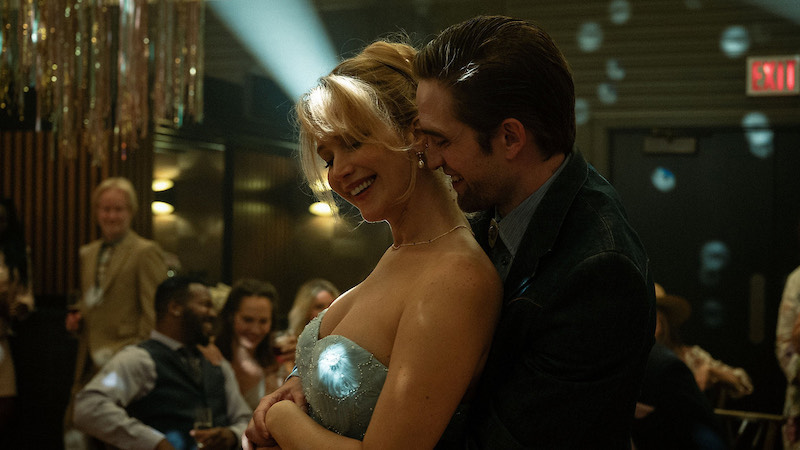
Set in a remote part of Montana, Jennifer Lawrence and Robert Pattinson as Grace and Jackson, respectively, are a couple high on love and the thought of starting a new life. That is, until real life hits them hard and fast. The fantasy of escape curdles into isolation: the physical suffocation of being cut off from everything, the financial and emotional grind of keeping a house running, and the slow death of anything that used to feel like “me.” On top of that, Grace is slammed by the demands of new motherhood, the hormonal freefall that comes with it, and a brutal creative block that leaves her feeling useless and invisible.
Ramsay first frames them like they’re running on chemistry and defiance. They drink, they fall into each other, they act like being in love and being reckless are personality traits you can build a life on. There’s a baby in the next room, but neither of them is interested in performing “responsible parent.” Grace quietly walks away from the version of herself that used to be a writer, almost as if she’s accepted that part of her is over. Jackson drifts in and out, coming home from a job that’s never clearly defined. Mostly, they’re just orbiting each other in a house with no real structure, no plan, and no adult conversation about money, childcare, sleep, or what happens if one of them breaks.
Meanwhile, Jackson contributes very little and makes matters worse in ways he either doesn’t recognize as harm or refuses to own, trying to fill a void that Grace cannot fill. One night, he brings home a rowdy dog that only adds to Grace’s misery. He expects her to welcome it or at least housebreak it — something she refuses to do because she never wanted the responsibility in the first place. And when Jackson later tries to repair the crumbling relationship, it leads to a major vehicular accident involving them and a horse. Since the dog is with them, he’s severely injured, too.
Grace is the only one who truly cares, while an exhausted Jackson says he’ll take it to the vet in the morning. So, in a shocking turn of events, Grace does the only humane thing possible: she puts the dog out of its misery herself. Then she makes Jackson deal with the repercussions of his bad decisions by having him bury it.
So this high-on-love connection between two damaged people may look romantic at first. Still, it very quickly drifts into heated arguments and absolute denial. Grace is always the one who has to bear the consequences of Jackson’s choices and actions, on top of carrying her own pain.
Grace is in a constant state of peril. She isn’t in crisis so much as living in one. The danger isn’t physical, it’s emotional, hormonal, mental, existential. She’s sleep-starved, grief-haunted, and creatively severed from herself, and she’s still expected to present as “fine.” While someone like Pam (actor), Jackson’s mom, shrugs it off, saying everyone gets a little loopy and suggesting online yoga as a way to take the edge off, others just tell her “everything is okay” or “you look good.” That reassurance always comes with quiet judgment. They’re not really asking how she is; they’re checking that she’s still manageable.
The gravity of grief and distress hanging over Grace never lands with anyone else. As a result, her response to the people who try to “help” and to the little tokens of support they offer is muted, flat, or even rude. She doesn’t perform relief for them. She doesn’t act grateful. She doesn’t play along with the “you look good” script. Because no one wants to address the reality of the situation, treat her with the basic respect of believing her, or actually understand her, Grace is pushed to act out in ways that feel delirious or violent. This is where Lawrence’s performance shines. It’s layered and unsentimental, with her guiding us through the madness that’s eating her from the inside. She doesn’t play Grace as hysterical. She plays her as someone past panic.
Visually, Ramsay shoots all of this like she’s building a case. The interiors never feel cozy. They feel airless and watched, all harsh afternoon light and stale rooms that never cool down. Even outside, under the Montana sun and all that big open sky, there’s no relief. The wide shots are suffocating, which only pulls Grace further into her spiral. Lawrence is often pinned in tight, unforgiving frames: sweat at her hairline, jaw clenched, eyes unfocused, shoulders curled in like she’s bracing for impact. Jackson, by contrast, is usually given space. He hovers in doorways, leans over her, blocks exits, forces her into a truck, pushes her toward facilities when she’s too raw to fight back. He’s always staged as a presence she can’t get away from, and the film knows exactly what that means for her mental state.
Any other approach, such as trying to spin this into a hopeful ending, would strip the film of its honesty. Ramsay refuses to turn Grace into an inspirational arc about resilience. She lets her be difficult. She lets her be selfish. She lets her be furious. She lets her stop apologizing for scaring people. Keeping Grace in that constant state of peril makes the film feel brutally, uncomfortably authentic, especially in how it treats mental health inside a domestic relationship. Grace isn’t dramatic. She’s endangered. And the most disturbing part is how easily everyone around her can look straight at that and still call it normal.
9/10