For years, Frank Castle (Jon Bernthal) has waged a one-man war on crime as The Punisher, using violence as both his weapon and his purpose. Though he is often framed as an anti-hero throughout Daredevil and Daredevil: Born Again, the character becomes something more tragic in The Punisher: One Last Kill, as he is forced to confront what remains when vengeance is achieved and his life no longer has a mission.
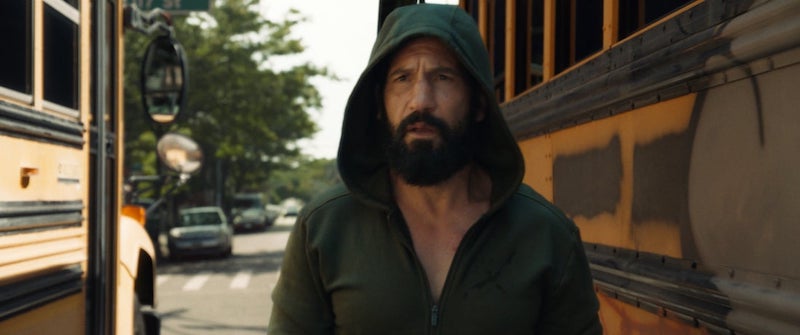
What makes The Punisher: One Last Kill work as a Marvel Studios Special Presentation is its restraint. Rather than expanding Frank Castle’s place in the larger cinematic universe, the short uses its self-contained format to narrow in on his fractured state of mind. The result is a grim character study about trauma, isolation, and the cost of building an identity around punishment.
Frank appears to be in a state of profound psychological collapse, shaped by grief, guilt, and a fractured sense of identity. Living in a small apartment in Little Sicily, New York, he is surrounded by the violence and tension of a neighborhood left vulnerable by the power vacuum created after he wiped out nearly the entire Gnucci crime family. His walls, once covered with crossed-out photos and maps of key locations, have become a visual record of his obsession. When Frank tears it all down after completing his mission, the blank space left behind says everything about the antihero and the emptiness that now occupies his life.
A one-shot sequence reveals how cafe owners are coping with the violence now plaguing the neighborhood. Thugs beat civilians, police cars burn, and ordinary people are left to fend for themselves. Enveloped in hopelessness, Frank searches for purpose now that the crime family responsible for taking his own family is nearly gone. That despair leads him to the graves of his wife and daughter, where his questions turn inward and nearly push him to take his own life.
The short’s most harrowing moment comes in an extended sequence where Frank cycles through visions of his family. At first, he sees them happy, preserved in the life he lost. Then their faces shift into disappointment, reflecting his own belief that he failed to protect them. By the end, they appear bloodied, turning memory into accusation. It is only when a vision of his daughter interrupts him that Frank is pulled back from taking his own life, making the scene less about shock than the crushing weight of grief, guilt, and survival.
The Marvel Studios Special Presentation isn’t so much concerned about how to expand its Marvel Cinematic Universe with Frank in it so much as it wants to tell a story about a broken man forced to confront the human cost of his violence on himself, on families like the Gnuccis, and on a community hollowed out by cycles of revenge.
That’s because Ma Gnucci (Judith Light) has put a bounty on Frank’s head for killing her sons. Memorizing a specific time that her youngest was last seen alive, she essentially says the apartment complex will be Frank’s tomb. She calls Frank a hungry avraice animal that took away everything she had. The grieving mother makes sure that it was the Gnucci’s who will kill frnak.
The most haunting voices in the special are not only Frank’s enemies, but the grieving families left behind and the voices echoing in his own mind. Curtis Hoyle (Jason R. Moore) appears as one of those voices, questioning whether God could ever forgive them for what they have done. The thought turns sharper when Curtis needles Frank about having nothing left to do and no clear purpose now that the mission is over. But when Frank looks back, no one is there. The moment turns Curtis from a memory of friendship into another manifestation of Frank’s guilt, forcing him to confront the emptiness he has been trying to punish his way through.
Other hallucinations take the form of Frank himself, dressed in full Punisher gear. That image makes his fractured identity even clearer. He is not only haunted by the people he lost or the friends who question him, but by the violent persona he created to survive that loss.
Karen Page becomes the embodiment of Frank’s self-loathing throughout these hallucinations. She repeatedly challenges the identity he has built around himself, accusing him of choosing war over the responsibilities of being a husband and father. According to her, those roles were never who Frank truly was, but costumes he failed to wear convincingly. The accusation grows more intense each time she repeats it, eventually confronting him face-to-face alongside visions of his late wife and bloodied family.
But the admission that he failed his family is the tipping point, as it marks the moment Frank can no longer hide behind the mission, the skull, or the violence he has used to give his pain shape. Once he says it aloud, the hallucinations stop functioning as ghosts of the past and become a judgment he cannot escape. What emerges is not absolution, but the possibility of a new purpose, one that forces Frank to look beyond his own grief and toward the city still suffering around him.
Still, there is the matter of the bounty on Frank’s head, which turns the apartment complex into a battleground for madmen, crooks, and killers looking to collect. As the violence erupts, the cries of a mother begging them to leave her home cut through the chaos. When her frightened son says he is scared, Frank finally understands he has a new purpose.
Without getting into spoilers, a significant portion of Frank’s climactic fight unfolds against Louis Armstrong’s rendition of “La Vie En Rose,” creating a striking contrast between the tenderness of the music and the brutal violence consuming the apartment complex. Frank absorbs each hit only to answer back with greater force, turning his attackers’ guns, knives, and bats against them as he crashes from floor to floor and building to building. Watching it, you can feel the physical toll as Frank is thrown from scaffolding to school buses before slamming into the pavement below. But this is not The Raid. The action is intense, but its purpose is emotional rather than tactical, with Frank moving through the chaos with frightening efficiency as he stays several steps ahead of those trying to collect the bounty.
In the end, The Punisher: One Last Kill is less interested in glorifying Frank Castle’s violence than examining grief, mental health challenges, and thoughts of suicide. The brutality becomes the backdrop for what the Marvel Studios Special Presentation really wants to explore. Given how directly the short engages with those themes, its PSA feels necessary, reminding viewers they are not alone and directing them to call or text 988, visit 988lifeline.org, or, outside the U.S., findahelpline.com for 24/7 support. I only wish it appeared earlier or immediately after the short ends, rather than during the mid-credits after the “A Kevin Feige Production” card.
Directed by Reinaldo Marcus Green, who also co-wrote the script with Bernthal, “The Punisher: One Last Kill” debuts exclusively on Disney+ on Tuesday May 12.
9/10
Watch “The Punisher: One Last Kill” here!