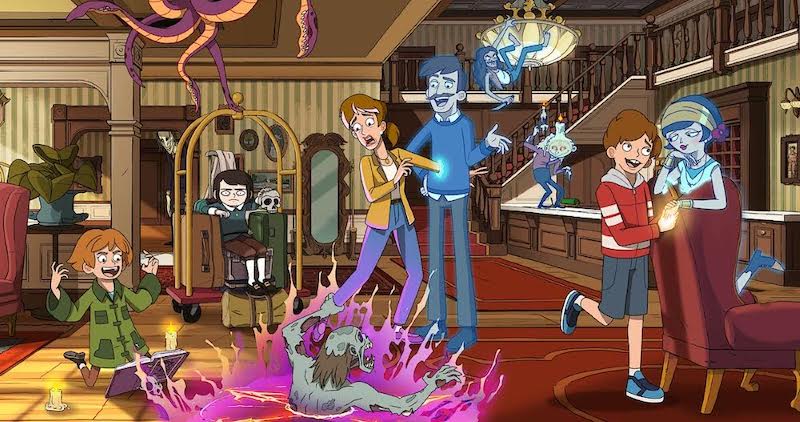
ThatsItLA joined a select group of journalists in Culver City for a special Haunted Hotel Q&A event, where creator Matt Roller, shared insights into the inspirations behind the series, exploring different horror subgenres, navigating adult language, and more.
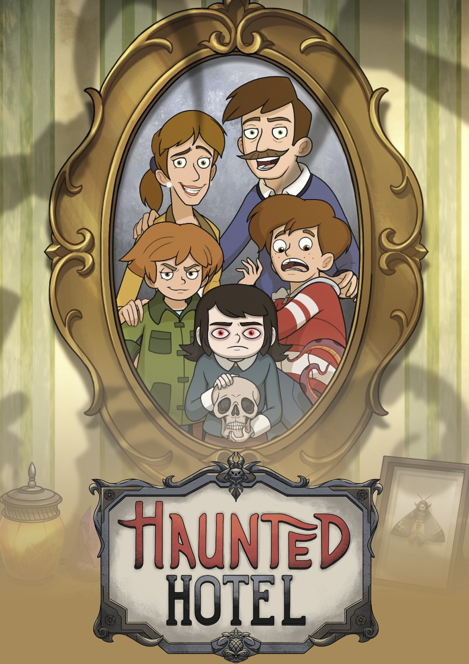
Matt Roller did not immediately fall in love with horror. In fact, his first brush with the genre came too early. As a kid, he saw Freddy Krueger rip out of someone’s chest and came away with a very clear reaction: “Oh, this is not for me.” Horror would eventually find him later, when he was in his 20s, after he had enough distance from that first nightmare to appreciate the craft, the tension, and the strange emotional logic that makes the genre endure.
Roller’s late-blooming love of horror now sits at the center of Netflix’s “Haunted Hotel,” an adult animated horror-comedy that Roller has been trying to bring to life for nearly a decade. For a project about ghosts, demons, monsters, and unfinished business, its path to the screen has its own resurrection story.
“I’ve been a comedy writer for like 15 years now, and I started working on this like 10 years ago,” Roller said during a Q&A. “It was one of those projects that sold to a lot of places, and they put it in a drawer, but I always believed in it.”
When the rights expired, Roller would take the project back out, pitch it again, and ask new people to reconsider the idea. Eventually, Netflix became the place that was willing to check into the hotel.
That persistence feels fitting for a series built around a place where the past refuses to stay buried. “Haunted Hotel” follows a family trying to survive life inside a supernatural hotel filled with ghosts, demons, monsters, cults, curses, and doors that can open into entire worlds. But for Roller, the series is not just an excuse to throw horror references at the screen. It is a way to combine the structure of a live-action comedy with the visual freedom of animation.
Roller came to animation through Dan Harmon after writing on “Community” and then moving over to “Rick and Morty.” From a writing perspective, he said, the two mediums are surprisingly similar because so much of the work begins on the page. The difference is what animation allows once those ideas leave the script.
“Animation is an opportunity to do things that would be far too expensive live action,” he said.
That freedom shapes the way “Haunted Hotel” moves through horror subgenres. One episode may pull from cult horror, with designs inspired by “The Void.” Another may use possession, demons, unfinished business, or supernatural rules as a jumping-off point. Roller is not interested in doing one-to-one parodies of horror films, but he does see the genre’s long history as a library of moods, images, and fears that the show can remix.
“There’s obviously a lot of “The Shining” in this,” he said, while also citing “The Orphanage” as his favorite horror movie. “It was just an opportunity to pull from a lot of horror movies I like and just drop either design elements or characters or stereotypes, and then enrich them.”
Visually, the show had to strike a careful balance. Roller wanted the human characters to have semi-realistic proportions so the ghosts, demons, and monsters could be pushed much further. That contrast allows the supernatural elements to feel bigger, stranger, and more threatening while still grounding the family at the center of the story.
The hotel itself was designed with that same sense of contrast. Roller grew up in New England, and the central location is an amalgam of New England hotels rather than a direct copy of one specific place. Because the show spends so much time inside the hotel, the creative team wanted it to feel textured and lived in, not like a generic cartoon backdrop.
The details mattered: cracked wooden floor panels, peeling wallpaper, rooms with different patterns and histories, and spaces that feel like they have been occupied by generations of people. Unlike a show like “Rick and Morty,” where a new planet or universe may arrive every week, “Haunted Hotel” keeps returning to the same supernatural location. That meant the hotel had to be interesting enough to look at over and over again.
“We want to make the space feel really lived in by many generations of people,” Roller said.
That sense of history also applies to the show’s emotional core. Although “Haunted Hotel” has plenty of monsters, slime, tentacles, demonic bargains, and absurd supernatural situations, Roller does not see the series as nihilistic. In fact, he sees horror as a genre where small choices matter.
Coming from shows like “Rick and Morty” and “Archer,” Roller recognized how much adult animation can lean into cynicism, violence, profanity, or emotional detachment. But “Haunted Hotel” is aiming for something different. Roller said science fiction often suggests that people are insignificant in an infinite universe, while horror frequently argues the opposite. A curse can exist because someone read from the wrong book. A family can suffer because of a choice made generations ago. The smallest action can echo.
“In a lot of horror, the point of so much horror is small things matter,” Roller said.
That idea helps explain why the show is not built around disposable deaths or shock-value cruelty. The characters may be running for their lives, but the danger is not treated as meaningless. Roller said the show does not lean on jokey deaths where someone falls off a cliff and the punchline is simply that they died. Instead, the goal is to preserve stakes, even when the premise is ridiculous.
That also affects the show’s approach to adult animation. While “Haunted Hotel” is not made for children, Roller said no one has told the team there are hard rules about what they can or cannot do. Still, he was never interested in defining the show’s adult identity through constant profanity or sexuality.
“I felt going in like this show didn’t need that,” he said.
By the end of season one, the show landed at TV-14. According to Roller, there was one use of the word “fuck,” but the team realized it could be funnier not to rely on that kind of language. For him, the show’s edge comes more from strange choices, emotional consequences, and ideas that linger in the viewer’s head.
That includes the fan response to Avedon, voiced by Jimmi Simpson, who has emerged as one of the show’s breakout characters. Roller said a large amount of the fan fiction he has seen online centers on Avedon going on adventures, and he joked that maybe the character could get his own movie one day.
The show’s voice cast includes Will Forte, Eliza Coupe, Skyler Gisondo, Natalie Palamides, and Jimmi Simpson, with guest stars such as Kumail Nanjiani. Roller even lends his own voice to Candlehead, a character who only says the word “candles.” What began as scratch dialogue in the pilot stuck because Roller knew exactly how he wanted the line to sound.
“I’m not an actor,” he said, “but that was the thing where, like, on the pilot, while it’s called scratch, you’re just kind of doing temp dialogue records until you find out who the final person will be, and it’s just the word candles.”
One of the show’s biggest breakout characters has been Abaddon, voiced by Jimmi Simpson. During the Q&A, Roller said he has seen fan fiction centered on Abaddon going on adventures, joking that maybe the character could get his own movie one day, one where he goes back to hell and kicks back in his castle.
The first season took about two years to complete, largely because the team had to find the look of the series and the design language for the characters. Now, with that foundation in place, the team is trying to keep the show on an annual schedule, with season two expected to arrive in October. Roller acknowledged that an 11-month animation turnaround is ambitious, but the goal is to keep “Haunted Hotel” tied to spooky season.
That seasonal rhythm makes sense for a series that treats horror as both a playground and an emotional language. Roller said one of the most exciting parts of the show is figuring out how much each episode should lean into comedy versus horror. Some episodes are sillier, such as one where Esther resurrects a zombie to attend a parent-teacher conference for her, only for the zombie to become an accidental surrogate father figure. Others are more emotionally grounded, such as an episode where demons trap the family in the hotel and force them to reveal secrets that make them angry with each other.
That flexibility is what keeps the show alive for Roller. One week, the writers can chase absurd supernatural comedy. The next, they can use demons and curses to explore what family members owe each other.
“It’s just great to have this show where we can do both,” he said.
For anyone trying to follow a similar creative path, Roller’s advice is straightforward: keep writing. He said many aspiring writers focus too much on protecting or perfecting one big idea when the real craft comes from execution. Even while running a show, he continues writing multiple movies and pilots a year because each project reveals something new.
“The idea might be like a third to half of the craft,” he said. “The rest of it is execution.”
That belief also explains the long life of “Haunted Hotel.” Roller had the idea, but he also kept returning to it, revising it, pitching it, and finding new ways to make it work. Like the best horror stories, it survived because something inside it would not stay dead.
All episodes of “Haunted Hotel” are now streaming exclusively on Netflix.