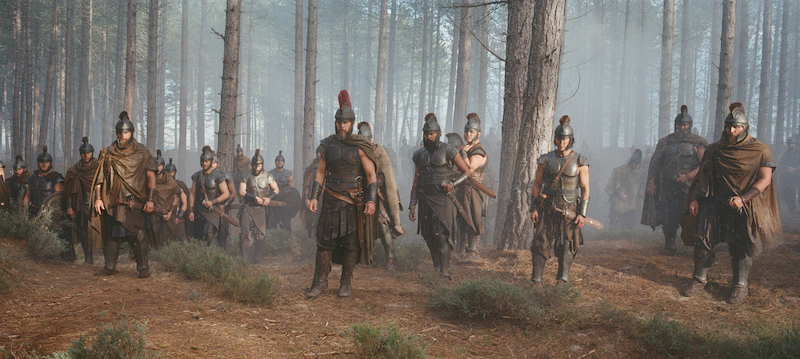
Homer’s “The Odyssey” is one of the greatest stories ever told. While it has been adapted countless times over the centuries, Christopher Nolan reimagines the epic in a way that feels remarkably accessible to modern audiences, thanks to its contemporary language and global cast, who deliver stellar performances. For all its gods, monsters, and sweeping spectacle, Nolan’s “The Odyssey” is ultimately a deeply human story about homecoming, loss, leadership, and the cost of finding your way back.
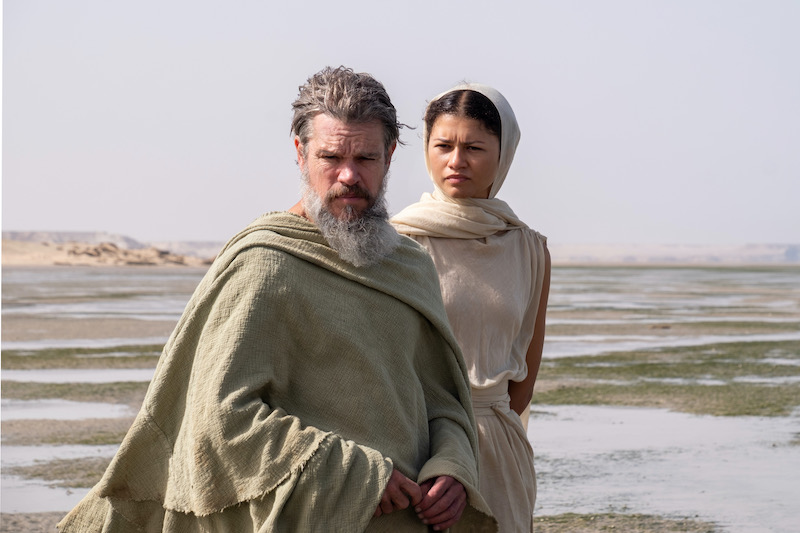
L to R: Matt Damon is Odysseus and Zendaya is Athena in THE ODYSSEY, written, produced, and directed by Christopher Nolan.
At the center of it all is Odysseus (Matt Damon), a leader defined as much by his intelligence as by the consequences of his choices. Nolan does not present him as an untouchable hero, but as a man carrying the weight of every life lost under his command. His journey home is shaped by divine wrath, human error, temptation, and the impossible decisions that come with leadership. As such, Damon’s Odysseus is always calculating, yet his attempts to save people often make things worse, while his hubris repeatedly gets in the way.
This 117-minute epic about a man trying to return home is a film about what remains of a man, a family, and a kingdom after war. Because the original source material unfolds through storytelling, flashbacks, and shifting perspectives, Nolan embraces a nonlinear structure that gradually pieces Odysseus’s journey together through memory, myth, and consequence. That approach comes alive through Travis Scott’s Bard, whose cadence, delivery, and commanding presence make his telling of Odysseus’s legend feel rooted in an ancient oral tradition.
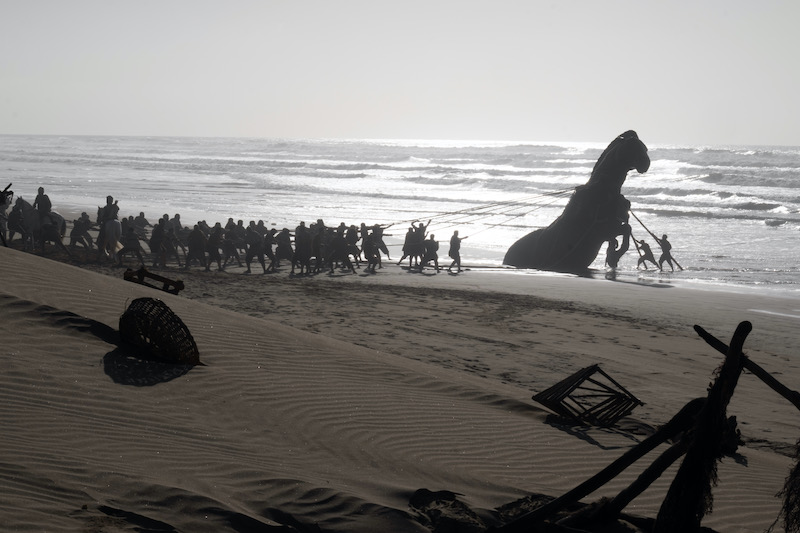
THE ODYSSEY, written, produced, and directed by Christopher Nolan.
But that is only one small part of the bigger picture, as the film centers on Odysseus’s return home. Benny Safdie’s Agamemnon and Lupita Nyong’o’s Paris have limited appearances, yet Nolan makes every appearance count. During the Trojan War, he is often photographed from behind or shrouded in shadow, keeping the legendary king at an emotional distance. Only through flashbacks away from the battlefield does Nolan begin to reveal the man beneath the crown, particularly in the devastating moments surrounding his daughter’s sacrifice, illustrating that even the greatest victories can exact unimaginable personal costs. While Helen is keenly aware of her place in the war, Nyongo’s performance brings strength and poise as she leaves. an impact. It is that journey that gives Nolan the space to examine loss, identity, leadership, and whether home can ever feel the same after war. Nolan and cinematographer Hoyte van Hoytema use large-format IMAX cameras to capture the horrors of war and the grandeur of locations across Morocco, Greece, Italy, Iceland, Scotland, and the United States. Given the scale of the story, shooting the film entirely in IMAX feels completely fitting. Setting all of that against the emotional landscape of Odysseus, a man whose intelligence, hubris, resilience, and determination are tested at every turn, giving his quest a deeply personal core.
One of the film’s strongest ideas is that Odysseus is not destroyed because he does not care about his men, but because he does. Nolan repeatedly puts him in situations where every option costs lives, while Damon captures a leader who still believes he can outthink fate. Even after Tiresias tells him that only he will survive, Odysseus refuses to accept it. “Then I defy the gods,” he says. It is a heroic sentiment, but one that comes at an enormous cost. Each choice seems to lead to another disaster, prolonging the voyage while threatening his sanity, his family’s safety, and the future of Ithaca itself.
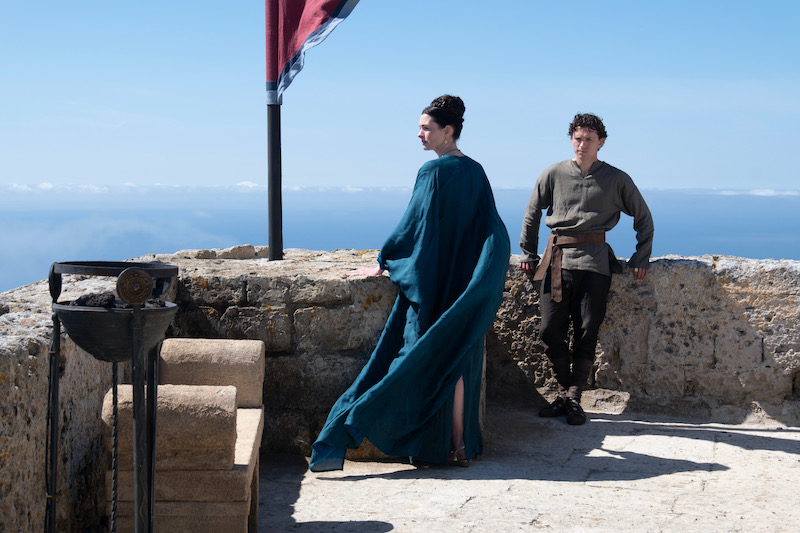
L to R: Anne Hathaway is Penelope and Tom Holland is Telemachus in THE ODYSSEY, written, produced, and directed by Christopher Nolan.
While much of “The Odyssey” rests on Odysseus and the weight of his choices, Nolan surrounds Damon with a supporting cast that gives those decisions real emotional consequence. Tom Holland’s Telemachus is caught between boyhood and responsibility. He is desperate to believe the father he barely remembers will return, while Anne Hathaway’s Penelope is equally compelling, transforming years of waiting into an act of political resilience as she fights to protect both her son and the kingdom. Together, Holland and Hathaway portray a royal family held together more by hope than certainty. Then there’s Robert Pattinson, who brings a sly menace to Antinous, a suitor who exploits Odysseus’s absence and positions himself to become the next king of Ithaca.
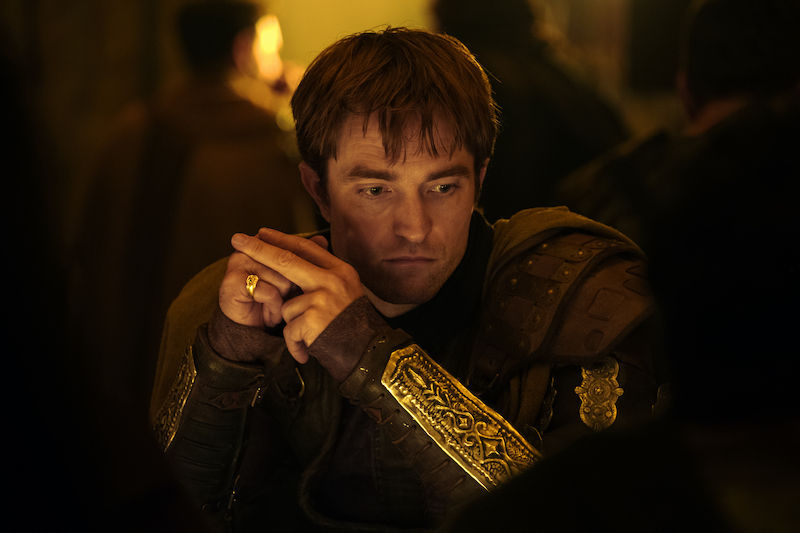
Robert Pattinson is Antinous in THE ODYSSEY, written, produced, and directed by Christopher Nolan.
Himesh Patel’s Eurylochus serves as an effective counterweight to Odysseus, questioning his leadership while making costly mistakes of his own. Samantha Morton plays Circe with a deceptive warmth, appearing as a poor farmer who welcomes the exhausted men with food before turning that act of hospitality into a trap. Eurylochus’s transformation into a pig gives Nolan the opportunity to explore flashes of body horror rarely seen in his work, while his later decision to slaughter the sacred cattle despite repeated warnings helps bring even more disaster upon the crew. That contradiction makes Eurylochus more than the group’s voice of doubt. He is also part of the reason their journey continues to fall apart.
Charlize Theron brings an alluring melancholy to Calypso, presenting immortality not as a gift but as a lonely prison. Then there’s Zendaya’s Athena. The goddess of wisdom and warfare who quietly guides Odysseus home with an understated confidence. John Leguizamo also leaves a strong impression as the fiercely loyal Eumaeus, proving that some of the film’s most affecting moments come not from its gods or monsters but from the people who refuse to give up hope.
Elliot Page, in a small but crucial role as Sinon. Page brings a quiet conviction to the character, turning the underworld encounter into a reckoning with the human cost of Odysseus’s quest to return home. As such, Sinon represents those whose lives were forever changed by the Trojan War. Odysseus’s descent into the underworld forces him to confront the uncomfortable truth that his greatest triumph was also built on deception. Other characters to note are Benny Safdie’s Agamemnon, who is used sparingly, yet Nolan makes every appearance count. During the Trojan War, he is often photographed from behind or shrouded in shadow, keeping the legendary king at an emotional distance. Only through flashbacks away from the battlefield does Nolan begin to reveal the man underneath the helmet. Those particularly devastating moments surrounding the sacrifice of his daughter illustrate that even the greatest victories can demand unimaginable personal costs.
Because the film unfolds through a series of flashbacks, the editing favors emotional progression over chronological order. Since “The Odyssey” is ultimately about memory, identity, and the stories people tell about heroes, Nolan gradually reconstructs Odysseus’s past piece by piece, inviting the audience to discover the man behind the legend alongside the characters who have only heard his name. Jennifer Lame’s intricate editing helps bring Nolan’s vision to life, moving between the past and present without losing the emotional thread of Odysseus’s story.
Then there’s Ludwig Göransson’s score, which matches the film’s scale without losing sight of its emotional core. It can be thunderous and overwhelming during the battles and mythological set pieces, then retreat into something far more melancholic as Odysseus reflects on everything he has lost. Nowhere is that felt more strongly than during his time with Calypso, where the music underscores the loneliness of a man trapped in paradise, longing for a home he may never see again. And matching those scores with Hoytema’s cinematography, which constantly contrasts the insignificance of man against the immensity of the natural world, brings more out of the scene. Towering cliffs, endless oceans, and vast landscapes remind us that Odysseus is never truly in control, no matter how brilliant his plans may be.
Christopher Nolan has long been fascinated by protagonists forced to live with the consequences of impossible choices. Whether it’s Leonard Shelby searching for truth in Memento, Bruce Wayne choosing what Gotham needs over what he wants in The Dark Knight, Cooper leaving his family behind in Interstellar, J. Robert Oppenheimer grappling with the legacy of the atomic bomb, or now Odysseus trying to find his way home after years of war, Nolan repeatedly returns to men burdened by the weight of their decisions.
Rather than simply adapting Homer’s epic, Nolan finds the humanity beneath the mythology, reminding us that stories endure not because of the monsters or the gods, but because they speak to universal truths about love, loss, leadership, and the longing to return home. It is a breathtaking achievement that deserves to be experienced in IMAX.
10/10