After almost 30 years in the making, Brad Bird’s futuristic noir, Ray Gunn is finally in theaters and soon after, available to stream. So, if you love classic hardboiled detectives solving cases in smoky rooms and shady alleys, “Ray Gunn” delivers that vibe with a fresh, retro-futuristic twist.
“Ray Gunn” takes place in a retrofuturistic world inspired by classic noir and retro futurism. The story centers on Ray, a tough private investigator struggling to keep ends meet in a high tech world where services like his are obsolete, hired to keep pop star Venus Nova safe. With his partner Eyra—a green, one-eyed alien who acts like a living camera and moves on tripod legs—Ray soon gets pulled into a murder case that uncovers secrets, prejudice, and corporate schemes.
In “Ray Gunn,” most characters are searching for the real truth. Ray and Eyra rely on each other, sharing jokes and a strong sense of right and wrong. They try to make a living without giving up their values, even when it means earning less or losing things like their office furniture. Their honesty often costs them more than they make.
Venus, the pop star at the heart of the story, is talented but controlled by her studio, which treats her more like a product than a person. Early on, the media paints her as a diva. As Ray gets to know her, he sees how hard she has to fight for herself—standing up to her managers and trying to make something that truly belongs to her.
The case gets more tangled as Ray investigates. At first, he’s supposed to catch Venus cheating, but things change when he finds out her body double, Levity Love (Kether Donohue), is involved. Soon, Ray realizes that protecting Venus might mean shielding her from the people controlling her life, not just from obvious dangers.
Ray starts out suspicious of Venus, since he’s been hired to watch her. As a private investigator, he’s always looking for hidden motives and clues. But Venus is tough to figure out, and their back-and-forth as they try to read each other adds a playful edge to their relationship.
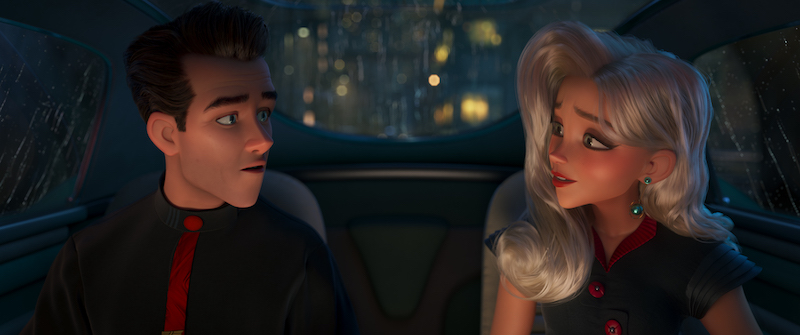
RAY GUNN – Raymond Gunn (Sam Rockwell) and Venus Nova (Scarlett Johansson). Cr: Skydance Animation ©2026
Venus starts out as a mystery, like many femme fatale characters. But instead of leaving her as just an enigma, Bird slowly reveals more about her. The public sees her as a diva, but Ray finds out she’s much more complex. Each time they meet, another side of Venus comes out, showing her as a real person with strengths, dreams, and flaws beyond her public image.
Bird, who co-wrote the script with Matthew Robbins, uses prejudice to explore identity and belonging. Eyra faces discrimination openly, while Venus feels pressure to hide parts of herself to fit in. Even though Ray Gunn is set in a futuristic noir world, its look at prejudice, fitting in, and changing yourself for others feels very current.
Still, the way the film explores prejudice, especially through characters like Eyra, is more interesting than the main mystery. The investigation gives the movie its shape, but the world and its characters are what really stand out. Honestly, some plot twists are even a bit predictable.
When the film focuses on the off-worlders, Metropia starts to feel more like our own world. They face suspicion, fewer chances, and sometimes have to find new ways to get by in a society that already has them pegged. The city itself shows this divide. For example, when Ray needs a good spot to photograph Venus, Eyra knows right away which hotel is in a neighborhood friendlier to aliens. It’s a small moment, but it shows how Ray and Eyra see the city differently—Ray through his work, and Eyra through his own experiences as an outsider.
Eyra deals with discrimination openly, while Venus feels she has to hide parts of herself to fit in. In Ray Gunn, prejudice isn’t just about rude comments or mean characters—it affects where people live, how comfortable they feel, what chances they get, and even how they act in public. These themes make the film feel very relevant, even if the main mystery doesn’t always measure up.
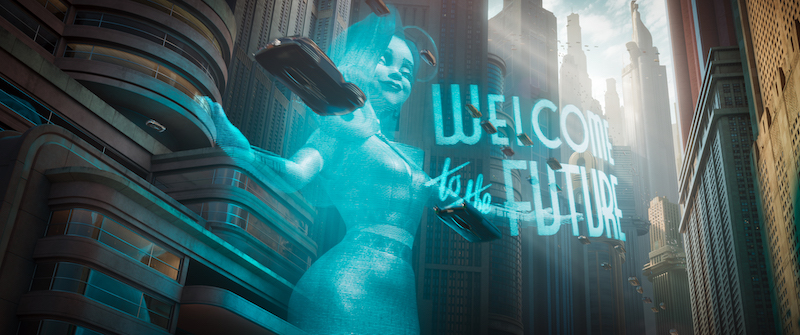
Metropia feels real because of how the characters interact with it, even with its retro-futuristic look. Ray and Eyra are private investigators just trying to pay the bills, taking on cases with shady clients, fake identities, and tech that can be evidence or contraband. Venus is a huge star, but her life is still controlled by studio bosses and corporations. The city is full of factories, clubs, tabloids, police, and people selling secrets, making it feel big and alive even though the story mostly stays in one place.
A big part of what makes Metropia work is the animation. “Ray Gunn” doesn’t just copy classic noir, it uses animation to take its retro-futuristic world further than live action could. Everything feels real: cars seem heavy, blasters can break, and the sets look built, not just digital. The way the film is shot makes Metropia feel like a real city, not just a cartoon, giving it a lived-in feel even when things get wild.
The characters move easily through huge cityscapes, alien places, and wild technology, letting Bird mix tough noir vibes, slapstick comedy, and fast-paced action without anything feeling out of place. The film never talks down to viewers just because it’s animated. Its mix of noir, romance, social themes, and a tricky mystery makes Ray Gunn great for adults, but there’s still plenty of humor, action, and cool visuals for younger audiences to enjoy now and maybe see differently as they get older.
“Ray Gunn” succeeds because, even with its mix of old and new, some things never change. People still struggle to pay rent, corporations still take advantage of talent, status still opens doors, and outsiders still have to find ways to get by in a system that wasn’t made for them. The future in Ray Gunn hasn’t fixed these problems—it’s just given them new ways to show up.
“Ray Gunn’s” world draws from famous architects and designers. Metropia’s huge, Hugh Ferriss-style buildings make Ray seem tiny in the city, and its Streamline Moderne look gives the movie a sense of a future shaped by the past. The city’s smooth lines, big buildings, and unique neighborhoods make it feel both futuristic and familiar—perfect for a story where classic noir meets science fiction.
Ray and Venus have great chemistry because they don’t trust or idolize each other right away. For Venus, it’s the first time someone treats her like a real person. For Ray, he’s finally met someone who can match him. Their playful banter is both flirting and a way to protect themselves. Rockwell and Johansson’s performances let both characters test each other without letting their guard down completely.
Rockwell’s dry delivery suits Ray’s tough-guy character without making him a cartoon version of old detectives. Johansson has the harder job, showing all the different sides of Venus—from confident star to witty, frustrated, or vulnerable—without any of them feeling out of place.
As Ray and Venus get to know each other, Ray starts to see Venus as a real artist and person, not just a celebrity image. Venus, in turn, sees Ray as more than just a struggling detective—she notices his morals and empathy. This slow change makes their relationship deeper than the usual noir romance.
Eyra, Ray’s partner, is voiced perfectly by Tom Waits. Eyra’s tough, practical outlook balances Ray’s idealism. He sees things as they are and knows that good intentions aren’t always enough in a crooked world. This makes Eyra more of an equal than a sidekick—he’s survived Metropia’s tough side too. Eyra knows they need money, but he never asks Ray to give up his ethics. Instead, he pushes Ray to think about whether they can keep doing this work without losing what matters to them.
That playful energy shows up in the action scenes too. In one standout moment, Ray gets stuck in an elevator with two goons working for alien mob boss Francis “Slugsy” Xavier. The tight space makes the fight tense, but Bird adds to it by using the elevator’s sudden movements as part of the action. When Ray sends it shooting up, everyone hits the ceiling. When it drops, they all crash to the floor, fighting over a gun. The clever use of gravity and space makes the elevator feel like another fighter in the scene.
But the action isn’t just about fighting—it’s playful too. A red-haired woman who was buying a blaster at Ray’s usual shop tries to help him against some goons, but almost every time she steps in, things get worse for Ray. She accidentally hits him with a pipe, and even a thrown brick ends up hitting him. Instead of making Venus an instant action hero, the scene lets her excitement get ahead of her skills, turning the fight into a funny series of mishaps for Ray.
Scenes like these show that “Ray Gunn” cares as much about character and comedy as it does about big action moments.
The mystery in “Ray Gunn” isn’t always as gripping as the film hopes. Even with its twists and turns, some parts are easy to guess. What really keeps the movie interesting is everything around the mystery, the characters, the detailed world of Metropia, Michael Giacchino’s music, and the mix of suspense and fun in the action. The film’s nods to classics like The Big Sleep, Chinatown, The Maltese Falcon, and Buck Rogers add to its sense of adventure. Even when the case loses steam, Bird’s world is so rich that you want to keep exploring it.
9/10