“Toy Story” has always been a series about a child’s plaything experiencing some sort of existential crisis. Whether it was learning to adjust when a newer, more exciting toy entered the picture, questioning whether a toy should be preserved and remembered or loved until it wears out, discovering what toys can mean when they are passed from one generation to the next, or even wondering whether their purpose has to come from belonging to a child at all, every chapter has forced Woody, Buzz, Jessie and the rest of the gang to figure out where they belong next.
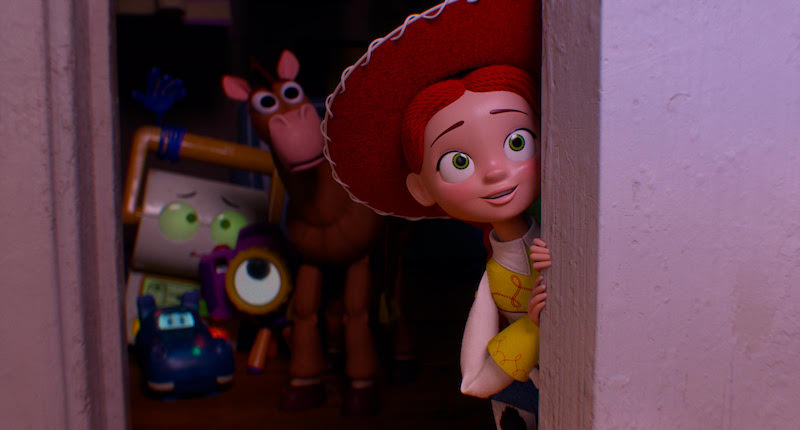
With “Toy Story 5,” that question takes on a new meaning as the toys find themselves competing for Bonnie’s attention in a world increasingly dominated by technology, represented by a smart tablet named Lilypad (Greta Lee). But while the film explores what happens when playtime meets screen time, there was just as much happening behind the scenes.
Now that “Toy Story 5” is available on digital, we dug into the film’s audio commentary with co-director Kenna Harris, production designer Bob Pauley, and visual effects supervisor Thomas Jordan, who revealed some of the surprising creative and technical decisions that went into bringing Pixar’s latest adventure to life. From wrangling 50 Buzz Lightyears to breaking one of Toy Story’s biggest rules, here are 10 things we learned about the making of “Toy Story 5.”
1. The Opening With 50 Buzz Lightyears Was There From the Beginning
One of “Toy Story 5’s” biggest sequences was also one of its earliest ideas.
The film opens with dozens of Buzz Lightyears washing ashore, creating an immediate mystery about where they came from and what exactly is happening. According to the filmmakers, the sequence appeared in Andrew Stanton’s first draft of the screenplay and remained remarkably close to that original idea throughout production.
The team also wanted audiences to immediately understand that these Buzzes were different from the one they already knew. Small visual changes, including more modern-looking digital displays, helped communicate that without having to stop the movie for an explanation.
It is also an example of something the “Toy Story” films have always done particularly well: allowing the toys’ movement, expressions and surroundings to tell the story before dialogue has to.
2. Toy Story 5 Has Strong Connections to “Toy Story 2”
While every “Toy Story” movie builds on what came before it, the filmmakers see “Toy Story 5” as having a particularly close connection to “Toy Story 2.”
That makes sense considering Jessie has a much larger emotional role this time around.
Her history with Emily, first introduced through the heartbreaking “When She Loved Me” sequence in “Toy Story 2,” becomes important again. The filmmakers revisited locations and memories associated with Jessie’s past while recreating them with the technology available to Pixar today.
Rather than simply reusing old assets, the team rebuilt several of those environments while trying to preserve the way audiences remembered them.
Even the natural surroundings reflect the passage of time. Places that Jessie remembers from decades earlier have aged along with her story.
3. Lily Pad Was Much Harder to Animate Than She Looks
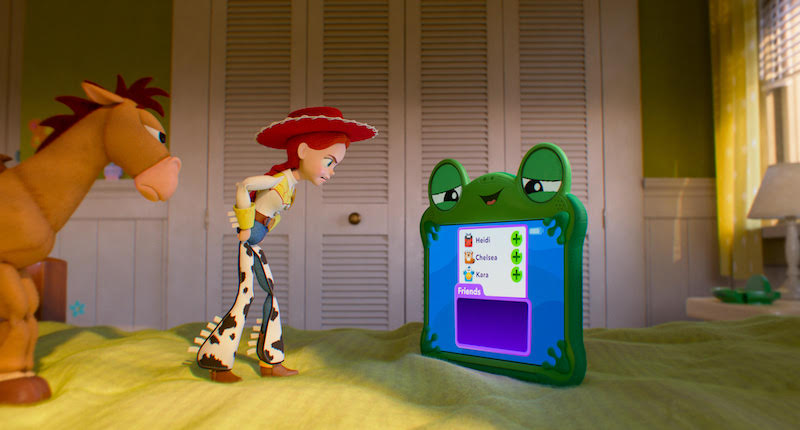
Lily Pad may have one of the cleanest character designs in the movie, but that simplicity created an unexpected challenge.
Unlike most characters, animators had to think about two different performances happening at once.
There is Lily Pad herself, with her physical movements and expressions, but there is also the screen on her body constantly displaying information and graphics.
Those elements had to work together without the screen becoming so distracting that audiences stopped paying attention to the character.
The contrast between Lily Pad and Jessie also plays into one of the film’s central ideas. Jessie approaches Bonnie through emotion, history and personal connection. Lily Pad approaches her through information, efficiency and technology.
That conflict gives the movie’s toy-versus-tech premise a little more emotional weight than simply asking whether kids prefer toys or tablets.
4. Bonnie’s Clothes and Bedroom Help Tell Her Story
Some of the smallest details surrounding Bonnie were designed to reflect how she changes over the course of the film.
Her wardrobe evolves alongside her emotional state, while the lighting inside her room slowly changes as technology begins taking up more of her attention.
The filmmakers discussed gradually introducing colder blue light into Bonnie’s environment as Lily Pad becomes more influential.
There is even careful attention paid to where light falls across Bonnie during key emotional scenes.
These are details most audiences probably will not consciously notice while watching the movie, but together they help communicate what Bonnie is feeling without requiring her to explain it.
5. We Finally Get to See Playtime Through Bonnie’s Imagination
One of the biggest visual departures in “Toy Story 5” comes when the movie allows audiences to experience the world through Bonnie’s imagination.
Instead of the polished three-dimensional environments traditionally associated with Pixar animation, these moments take on a handmade arts-and-crafts quality.
The filmmakers leaned into imperfect shapes, pastel textures and imagery that feels as though it could have been created by children while playing.
That idea becomes especially important during the final playtime sequence, when Bonnie and Blaze’s imaginations begin working together.
The team spent close to a year refining the look and feel of the sequence.
Rather than creating perfectly polished imagery, the challenge was sometimes doing the opposite: making Pixar’s sophisticated animation technology look convincingly handmade.
6. Lily Pad Texting Bonnie Breaks a Major Toy Story Rule
For decades, one of the most important rules in the “Toy Story” universe has been simple: humans cannot know that toys are alive.
There have obviously been a few major exceptions, with Woody revealing himself to Sid in the original Toy Story being the most famous.
That is why Lily Pad directly communicating with Bonnie through text became such an important moment for the filmmakers.
They understood that it crossed a boundary the franchise rarely touches.
Instead of introducing the idea casually, parts of the story were rearranged so the moment could receive a proper buildup.
After five films, it is interesting to hear that the filmmakers still treat those original rules seriously enough that breaking one requires its own dramatic setup.
7. Blaze’s Hair Required Pixar to Develop New Technology
Blaze presented another technical challenge for Pixar’s animation team.
Her tightly curled hair required the development of new simulation tools capable of handling how individual curls move, interact with one another and make contact with her clothing.
Instead of animating each strand individually, the system had to understand how groups of curls should naturally behave together.
That attention to specificity carries into Blaze’s environment as well.
Her home includes subtle visual details influenced by Armenian culture, including decorative patterns and pomegranate imagery.
They are the kind of background touches that may only appear briefly on screen but help make a character’s home feel like an actual lived-in space.
8. Fifty Buzz Lightyears Somehow Turned Into an Even Bigger Animation Problem
Animating 50 Buzz Lightyears was difficult enough.
Then Pixar put them on horses.
The filmmakers talked about the challenge of creating scenes involving dozens of Buzzes and dozens of horses while still making the movement feel natural rather than like characters were simply being copied and pasted across the screen.
Things became even more complicated during the movie’s large highway sequence.
A moving truck, loose objects in the truck bed, Buzz Lightyears standing on those objects, other vehicles, lights, signs and background details all had to move together inside the same environment.
One of the shots was described as among the more complicated sequences Pixar has attempted.
And apparently, the filmmakers once considered making the sequence even more elaborate before eventually simplifying some of their ideas.
Sometimes even Pixar has to look at something and decide it might be too much.
9. Taylor Swift Got the “Songwriter Zoomies” After Watching the Movie
Taylor Swift’s involvement with “Toy Story 5” did not begin with someone simply handing her a finished song to perform.
According to the filmmakers, Swift watched the movie and quickly called them afterward.
What stood out to the team was the way she immediately started discussing the story and its themes. They felt she was responding to the film almost like another writer rather than an artist simply looking for inspiration for an end-credits track.
Then came what the filmmakers jokingly described as the “songwriter zoomies.”
Swift apparently felt compelled to begin writing almost immediately and quickly recorded the outro song inspired by what she had seen.
The result was emotional enough that members of the filmmaking team recalled crying when they first heard it.
For a movie centered around growing up, changing relationships and figuring out where we belong, having the closing song come directly from someone reacting to those themes made the collaboration feel particularly fitting.
10. The Filmmakers Knew They Had Found Their Ending When They Saw Buzz and Jessie Together
Some movie endings take years to figure out.
Others suddenly click into place.
The filmmakers recalled watching the final Buzz and Jessie moments during editing and realizing that they had found the ending of the movie.
Even the lighting helps sell the emotion of the scene. Instead of suddenly giving the characters an unrealistically romantic glow, the sequence uses everyday sources like traffic lights and vehicle taillights to create warmth around them.
The story then transitions into Bonnie and Blaze playing together, bringing the movie back to the simple act that started the entire franchise: children using their imaginations with their toys.
The credits continue that idea with artwork and small glimpses of what happens after the main story ends.
For the artists behind the movie, however, finishing another Toy Story also carries a different kind of emotion.
Some members of the team have worked on multiple films in the franchise, while others are experiencing the world for the first time. The filmmakers described “Toy Story” as something that has become part of Pixar’s creative DNA, with each new generation of artists getting its own opportunity to open the toy box.
More than 30 years after audiences first met Woody and Buzz, “Toy Story” continues to be about characters trying to find their place in a changing world. The difference now is that the generations of artists telling their stories are changing right along with them.