Ridley Scott’s “The Dog Stars” has everything it needs to be a fascinating post-apocalyptic survivalist flick. There’s a great cast led by Jacob Elordi and Margaret Qualley, alongside Josh Brolin, Guy Pearce, Alison Janney, and Benedict Wong, as well as majestic shots of Italy doubling for a post-apocalyptic Colorado. But a weak story, combined with Brolin and Pearce overshadowing the film’s leads, prevents “The Dog Stars” from becoming as compelling as it could have been.
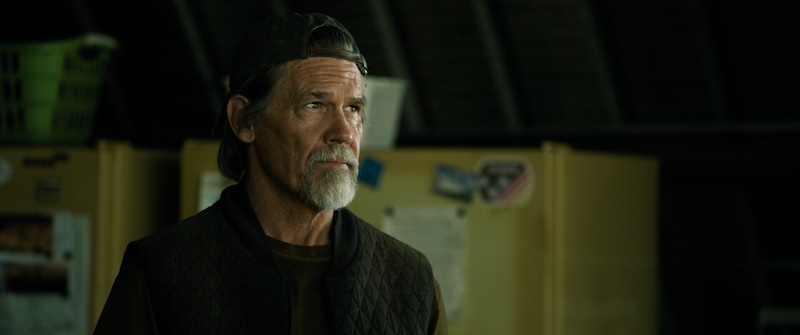
Josh Brolin as Bangley in 20th Century Studios’ THE DOG STARS. © 2026 20th Century Studios. All Rights Reserved.
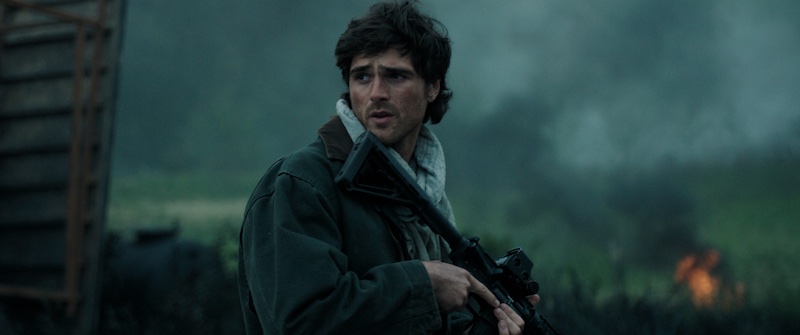
Based on Peter Heller’s novel and adapted by screenwriter Mark L. Smith, “The Dog Stars” follows Hig (Jacob Elordi), a mechanic and pilot living at an abandoned airfield in a remote part of Colorado after a devastating virus has wiped out most of humanity. He spends most of his time with his loyal, trustworthy canine companion, Jasper. Jasper is the last living reminder of his relationship with his late wife, Melissa (Sai Bennett). Together, Hig and Jasper fly the skies and roam empty cities in hopes of finding civilization. However, whenever there are days that he struggles to find the will to live, he contemplates slamming his yellow Cessna into the side of a mountain.
That’s where his friend Bangley (Josh Brolin) comes in. The heavily armed survivalist has a cynical outlook and shoot-first mentality that creates one of the film’s most entertaining dynamics. While Hig keeps searching for reasons to live, Bangley is mainly concerned with making sure they survive another day. The film also makes it clear that Bangley is prepared for almost any disaster. He has a huge cache of weapons, including guns and explosives, as well as night vision goggles and warpaint.
While Hig refuses to live in a world consumed by grief, he keeps himself occupied with routines like maintaining his plane, scouring an abandoned Denver for supplies, rummaging through bars, and retrieving medicine stashed inside a hospital elevator. Bangley, however, worries that Hig’s constant flights and visits to a nearby family could attract hostiles known as Reapers or bring illness back to the airfield. Yet Hig persists. Because of that, Bangley believes it’s time his partner saw the world the way he does: as a permanent war zone where morality is a liability and “roaches,” his term for the remaining survivors, are simply predators competing over scraps.
Hig’s flights across Denver eventually lead him to intercept a staticky transmission carrying a Grand Junction call sign. To Hig, it becomes proof that something may lie beyond the isolated life he and Bangley have built. But as Hig grows increasingly obsessed with Grand Junction, Bangley believes his partner is becoming distracted and careless. Determined to force Hig to see the world the way he does, Bangley teaches him a harsh lesson about what happens when emotion and hope interfere with survival. The lesson backfires in the worst possible way, resulting in Jasper’s death and leaving Hig even more consumed by grief.
For Bangley, Jasper’s death does not change the lesson. If anything, it reinforces it. The world will not stop because Hig is grieving, and allowing that grief to cloud his judgment only creates more opportunities for someone else to kill him. Bangley’s brutal worldview may lack compassion, but it comes from years of treating every mistake as potentially fatal.
With Jasper gone and Grand Junction still lingering in his mind, Hig finally decides to leave the airfield behind. His search eventually brings him to Cima (Margaret Qualley), a medical student living with Pops (Guy Pearce), another heavily armed survivor who is understandably suspicious of anyone approaching their home. Like Bangley, Pops has survived by assuming the worst about strangers, though Cima is more willing to believe human connection still has value.
Elordi and Qualley develop an understated chemistry as Hig and Cima slowly become comfortable around one another. Both characters have experienced tremendous loss, and their connection gives Hig something he has not had since losing Melissa and Jasper: another person he might actually want to build a life around. But despite the performances working on an individual level, their relationship never develops into something emotionally affecting enough to carry the film. We understand why these two survivors gravitate toward one another, but “The Dog Stars” rarely gives their relationship enough room to become something we’re equally invested in.
The characters are easy to understand, given how archetypal they are, but harder to invest in emotionally because they often function as representations of different survival philosophies before they feel like fully lived-in people. And they don’t go beyond that.
Strangely enough, Jasper provides one of the film’s clearest emotional connections because there is nothing particularly complicated about what he represents. He is loyal, innocent, and one of the last pieces of Hig’s old life. We understand their relationship simply by watching them together. So when Jasper dies, the immediate sadness comes from losing the dog itself as much as what that loss means for Hig. The human characters, by comparison, spend considerably more time talking about survival, grief, morality, and what remains of civilization.
Pearce has the advantage of making Pops feel immediately distinctive despite occupying familiar territory. Like Bangley, he assumes strangers are dangerous until proven otherwise, and much of his relationship with Hig begins from a place of suspicion. But Pearce brings a dry irritability and guarded humor to Pops that makes him fun to watch. It is the same quality Brolin brings to Bangley. Neither character necessarily has the emotional complexity that Hig is given, yet Brolin and Pearce make their characters feel more vivid whenever they appear.
While the characters are thinly written, the action that is supposed to support a film about surviving against the odds, hostile tribes, and communities like Grand Junction often lacks consequence. These encounters are there to generate suspense, but even when the action is tense, it rarely has a lasting effect on the characters or alters the direction of their arcs.
Grand Junction is perhaps the clearest example of that problem. After spending much of the film listening through static and white noise for signs of another civilization, Hig finally reaches the place he has built up in his mind as a possible refuge. On the surface, the airport appears to be exactly what he was searching for. It is functional, organized, and populated by survivors who work as mechanics, farmhands, bartenders, and soldiers. There are even people drinking and dancing, creating the appearance that some version of normal life has survived.
Presiding over Grand Junction is Darlene (Alison Janney), who still wears an old Pan Am stewardess uniform while overseeing the airport with an unnerving sense of hospitality. There is something noticeably off about the people who live there, many of whom carry a vacant look as they go through the motions of assigned roles. Newcomers are treated less like people than resources. She sees Hig and Pops as laborers, and Cima as a valuable medical worker who Darlene even tries to pair off with one of the soldiers. The absurdity of the moment only reinforces how little agency anyone in Grand Junction seems to have.
Aside from Benedict Wong, “The Dog Stars” features a surprisingly homogeneous group of survivors, which makes its vision of post-apocalyptic America feel less representative of the country that supposedly existed before the virus. While I can understand that much of the population has been wiped out, it is difficult to believe that nearly every surviving community Hig encounters would be this homogeneous.
For all of its faults, “The Dog Stars” is never difficult to look at. Cinematographer Erik Messerschmidt captures the world’s isolation through sweeping landscapes and abandoned cities that make humanity feel incredibly small. The shots add more to the world-building than the script. Aerial shots of a desolate America, where wild packs of dogs roam free, are just some of the details that give audiences a sense of the world’s state. Seeing nature reclaim spaces once filled with people does a lot of the heavy lifting when the story itself struggles to create the same sense of wonder or dread.
That is ultimately what makes “The Dog Stars” such a frustrating experience. Scott and Messerschmidt create a visually stunning post-apocalyptic world, Elordi and Qualley give committed performances, and Brolin and Pearce inject much-needed personality whenever they appear. But the characters remain too thin, the action too inconsequential, and some of the film’s most interesting ideas, particularly Grand Junction, disappear almost as quickly as they arrive.
“The Dog Stars” has the dog, although don’t get too attached. It has the stars, although don’t get too attached to those either. It has beautiful landscapes, grief, loneliness, and a search for something worth living for. But despite having nearly everything it needs to stand out from an increasingly crowded post-apocalyptic genre, it never quite gets there. In the end, it is a film that exists when it could have been something much more.
5/10