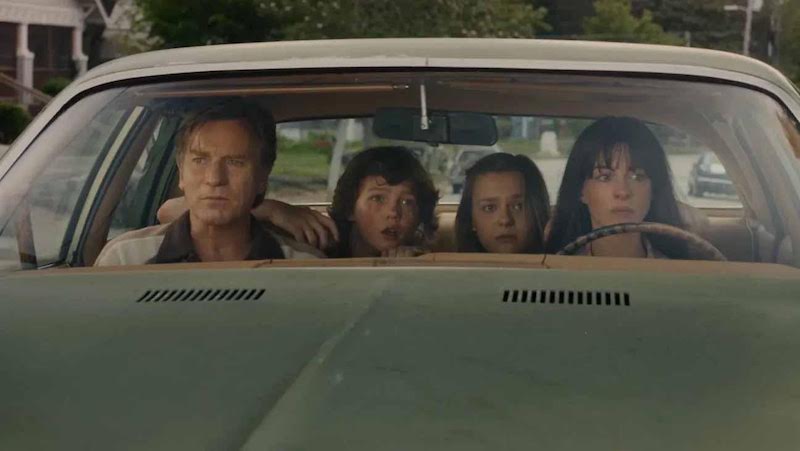
The End of Oak Street may look like a dino-sized survival thriller set in 1980s suburbia, but there’s much more to David Robert Mitchell’s latest film than what the trailers have advertised. Beneath all the prehistoric chaos is an emotional story about a broken family that has to learn how to come together before they become dinner.
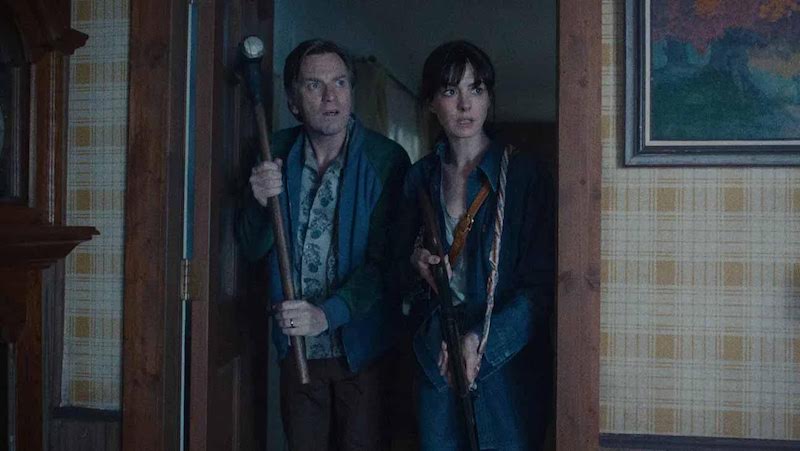
In the film, Greg Platt (Ewan McGregor) is the conflict-avoidant patriarch who is struggling to keep his unemployment a secret from his emotionally starved, intellectually alive wife Denise Platt (Anne Hathaway). The two live their lives through avoidance, secrecy, and a created fantasy instead of honest partnership.
During a neighborhood block party, they seem like the picture of the perfect family, with neighbors complimenting their son Brian (Christian Convery) and college-bound daughter Audrey (Maisy Stella). However, behind closed doors and away from any eavesdropping, they are anything but. The tensions in their marriage are about to erupt, only to cool down again, as a series of strange lights, prehistoric plants, and an impossible tear in the fabric of time take their suburban street out of time and drop it into the age of dinosaurs.
Cut off from the world, with no power or running water, the family is forced into survival mode. But surviving means confronting more than the creatures outside. Greg and Denise must also face the lies, resentments, and silent fears that have been stalking their marriage for years, forcing them to decide whether they can finally see each other clearly and come together before the end of the world reaches their doorstep.
While dinosaurs showing up at a family’s doorstep would be the obvious selling point for a film of this size and scope, “The End of Oak Street” is less about surviving prehistoric creatures than it is about a fractured family learning how to come together amid years of lies, resentment, and emotional distance.
And since “The End of Oak Street” is ultimately concerned with the survival of the Platt family, the film mirrors their struggle against the creatures outside with the equally difficult task of repairing a broken marriage and keeping their family from falling apart. Before that survival becomes quite literal, however, it is much more figurative. Greg is unemployed and hides it from his family, taking on side hustles like delivering pizzas to bring in some quick cash. Denise, meanwhile, has already begun emotionally planning her exit, channeling her own dissatisfaction into fiction that catches the attention of an editor who encourages her as a budding writer.
Their crumbling marriage tells us everything we need to know about the Platt matriarch and patriarch. Greg feels Denise is already halfway out the door, her novel’s fantasy of escape seeming to confirm it, while Denise feels she’s been carrying the emotional load on her own. They’re both right: neither feels actively chosen by the other. Even in the middle of the crisis, their default modes harden. Greg clings to a sudden faith that “God won’t let us die here,” and Denise reminds him he only goes to church at Christmas, which underlines just how far apart they are as they fight to survive.
Of course, the family’s survival, along with Denise and Greg’s marriage serving as a parallel arc, makes it clear that this is no ordinary sci-fi film. It’s a creature feature with genuine emotional depth. As such, Mitchell has to make sure the film’s quieter family moments carry just as much weight as the prehistoric threats waiting outside their door.
Brian and Audrey are crucial to the film’s emotional architecture because we experience both the family’s physical survival and the survival of their parents’ marriage through their eyes. Before the fear of being eaten ever sets in, we see how Greg and Denise’s constant fighting already puts them on edge. Like their father, the kids cope through avoidance, escaping into music rather than confronting what is happening around them. But when that distance is no longer possible, Mitchell captures their fear by holding on Brian and Audrey while their parents’ arguments continue loudly through the walls.
This fear finally forces the parents out of avoidance mode. The immediate need to protect their children pushes their marital conflict aside. Once circumstances force Greg and Denise to work together, they begin to rediscover the instincts that once made them a partnership. Mitchell lets that shift happen through action rather than speeches. For Greg, he becomes more decisive and protective, and for Denise begins trusting him again, and the two share brief moments of recognition that suggest there is still something between them worth saving.
What makes those moments work is that the film doesn’t abandon its sense of humor once the danger escalates. Even in the middle of a desperate search, Mitchell finds room for small, absurdly human interactions that briefly remind Greg and Denise of the people they used to be together. Those quieter beats keep their reconciliation from feeling like it exists only because dinosaurs are chasing them.
That emotional balancing act works largely because of the cast. McGregor gives Greg a softness that sees him less like a domineering patriarch than a man terrified of disappointing his family. Even when Greg is lying, deflecting, or clinging to fragile optimism, McGregor keeps enough warmth in the performance to make his cowardice and his love feel believable at the same time. Then there is Hathaway. She gives Denise an intelligent, exhausted anger that never feels one-note. Her frustration is always tied to the sense that she has spent years wanting more from both her marriage and herself, which makes the character’s impulses toward escape feel melodramatic.
Convery and Stella are just as important to selling the family dynamic. Brian’s nervous energy and defensiveness gradually give way to guilt, fear, and responsibility. In contrast, Stella gives Audrey a quieter sense of curiosity along with moral clarity that makes her feel like the family’s rational center.
So whenever the family has to spend time together, their chemistry is what ultimately makes the Platts worth rooting for. We want to see them come together during these strange circumstances, and if their bond can survive some hungry dinosaurs, maybe it can survive the problems that were already threatening to tear them apart.
Mitchell also uses the frame to visualize the emotional distance within the Platt family. One particular exchange has the parents dominating the extreme foreground while one of the children sits farther away in the background. Rather than cutting back and forth between them, Mitchell keeps both characters within the same composition, allowing us to watch one speak while simultaneously reading the other’s reaction. They may occupy the same room and the same frame, but the physical distance between them reflects just how disconnected this family has become.
Additionally, Mitchell’s direction also knows that suspense doesn’t necessarily come from showing the dinosaurs themselves. For much of the film, he delays giving us a clear look at what is lurking outside, instead using framing and the characters’ limited perspective to build anticipation. These dinosaurs hide themselves in the treeline. Other times, they are merely shadows on a shed, which could make anyone question whether or not they saw what they saw. Then there are moments when the audience can see the danger. At the same time, the Platts remain completely oblivious to it, whether they are distracted by a conversation, separated from the threat by another room, or simply looking in the wrong direction. The effect turns the frame itself into a source of tension, leaving us waiting for the family to finally notice what we already know is there.
One particularly effective shot places Greg on one side of a fence and a dinosaur moves on the other. With the barrier separating the two, audiences can feel Greg’s panic as he remains dangerously close to something he cannot fully see. Mitchell repeatedly plays with that proximity, allowing prehistoric creatures to occupy the same suburban spaces as the family without immediately forcing the two into confrontation. So this leaves audiences cringing or curling up into a ball or even pointing at the screen or gasping at shocking moments. And there are some shocking moments.
Then there is how Mitchell uses the long takes, which give us enough time to scan the frame and anticipate where the danger might come from. These shots give audiences the full scale of the action and neighborhood itself, and while some may not be tracking shots, there are notable static shots where Gregg and Denise have to create a distraction for the kids to run to safety. These shots make the eventual dinosaur encounters more effective because the film has trained us to look beyond the Platts and pay attention to what may be hiding around them.
At just 99 minutes, “The End of Oak Street” moves quickly without feeling like it is rushing past the emotional material. Mitchell shifts between domestic drama, creature-feature suspense, dark humor, and coming-of-age anxiety with surprising ease. As such, the film knows when to let a quiet family moment breathe and when to push the Platts into another frantic encounter, which keeps the emotional and genre sides from feeling like two separate movies stitched together.
The 1980s setting also gives the film a playful feeling of nostalgia without overwhelming the story. The soundtrack, suburban setting, and family-adventure tone give the movie an Amblin-like quality, but Mitchell never lets that influence erase the darker edges of the material. It’s not nostalgic for the sake of being nostalgic. Songs like Pat Benatar’s “Hit Me With Your Best Shot” give life to the block party, while Audrey escapes to the car, starts it up, and pushes in a cassette of Steve Winwood’s “Valerie.” For a moment, she sings along, letting the music cut through the panic around her. It’s a small beat, but it gives Audrey a feeling of normalcy and reminds us that beneath the survival instincts, she is still a kid trying to hold onto something familiar.
And Michael Giacchino’s composition also does a lot of the heavy lifting when it comes to establishing the film’s 1980s identity. His music helps bridge the film’s shifts between suburban family drama, wonder, and outright creature-feature suspense, giving the dinosaur encounters scale while still leaving room for the quieter emotional moments to land.
Not every subplot is given the same attention, though. The introduction of Janet, a frightened girl Brian and Audrey take in, gestures toward a broader idea of found family, but the film never develops her enough for that thread to carry much emotional weight. It is understood that Janette has just moved into the neighborhood, so there are already rumors on whether or not she is from cathloic school, etc. Likewise, Brian’s feud with the boy whose arm he broke establishes his recklessness and gives him a human-scale threat before the dinosaurs arrive, but the conflict largely fades once the survival story takes over. Both subplots add texture, but neither meaningfully reshapes the Platts’ choices, leaving them feeling underdeveloped in an otherwise tightly focused family story.
In the end, The End of Oak Street is really about what remains when the idea of home is stripped away. The End of Oak Street begins as a picture of suburban normalcy and then becomes a literal death trap, which forces the Platts to decide whether home is the place they live or the people they are still willing to fight for. The dinosaurs may be the film’s biggest attraction, but it is the family’s emotional survival that gives the story its bite.
9/10
The End Of Oak Street in theaters August 14, 2026