It can start with one bad night. And when a protagonist finds themselves in the world of “Resident Evil,” it’s going to be one really bad night. To be more than just another video game adaptation of the long-running franchise, Zach Cregger brings a more grounded approach to a film series that has often leaned into increasingly elaborate action spectacle, while keeping the spirit of what made the games so horrifyingly entertaining.
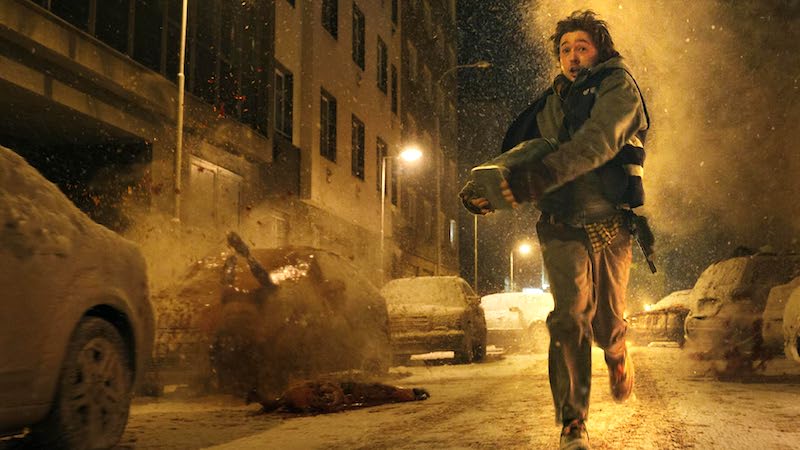
Rather than surrounding his story with familiar characters like Leon Kennedy and Jill Valentine, highly trained agents, soldiers, or larger-than-life heroes, Cregger puts an ordinary medical courier at the center of the nightmare and lets the chaos unfold around him. That unlucky courier is Bryan (Austin Abrams), a glorified Postmates driver tasked with delivering a sealed medical transport case to Raccoon City General. He’s already having a rough night before the monsters ever show up, thanks to an uncomfortable conversation with his girlfriend Michelle about a possible pregnancy. So when work gives him an excuse to get out of the house and head into the mountains, Bryan takes it.
Of course, the delivery quickly becomes anything but routine. Bryan heads toward Raccoon City through snow-covered mountain roads in the dead of night, seemingly ignoring every warning sign along the way. Things go from bad to worse when a barefoot woman suddenly appears in the road, forcing Bryan out of the relative safety of his car and into a situation he is completely unprepared to handle. Though he thought he would get some help from a Raccoon City sheriff who transports the infected woman, things quickly go off the rails or rather the road. Each unfortunate event leads our hapless hero deeper into the city while also expanding upon the world building.
From there, Cregger steadily turns what should have been a simple delivery into a nightmare filled with dark roads, abandoned spaces, strange noises, and increasingly grotesque creatures. Bryan eventually finds himself at a remote barn, where he searches for more firepower to go along with the handgun he took from the officer killed by the infected woman. Instead, he encounters an infected dog, another infected human, and the same woman he thought he had already killed.
Completely inept when it comes to handling firearms, Bryan admits that most of what he knows about guns comes from playing video games. He struggles to load weapons, wastes ammunition, and quickly discovers that simply putting an infected creature down doesn’t necessarily mean it will stay down. The virus allows them to adapt and mutate into something even more grotesque, and Bryan gets a horrifying lesson in just how unpredictable those transformations can be as he moves deeper into Raccoon City. His lack of survival skills, limited firepower, and inability to anticipate what might come next make every encounter feel more dangerous because Bryan is essentially learning the rules of survival as he goes.
That unpredictability generates much of the tension. Bryan rarely knows what is waiting around the next corner, and neither do we. Sometimes it is nothing more than a distant sound in the darkness or movement just outside his field of vision. Other times, whatever eventually steps into the light is far worse than anything Bryan—or the audience—could have imagined. And when Cregger shifts into Bryan’s first-person perspective, those video game sensibilities come even further to the forefront, putting audiences directly into his panic as he searches darkened rooms, checks corners, and tries to figure out what might be waiting just beyond his line of sight.
Cregger also takes full advantage of just how grotesque the T-virus allows Resident Evil to become. An infected dog splits its face apart, human bodies merge into a crawling mass of arms and legs, an enormous infected man carries a swarm of rats inside his stomach, and another mutation spits acid. Heads explode, flesh tears, boils and scars distort bodies, and each new transformation seems determined to be more disgusting than the last.
Yet Abrams keeps all of that grotesque horror from becoming oppressively grim. Bryan reacts to each new nightmare with panic, disbelief, profanity, and the kind of exhausted frustration that makes him immediately relatable. His ongoing battle with padlocks practically becomes a running gag, while his tendency to talk himself through terrifying situations gives the movie a darkly comedic edge. There’s nothing particularly heroic about the way he enters a room or picks up a gun. He fumbles, hesitates, talks himself through problems, and frequently looks like he would rather be anywhere else. Abrams understands that much of the comedy comes from Bryan being painfully aware of just how unqualified he is for everything happening around him.
Padlocks and locked doors are also a recurring part of the games’ exploration and puzzle design. In some entries, players need keys or lockpicks to get through them, but those solutions don’t come quite so easily to someone like Bryan. His preferred method is usually to shoot the lock off with a gun, and at one point he even resorts to ramming a truck through a locked gate, only to discover afterward that the key had been sitting in the overhead visor the entire time. Unfortunately for Bryan, there’s also no convenient save file to reload when he comes across one of the franchise’s familiar typewriters. Still, the callback is a nice touch for longtime fans.
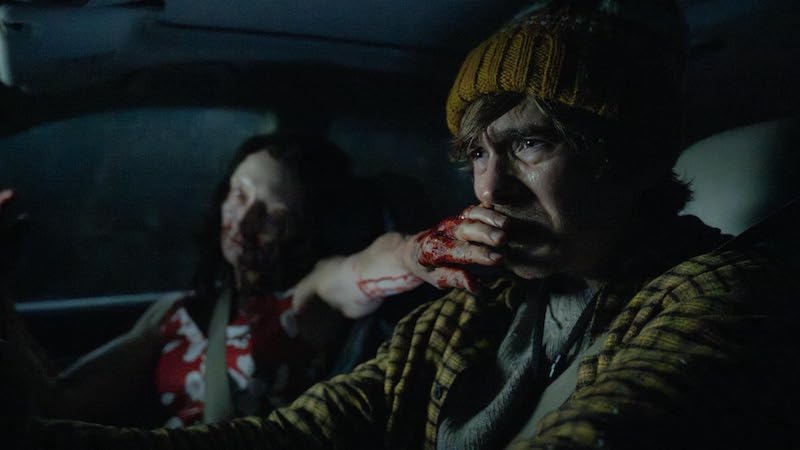
What makes the performance work, though, is that Abrams never turns Bryan into a complete joke. Underneath all of the swearing and nervous rambling is someone who genuinely cares about the people around him. He may have started the night running away from an uncomfortable conversation with Michelle, but when strangers need help, Bryan repeatedly puts himself in danger rather than simply walking away. Even if those strangers turns out to be infected with the T-Virus. Abrams lets that decency gradually push through the panic, giving Bryan an emotional arc beyond simply figuring out how to survive until morning. He wants to get home, but repeatedly finds himself getting closer to the source of the outbreak when confronted with dangers.
What makes the performance work, though, is that Abrams never turns Bryan into a complete joke. Underneath all of the swearing and nervous rambling is someone who genuinely cares about the people around him. He may have started the night running away from an uncomfortable conversation with Michelle, but when strangers need help, Bryan repeatedly puts himself in danger rather than simply walking away—even when those strangers turn out to be infected with the T-virus. Abrams lets that decency gradually push through the panic, giving Bryan an emotional arc beyond simply figuring out how to survive until morning.
The irony is that almost every attempt Bryan makes to get home only pushes him closer to the source of the outbreak. After the horrors he encounters at the barn, he bolts in the opposite direction almost entirely on instinct, too shaken to think about where he is actually going. An Umbrella retrieval team later brings him even deeper into the city after discovering that the package he has been carrying contains an additive needed for the antidote. And when a mass of infected bodies begins hunting him, his only escape sends him underground. Bryan keeps trying to put distance between himself and Raccoon City, yet every new threat seems to funnel him further into its nightmare.
Cregger’s direction keeps that downward spiral tense without making the film relentlessly grim. He knows when to let a dark hallway, distant noise, or unseen threat linger long enough to make audiences uneasy, but he also knows when Bryan’s ineptitude can puncture that tension with humor. A botched attempt to use a weapon, a panicked outburst, or another encounter with a stubborn padlock gives the audience just enough room to laugh before the next threat arrives. That balance keeps the film moving while preventing the horror from becoming exhausting.
More importantly, Cregger keeps raising the stakes without simply making each monster bigger than the last. Bryan begins the night worried about finishing a delivery and getting home to Michelle, but the consequences gradually expand from his own survival to the fate of the people trapped in Raccoon City. The deeper he gets, the more important the package becomes, and the less possible it is for him to simply turn around and walk away.
By the time Bryan’s one bad night reaches its end, Resident Evil has put him through just about every nightmare Raccoon City can throw at him. Cregger’s Resident Evil delivers a fast, gruesome, and surprisingly funny survival-horror film that understands when to let the tension build, when to unleash its grotesque creatures, and when Abrams’ exhausted everyman reactions can give audiences a much-needed laugh.
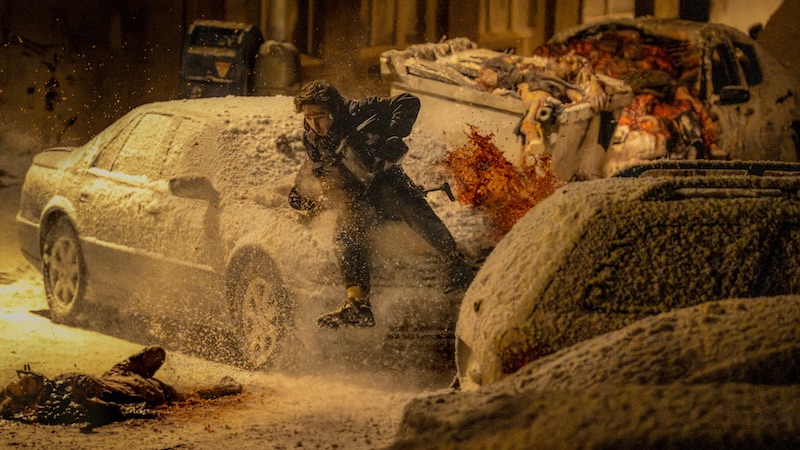
More importantly, the film works because Bryan never feels like someone destined to become a hero. He is simply an ordinary guy trying to survive long enough to get home, gradually discovering that running away is no longer an option. Abrams sells that transformation without losing the awkwardness, panic, and humor that made Bryan relatable in the first place.
Longtime Resident Evil fans will recognize plenty of familiar touches, but Cregger doesn’t require audiences to know the games to enjoy the ride. Sometimes all a horror movie really needs is one hapless courier, one increasingly important package, and one spectacularly bad night in Raccoon City.
9/10
Resident Evil is in theaters September 18, 2026.