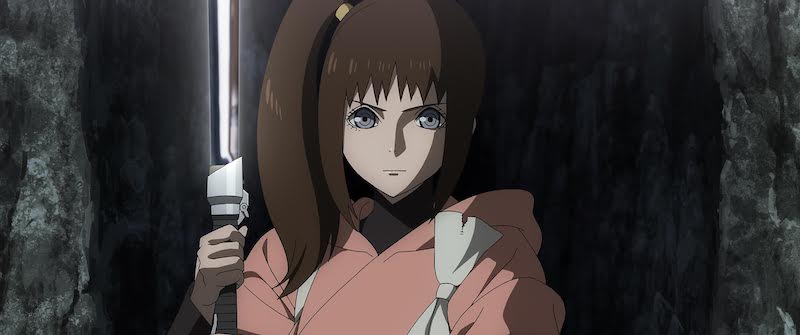
“Star Wars: Visions” gave audiences a new way to experience the galaxy far, far away, inviting acclaimed animation studios from Japan and around the world to tell stories outside the franchise’s traditional canon. Now, the project is expanding beyond its anthology format with “Star Wars: Visions Presents” a series of standalone spin-offs that will allow stories first introduced as shorts to continue through longer-form storytelling. And it all starts with “Star Wars: Visions Presents – The Ninth Jedi.”
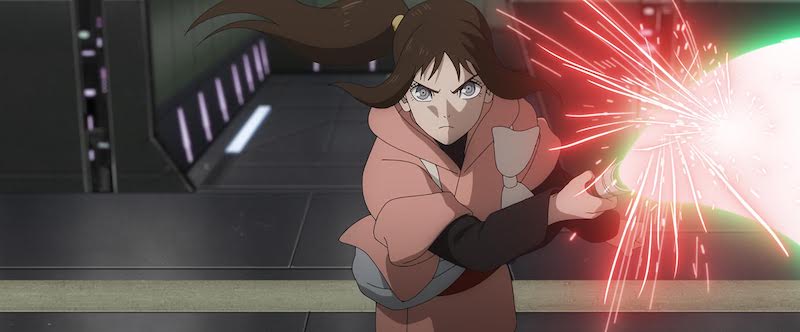
Lah Kara in a scene from Star Wars: Visions Presents – The Ninth Jedi, exclusively on Disney+. Photo courtesy of Lucasfilm. © 2026 Lucasfilm Ltd. All Rights Reserved.
First released as a part of the Vol. 1 anthology series, “The Ninth Jedi” is set generations after the Jedi Order’s fall, Margrave Juro (Andrew Kishino) summons seven supposed Jedi to receive newly forged lightsabers. Sabersmith Lah Zhima (Simu Liu) is captured by Sith hunters, forcing his Force-sensitive daughter Kara (Kimiko Glenn) to deliver the weapons herself. At Juro’s temple, six of the guests reveal themselves as Sith imposters, but Juro, Kara, and the genuine Jedi Ethan defeat them. Joined by the repentant Homen, they form the beginnings of a new Jedi Order and set out to rescue Lah Zhima.
In “The Ninth Jedi: Child of Hope,” Kara joins Ethan, Margrave Juro, Homen (Patrick Seitz), and the droid 99-99 on a mission to rescue her kidnapped father, Lah Zhima. When bounty hunters Anda and Unda attack their ship, Kara is separated from the group and rescued by Teto, a service droid stranded aboard his late master’s starship for centuries. After Kara helps Teto reunite with his master’s remains, the droid pledges himself to her. When the hunters board the ship, Teto sacrifices himself to save Kara, destroying the vessel and taking their attackers with him. Reunited with her allies, Kara mourns Teto as Juro concludes that the mysterious Nawaan was responsible for her father’s abduction.
Now, “Star Wars: Visions Presents – The Ninth Jedi” enters its standalone-series phase, with Kara continuing her training under Margrave Juro as she and his small fellowship of Jedi-in-training embark on a quest to save her father. While the central rescue mission is fairly standard for a short that received a follow-up before expanding into a full series, its exploration of Star Wars mythology remains entertaining and surprisingly fresh. This is a galaxy where the Jedi and Sith have all but disappeared, leaving warlords, independent city-states, and masterless Jedi to fill the power vacuum. Without an Empire, Republic, or familiar Skywalker-era conflict to fall back on, the series has the freedom to examine what being a Jedi and a Sith means when the Order, its masters, and its rules no longer exist.
With that freedom and place within the Star Wars timeline, it’s gotten to a point where the memories of these factions like Jedi Knights and Sith Lords exist, but there’s no functioning institution, no Council, no Sith hierarchy. There are just remnants and rumors. So Warlords like Nawaam fill that vacuum by building personal empires from brutes, droid armies, and “masterless Jedi.” Although he fashions himself in the image of a Sith Lord, he wields a blue lightsaber rather than a traditional red blade.
Nawaam’s strength comes through in his ability to turn the galaxy’s instability into personal power. Unlike a Sith Lord or Imperial general commanding an established military hierarchy, he rules through a brutal, almost gladiatorial system in which loyalty lasts only as long as he remains the strongest person in the room. As such, he is the warlord who openly invites underlings to take him down with those who do being granted the role of leader. This makes his power even scarier considering that he has built an empire through fear, opportunity, and the promise of power.
That gives “Star Wars: Visions Presents – The Ninth Jedi” a feudal quality that distinguishes it from the centralized conflicts that typically define Star Wars. Force-sensitive fighters no longer fall neatly into the categories of Jedi or Sith. Some become mercenaries, soldiers, merchants, or local rulers, while Nawaam absorbs others into an army governed by strength and fear. His “masterless Jedi” resemble ronin more than Sith acolytes, serving whoever can provide them with power, protection, or purpose.
Margrave Juro’s small fellowship offers an alternative, though the series never pretends that rebuilding the Jedi will be easy. There are no temples, recognized masters, or established teachings to guide them. Juro is attempting to reconstruct an institution from people who possess only fragments of its history, and the deeper the series moves into that past, the clearer it becomes that the old Jedi Order may not deserve to be restored exactly as it was.
Juro functions less as the story’s emotional anchor and more as a political architect and leader. The nomadic warrior has an extensive network of former Jedi, merchants, local rulers, miners, and resistance forces scattered across the galaxy to work with in case he needed it. As such, he knows whom to approach, what resources they can provide, and how to use those relationships to his tactical advantage. Rather than commanding an established Order, Juro builds coalitions one connection at a time, persuading independent communities that their survival depends on joining a conflict many would rather avoid.
The surviving Jedi were not merely defeated by an outside enemy. Some became entangled in politics, trade, and corruption while attempting to restore stability to the galaxy. That revelation complicates Lah Zhima’s reputation as the Padawan who murdered his own master. What was remembered as an act of betrayal may have been his attempt to stop a Jedi who had abused his authority and fallen to the dark side.
Zhima’s decision to strike down his former master is less an act of defiance and more of a moral intervention. That history also gives Kara’s search for her father more emotional weight. She is not only trying to find Zhima but also to reconcile the heroic man she remembers with the morally complicated figure described by everyone around her. Zhima’s past also shaped Nawaam. The boy who once saw the padawan strike down his master now calls him master and interprets the act as proof that true power could only be achieved by abandoning emotion.
So when Kara loses control while protecting an isolated village, her lightsaber turns red. The anthology series establishes that Zhima’s sabers reflect the wielder’s heart. So the color red represents her anger and fear rather than an irreversible fall to the dark side. As such, Kara’s arc takes an interesting turn and so does the mystery of the lightsabers as their power and colors are directly tied to emotions and how they are controlled as opposed to how they control the characters.
Nawaam builds his entire philosophy around that misunderstanding. He rejects both the Jedi and Sith labels. And so he fashions himself as a leader who is beyond their outdated conflict. He promises peace still depends on surveillance, intimidation, military occupation, and the Kyber Crystal Cannon. This cannon is visually striking, and its power is intimidating, as it can reach beyond the stars and destroy planets with ease. His pursuit of “nothingness” is less an enlightened alternative to the light and dark sides than it is another excuse to treat empathy as weakness.
So Kara’s worldview goes against everything Nawaam stands for. Her journey across the season is not about suppressing fear, anger, or grief until she resembles the emotionally detached Jedi of the past. It is about learning to acknowledge those feelings without allowing them to control her choices. Lah Zhima encourages her to find an answer beyond the old teachings, making her development inseparable from the larger question of what this new Jedi Order should become.
Because “Star Wars: Visions Presents – The Ninth Jedi” originated within an anthology unbound by established canon, it has the freedom to develop its characters without the weight of lore that preceded them. That makes it easier to become emotionally invested in Kara, especially since she is not a Jedi simply because she is powerful or “chosen.” Her journey is built around a generational wound that all started with what her father did and the burden he had to carry.
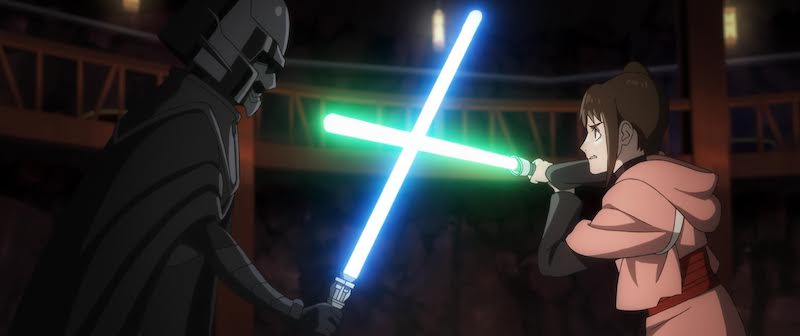
(L-R) Nawaam and Lah Kara ( in a scene from Star Wars: Visions Presents – The Ninth Jedi, exclusively on Disney+. Photo courtesy of Lucasfilm. © 2026 Lucasfilm Ltd. All Rights Reserved.
The animation does much of the work required to make those ideas land. Changing lightsaber colors, large-scale space battles, and the contrast between the cold machinery of Nawaam’s forces and the smaller communities caught in their path give the series a visual language of its own. The most effective action sequences are also grounded in the realities of this fractured galaxy. Juro’s fellowship cannot defeat Nawaam through sheer force, so they rely on infiltration, sabotage, improvised alliances, and tactics such as using a black hole to escape pursuit or turning mining vessels into an artificial asteroid field.
Those sequences reinforce the idea that this is not a traditional war between two established galactic powers. It is a small resistance movement attempting to outthink a warlord with vastly greater resources. Refugee convoys, miners, isolated villages, and local rulers also give the conflict consequences beyond the Jedi themselves, showing how Nawaam’s promise of peace through strength affects the ordinary people expected to submit to him.
However, expanding two shorts into an eight-episode series also creates new challenges. The season has an enormous amount of history, political context, and Force mythology to establish, and it often delivers that information through lengthy conversations. Some revelations, particularly those involving Lah Zhima’s former master and the collapse of the Jedi Order, are compelling but densely explained. Kara is sometimes asked to absorb decades of betrayal, corruption, and disputed history before the story quickly moves on to its next battle.
The supporting characters can also feel more functional than fully developed. Juro, Homen, Ethan, and the various allies gathered throughout the season help demonstrate the reach of this emerging Jedi movement, but Kara, Lah Zhima, and Nawaam receive most of the meaningful emotional material. With only eight episodes, the series occasionally struggles to balance its expanding ensemble with the mythology it is so eager to explore.
For all its shortcomings, “Star Wars: Visions Presents – The Ninth Jedi” is worth a visit for anyone exhausted by keeping up with the current state of the Skywalker Saga. Its freedom from established canon allows it to introduce new ideas about the Force, question whether the Jedi Order should be restored at all, and build an era that feels familiar without depending on nostalgia. Unfortunately, the dense exposition and underdeveloped supporting characters occasionally prevent the series from reaching its full emotional potential. And yet, Kara’s journey, the evolving lightsaber mythology, and the visually inventive action justify expanding the story beyond its original shorts. If Visions Presents is meant to prove that some anthology stories can sustain a larger narrative, The Ninth Jedi is a promising first step into a galaxy with plenty of story potential.
All Episodes of “Star Wars: Visions Presents – The Ninth Jedi” is exclusively on Disney+ today.
8/10