“Black Phone 2” is the kind of sequel that reminds you not every successful horror movie needs a follow up. The original “Black Phone” worked because it stayed small, character driven, and emotionally grounded, and this new installment seems completely unaware of why people connected with that film in the first place.
The Scott Derrickson-directed sequel, written with returning screenwriter C. Robert Cargill, plays like two different horror movies trying to prove to the audience which is the scariest. As it tries to expand the mythology established in The Black Phone, it ends up wandering away from the core that made the original work. So, instead of building on character and tension, it layers in more supernatural mechanics, more exposition, and more lore without adding anything emotionally substantial.
As such, the superb cast does what it can, but most of the time the performances feel like damage control for a script that is more interested in explaining itself than actually telling a story.
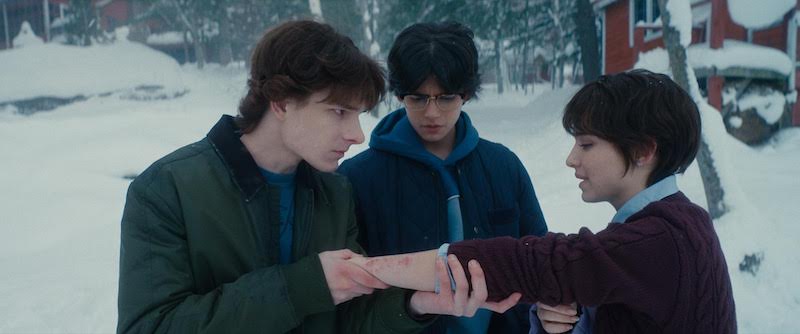
Set in 1982, four years after the events of the first film, “Black Phone 2” centers on a fifteen year old Gwen (Madeleine McGraw), Finney’s (Mason Thames) younger sister, who is now plagued by violent dreams involving three boys murdered under mysterious circumstances at a winter camp. The black phone begins to ring again and her visions play out like grainy Super 8 footage, showing the boys freezing to death in increasingly unsettling fragments. It is a hauntingly effective way to separate Gwen’s dream state from the real world, and it briefly feels like we are watching her wander through a lost 80s horror film while everyone around her scrambles to understand what she is seeing.
As the nightmares intensify, Gwen discovers a possible connection to the camp where her mother once worked as a counselor. Finney, still carrying the weight of surviving the Grabber (Ethan Hawke), is trying to numb his trauma of the past by getting high.
But when Gwen realizes her visions may be tied to the camp her mother once worked at, she and Finney head to Alpine Lake, a remote youth camp in Colorado wrapped in rumors and buried history. The two are hoping to silence the ghosts of their pasts but what they end up doing is discovering The Grabber’s evil shadow extends beyond the mortal plane.
What made the first Black Phone stand out in the horror genre was its focus on human vulnerability, childhood fear, and psychological tension. It was a coming of age film wrapped in a shroud of horror. Which is why the sequel’s use of the supernatural feels like a deviation instead of an evolution. The original never treated ghosts as lore, it treated them as trauma talking back. Finney was not part of a mythology, he was a kid trying to survive a monster with whatever remnants of the dead were willing to help him.
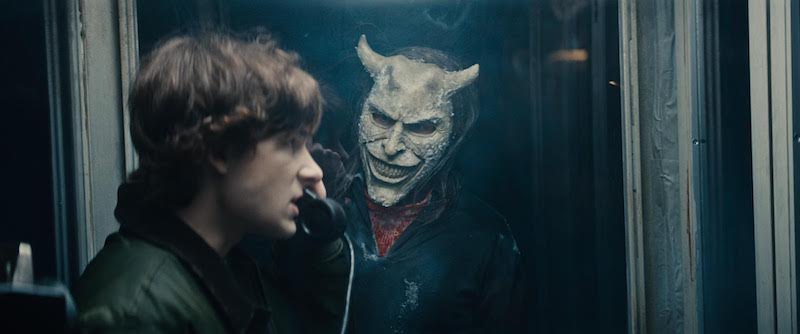
So the film relies on using the Grabber as some sort of vengeful ghost from beyond the grave who wants nothing more than to see Finney suffer for what he did to him. And the way it goes about explaining that haunting is where the wheels really start to come off. Instead of letting the horror speak through silence, implication, or the psychological fallout of survival, the film insists on spelling out every rule, every vision, every tragic backstory. Unlike the first where the fear struck organically, “Black Phone 2” has to be heavy on the exposition.
Scenes that are supposed to be unsettling are undermined by the dialogue dumps about the camp’s past, usually delivered through Gwen’s tense exchanges with Barbara, a rigid authority figure who quotes scripture whenever anyone gets too close to the truth. The Grabber’s explanation for how he continues to exist follows the same pattern by using lore, spiritual mechanics, and dream sequences to justify his existence.
To be fair, Derrickson still knows how to stage the hell out of a shot. Every so often the film stumbles into something visually arresting and you remember why the first movie hit the way it did. The phone booths are dropped into wide open nothingness — sometimes in a barren tundra, other times on a frozen lake — and the camera circles them like a memory closing in. As it rotates, the Grabber’s victims appear in the landscape, their burned and mutilated bodies contrasted against the calm white of the mountains. For a moment the film stops explaining itself and just lets the horror exist.
As soon as the film leans harder into dreams and nightmares, it inevitably invites comparisons to “A Nightmare on Elm Street 3: Dream Warriors,” but not in a way that does it any favors. The Grabber is basically reimagined as a knockoff Freddy Krueger, facial scarring and all, with the added gimmick that whatever happens to Gwen in the dream world also happens to her in reality. Instead of feeling inventive or unsettling, it plays like the film is borrowing someone else’s nightmares because it cannot generate its own and tries to pass it off as something that would expand the film’s mythology and lore.
Still, you can tell Derrickson and Cargill want to do something new by refusing to double down or repeat the same story beats of the original. They believe they are expanding the world in a meaningful way, even if what they are really doing is stretching a finished story past its breaking point. The film never stops trying to convince you it is scary — leaning on well-timed jump scares, flashes of mutilated children, and the constant presence of the Grabber — but even those moments feel like reminders of something the movie has already exhausted. Hawke’s Grabber only appears through dream logic now, but he is somehow still able to interfere with the real world, most notably through his torment of Armando (Demián Bichir), the supervisor at Alpine Lake. Those scenes should be the stuff of nightmares.
In the end, “Black Phone 2” doesn’t feel like a continuation of a story but rather it feels like a studio trying to reverse-engineer a franchise out of a film that never asked for one. What was once grounded in fear, grief, and survival has been drowned in lore, rules, and dream logic that explain everything and deepen nothing. And while the cast does what it can, it spotlights the challenges of expanding a perfectly contained original story.
7.5/10