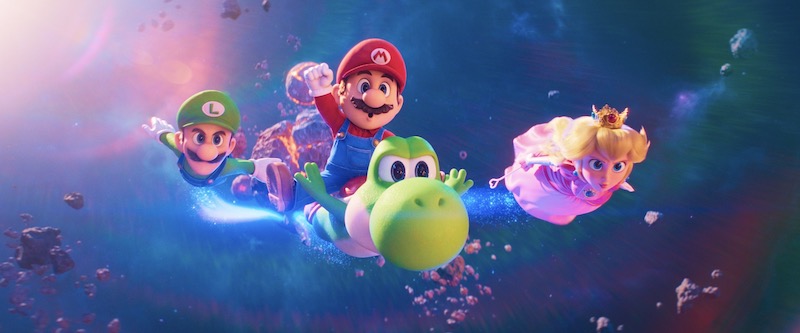
Universal Pictures and Illumination’s “The Super Mario Galaxy Movie” is a sequel that improves on its predecessor in nearly every meaningful way. While the first film often struggled with its writing and character dynamics, this follow-up feels more assured, embracing the charm, imagination, and sense of adventure that have defined Mario for nearly 40 years. Through vibrant visuals, inventive animation, and a story that balances nostalgia with simple crowd-pleasing fun, “The Super Mario Galaxy Movie” proves itself to be an entertaining new chapter for the franchise. Oh, and happy anniversary, Nintendo.
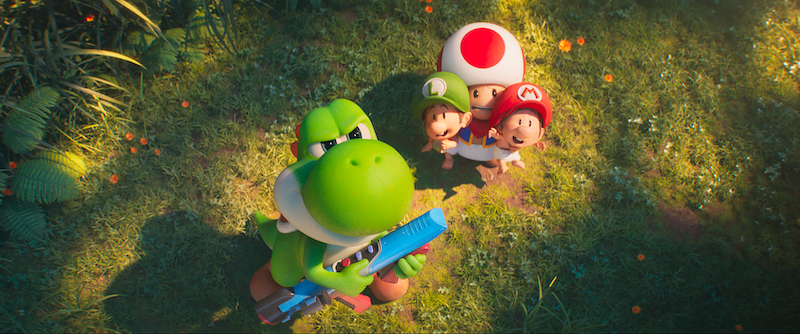
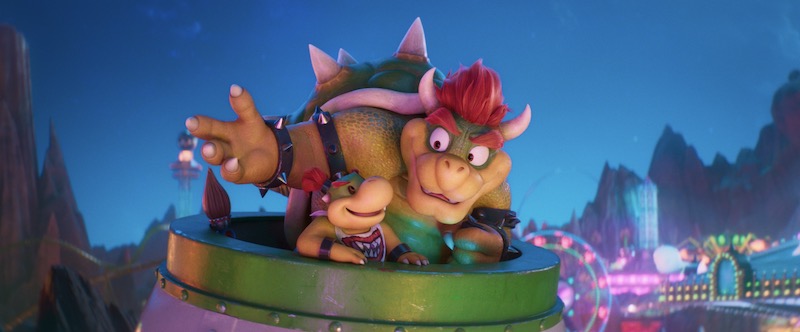
Picking up after the events of The Super Mario World, “The Super Mario Galaxy Movie” opens with Bowser Jr. setting out on a mission fueled by revenge and reunion. His target is Rosalina (Brie Larson), the cosmic guardian of the Lumas, who is introduced through a quieter opening that highlights her maternal bond with them before Bowser Jr.’s attack throws everything into chaos. In just a few beats, the film establishes its central conflict, emotional stakes, and the urgency that drives the adventure forward. It is also a much stronger opening than the first film, balancing character introduction and high-stakes setup through the clash between Rosalina’s cosmic energy and Bowser Jr.’s chaotic arsenal of Bullet Bills, Chain Chomps, and a magic paintbrush that turns the prince’s imagination into a real threat.
The biggest improvement comes from how much more confident the film feels in its storytelling. Rather than rushing from one reference or set piece to the next, it gives its characters clearer motivations and allows their relationships to breathe in ways the first film often struggled to do. The pacing is still chaotic at times, but that energy feels more fitting here given the urgency of the mission and the franchise’s game-based roots. This is still a Mario story, after all, and the film understands that simplicity doesn’t come at the expense of emotional investment.
What makes the story work is how much more compelling its emotional through lines are this time around. “The Super Mario Galaxy Movie” gives its characters stronger motivations, making the adventure feel more engaging from scene to scene. Mario remains the film’s quiet center, a hero whose courage is tempered by moments of vulnerability and emotion, while still respecting Peach’s ability to lead in a time of crisis. Bowser Jr., meanwhile, emerges as one of the film’s more surprising emotional anchors, with his destructive impulses shaped by a clear need for approval that gives his actions more dimension.
More than anything, the film is driven by the family bonds that connect its characters. From the father-and-son dynamic between Bowser and Bowser Jr. to the sibling bond between Mario and Luigi, these relationships are woven into the film’s major plot beats, giving audiences a real reason to care about what is at stake. Even Bowser Jr.’s worst actions are framed through that desire for connection and validation, which makes his chaos oddly heartfelt in a twisted sort of way.
Just as important is how the film expands its world through visual storytelling. Through its shifting animation styles, greater sense of scale, and its drawing on decades of Mario iconography while folding in Star Fox crossovers, the sequel feels more invested in building a universe than simply recreating familiar imagery. That imaginative approach extends to Wart’s hidden casino, where Birdo and Mouser serve as his muscle in a setting that feels both theatrical and surreal. Designed like a gravity-defying cube, the casino constantly resets its orientation, so what appears to be a wall one moment becomes the floor the next. It is the kind of visual idea that not only looks striking, but also reinforces how playful and unpredictable this version of the Mario universe can be.
And the film’s visual ambition does not stop at making its 8-bit and 16-bit origins feel more cinematic through CGI animation. It also folds in nods to anime and puppetry, broadening the stylistic language of the Mario universe in ways that make the world feel even more expansive. That creativity extends to the film’s use of Star Fox, whose arrival comes with an appropriately epic explanation that not only adds scale to the adventure but also does a better job of justifying these larger crossovers than the previous film managed. Then there is the puppetry, with a felt-inspired set piece that leans into the father-and-son dynamic in a way that is both visually playful and emotionally revealing.
As much as the world-building and visuals expand the world and serve as callbacks, the entire sequel overflows with nostalgia. While the callbacks and cameos are obligatory, this time around, they are done with more care, adding texture to the world instead of functioning as empty applause cues.
While there is plenty that works here, especially for fans already invested in the games, “The Super Mario Galaxy Movie” is not without its flaws. The film is at its strongest when it focuses on family, but it also tries to carry too many storylines at once. Between Peach’s origin and destiny, Bowser Jr.’s relationship with his father, and Planet Bowser’s universe-ending threat, the movie often feels stretched thin. As a result, several of its ideas are more compelling in theory than in execution. Mario’s romantic subplot with Peach never develops much depth; the search for Rosalina gradually fades into the background amid the film’s constant chaos; and Bowser’s attempted rehabilitation and desire to be trusted are introduced as meaningful concepts but not explored enough to truly resonate.
The biggest difference between “The Super Mario Galaxy Movie” and its predecessor is how much more confident it feels from the start. Where the first film often relied on recognition and speed to keep things moving, this sequel brings a clearer sense of purpose to both its storytelling and character dynamics. It is still packed with Easter eggs, cameos, name-drops, callbacks, and nostalgia, which comes with the territory of adapting one of the most successful video game franchises of all time. This time, though, those elements are anchored by a stronger emotional core and a more fully realized sense of adventure. That does not make the film especially complex, but it does allow its humor and emotional beats to connect more effectively.
8.5/10
“The Super Mario Galaxy Movie” opens in theaters on April 1, 2025.