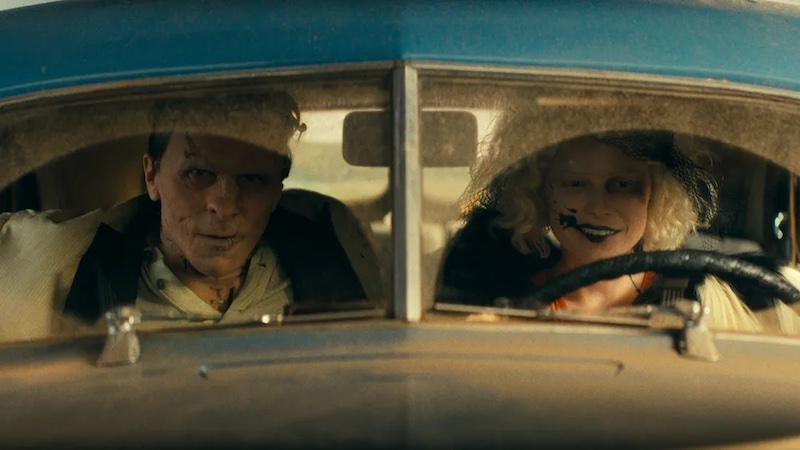
“The Bride!” is a cinematic gothic romance that shocks the senses. Written and directed by Maggie Gyllenhaal, the film transforms the familiar monster myth into something fiercely contemporary, timely, and most importantly, a great horror movie that doubles as social commentary. It leans fully into existential dread, amplifying the tragedy of creation while building an unhinged love story that pulses at its core. Along the way, it reminds us that classic monster stories have often been told through a male lens, and Gyllenhaal is fearless in flipping that perspective.
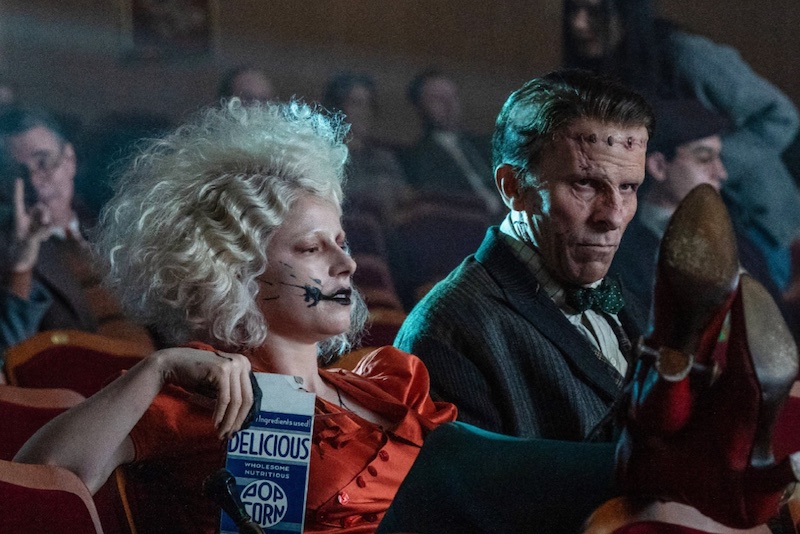
Set in 1930s Chicago, the restless ghost of Mary Shelly (Jessie Buckley) claws her way out of the literary afterlife to complete the story that she never finished. So she possesses Ida (also Buckley), a woman who plays along to the requests of sleazy men at a club owned by Lupino (Zlatko Burić). She is basically the good girl who says “yes, please,” when asked. When she finds the cracks of the psyche to get in, Mary possesses Ida to tell this ghost story that doubles as a horror story that is also a love story.
The possessed Ida causes a scene at Lupino’s club, telling the female patrons to watch their tongues around that man. A bit of foreshadowing as Lupino is revealed to take the tongues out of his victims so they can no longer speak. When she is killed, she is subsequently buried by a few of Lupino’s stooges and supposedly forgotten.
Years later, when Frankenstein’s monster or Frank (Christian Bale) arrives at Dr. Euphronius’ (Annette Benning) office, he asks her to help him create a companion for him. Together, they give life to a murdered Ida, who is also recognized as “the Bride” and Penny. “The Bride” isn’t what she once was as she is outfitted with a leg brace and has a black smudge across her cheek. It isn’t so much a disfigurement as something that gives her an identity.
Initially, the romance is severely lacking. Frank makes clumsy, sometimes aggressive advances, and Ida rejects them. Gyllenhaal never lets us forget that he literally commissions her body as a conjugal companion, a fact that hangs over every tender moment and keeps raising the same question about consent.
That tension snaps into something darker when Ida is sexually assaulted. Frank responds with violence, killing her attackers, and that act becomes the point of no return. It pushes them into a fugitive life shaped by the fallout of male brutality and the systems that excuse it. As they run, Ida starts to see Frank less as the man who ordered her into existence and more as another damaged, lonely, constrained creature. Not innocent. Not simple. But recognizable.
Gyllenhaal doesn’t deliver an ordinary modern-day adaptation of Frankenstein or a simple reimagining of the 1935 film Bride of Frankenstein. Instead, she takes those inspirations and molds them into something entirely new while still paying homage to the stories that came before. It’s a film that sees Christian Bale and Jessie Buckley commit so completely to their roles that the film never loosens its grip. Their performances are raw, unpredictable, and deeply human, pulling audiences into a world that feels at once literary, grotesque, and strangely romantic.
Gyllenhaal’s boldest choice is structural. She frames Mary Shelley as a ghost with multiple purposes. To the audience, she is a narrator. To Ida, she is a possessor. In either role, she becomes the guide that moves the story forward and keeps its strange logic intact. And as the saying goes, it is about the journey, not the destination, and “The Bride!” is one wild journey.
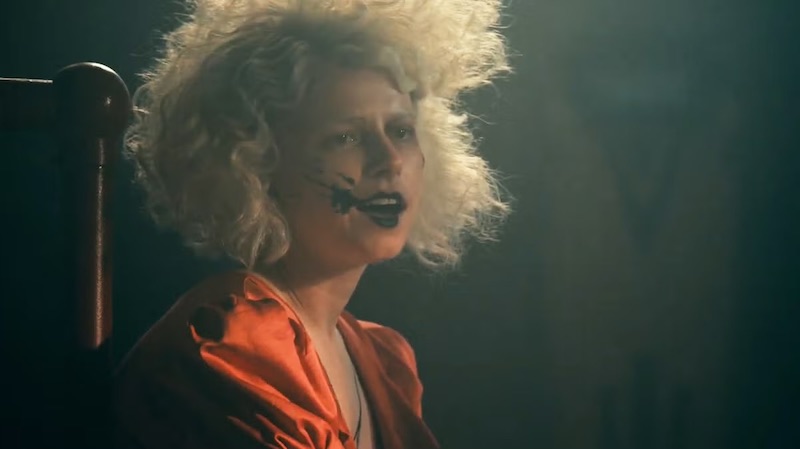
The Bride, also known as Penelope and “Pretty Penny,” is even harder to pin down, since the film tells us the character moves through multiple identities before settling on a name, beginning disoriented and amnesiac before evolving into a fiercely articulate witness. When her vocabulary starts to detonate, it feels like her brain is attacking the language that traps her. She chews on the word “mate” and riffs words like shipmate, hellmate, stalemate, decimate, transubstantiate, sublimate, consummate, and checkmate.
The film begins unpacking everything crammed into the word “mate.” Marriage and ownership. Companionship and breeding. Punishment and strategy. Even a kind of spiritual transformation. What starts as a neat label for the role she was built to fill becomes the exact pressure point she keeps pressing until it cracks. By the time she lands on “checkmate,” the Bride is no longer the object being moved around. She is the one making the move and telling you the game is over.
That moment also captures the larger energy running through “The Bride!” Gyllenhaal is not interested in presenting a passive monster story. She is interested in rage, rebellion, and the voices that history tried to bury. Throughout the film, women who were once dismissed, discarded, ignored, or silenced begin to speak back. Sometimes it is funny. Sometimes it is brutal. Often it is both at the same time. The point is not subtle. Male violence and the silencing of women are not relics of the past. They are systems that mutate and survive across generations.
What follows is less a tidy political program than a revolt of perception. The Bride does not suddenly become a revolutionary leader issuing commands. Instead, her existence cracks the story the world keeps telling about monsters, brides, and respectable women. Once that crack appears, other women rush into it. They move differently. They speak differently. And the idea of who gets to be heard begins to shift. They assume her likeness by adding a sploch of black to the right side of their cheek. It’s like war paint.
Buckley is doing the kind of dual performance that makes you forget it is one actor playing two roles. As Mary Shelley, she is sharp and controlled, the ghost author who has had centuries to refine her rage into language. As Ida, also known as Penelope and “Pretty Penny,” she starts out dazed and pliant, then slowly turns into something volatile and electric. It is a performance that feels bodily. Like the words are not just clever, they are clawing their way out.
You can hear the switch between them in the rhythms alone. Mary speaks like someone who knows exactly what she is doing and exactly what she wants. Ida speaks like someone waking up in a life built for her by others, then refusing to stay in it. There’s even a moment where we see her severed head inside a glass jar, symbolizing the suffocation that she’s experienced in the past and how Mary is the only one who can offer freedom. Part of the film’s charge comes from watching Buckley embody both sides of that tension. The mind that has been stewing for centuries and the newly reanimated body that finally gets to act on it.
Bale gives Frank the same kind of contradiction. He plays him as menacing, melancholic, and strangely sincere all at once. Early on, Frank can be frighteningly single-minded. He is a man who literally orders a conjugal bride, and Bale lets that entitlement sit in the room even as the film tries to be tender. But as the story unfolds, he lets in these unexpected cracks of vulnerability and even a little offbeat humor. It is there in the way Frank treats a first handshake like a life-changing event, or the way he lights up over old Ronnie Reed pictures. Moments like that do not excuse him, but they do make him human.
That is what gives the romance its complicated pull. Frank never stops being complicit in the Bride’s creation. The film does not let him off the hook. And yet Bale also makes him feel like a deeply lonely creature learning how to love without owning. The result is queasy and tender at the same time, which feels exactly like the point.
A parallel thread running through the film is Detective Jake Wiles (Peter Sarsgaard) and his assistant, Myrna Malloy (Penélope Cruz), as they chase Frank and the Bride across state lines. On paper, the dynamic looks familiar. Wiles plays the hardboiled detective with the smug confidence and the occasional “asshole act,” flirting his way through interviews and leaning on his badge when charm fails. Malloy is introduced as the classic Girl Friday, the assistant who is supposed to take notes and look good while doing so.
However, Gyllenhaal subverts that dynamic by showing that Malloy is the one actually doing the detective work. She spots patterns, connects the Ronnie Reed films to the case, buys the train tickets, and keeps the investigation moving forward while Wiles drifts on bravado and access. Their banter is strong enough to warrant its own spinoff film. She rolls her eyes at his routine while he pretends he is still the one in charge. But the script allows him to admit that she is the one who gets the job done. He even hints at the gender role reversals where he is the one seducing the police and detectives, while she is the one who finds the clues and connects the dots. Malloy knows she is the sharpest mind in the room, and she is not shy about wanting credit for it.
In a way, the two storylines start to mirror each other. The men spend much of the film performing roles they think the world expects from them. Frank pretends he understands love because he ordered it into existence. Wiles pretends he is a brilliant detective while coasting on charm and reputation. The women, meanwhile, are the ones doing the real transformation. Ida fights to reclaim her voice and rewrite the story written for her, while Malloy quietly solves the mystery everyone else is pretending to control. It becomes another subtle reversal in a film that keeps asking who actually gets to write the story.
“The Bride!” understands how often the genre has been built around male desire and male control, with women reduced to symbols and solutions. Gyllenhaal flips that expectation. The Bride is not here to complete the monster or redeem the man who made her. She is here to disrupt the story itself. It is a film that sees Christian Bale and Jessie Buckley commit so completely to their roles that the film never loosens its grip. Their performances are raw, unpredictable, and deeply human, pulling audiences into a world that feels at once literary, grotesque, and strangely romantic.
10/10

1 comment
This review of The Bride! offers a compelling and insightful take on what appears to be one of the most daring reinventions of Gothic cinema in recent years. By highlighting the film’s blend of existential dread, social commentary, and unconventional romance, the article effectively captures the bold creative vision of director Maggie Gyllenhaal and the hauntingly powerful performances by Jessie Buckley and Christian Bale. I appreciate how the piece contextualizes this adaptation within the broader Frankenstein legacy while also emphasizing its modern feminist perspective—making it clear that The Bride! is not just a genre film, but a thoughtful re-examination of narrative, voice, and agency. An engaging, articulate review that truly does justice to a story that seems poised to resonate deeply with contemporary audiences.