Marvel Television can be great when it’s in the right hands. From WandaVision and Agatha All Along to Loki, these shows have served as bridges between the MCU’s past and future, even if that means having to do a little homework to fully understand what you’re watching. For those who have followed Vision’s existential journey, from his battle against Ultron to his death at the hands of Thanos and the life Wanda recreated through her grief, VisionQuest brings that journey full circle. Its eight episodes embrace serialized television while finding room to expand Marvel lore without letting that lore become the whole point.
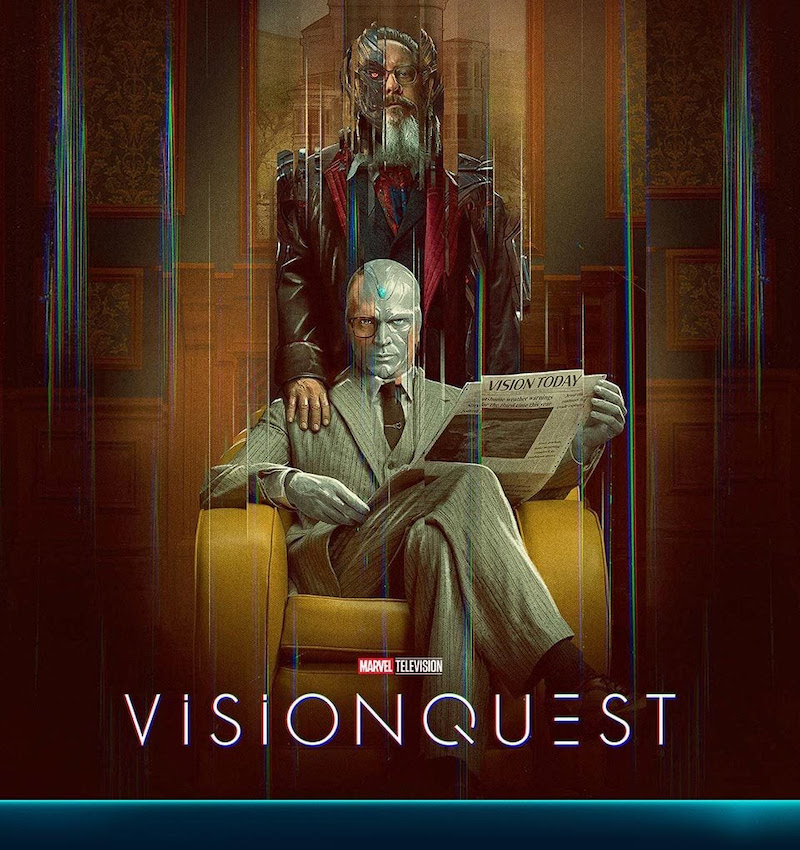
Following the events of WandaVision, Vision (Paul Bettany)—or at least a version of him—has escaped those who sought to weaponize him and gone into hiding. Searching for purpose and a connection to a life he never truly experienced, he has fashioned a mindspace for the artificial intelligence personas embedded within his programming. These familiar faces from the MCU’s past include the sharp-witted and socially perceptive F.R.I.D.A.Y. (Orla Brady), the irreverent and adventure-seeking E.D.I.T.H. (Emily Hampshire), and the ever-vigilant, buttoned-up J.A.R.V.I.S. (James D’Arcy). General maintenance AIs D.U.M.E. (Henry Lewis) and U (Jonathan Sayer) round out the household. Each is introduced with an on-screen graphic outlining its functions, but it’s their clashing personalities that make the group memorable. Then there’s Ultron (James Spader), whose presence complicates everything.
Vision’s quiet existence comes to an end when a mysterious bounty puts him on the run alongside Thomas Shepherd, a young man who may be the reincarnation of his son. What begins as a matter of survival becomes a search for answers about both of their identities, complicated by a hunter on their trail and the less-than-trustworthy intelligence residing within Vision’s own mind.
What makes VisionQuest intriguing is how it forges its own path within the trilogy, wrapping an existential journey of self-discovery in a cyberpunk cat-and-mouse fugitive thriller. The series moves through detective noir, espionage, psychological drama, and even gothic science fiction without entirely losing its emotional center. Where WandaVision drew on classic sitcoms to explore grief and Agatha All Along embraced supernatural mystery, VisionQuest opts for something more technologically driven. The genres change, but the question remains: What makes someone who they are when their memories and existence have been shaped by others?
For this Vision, that question is more than theoretical. Although his body carries the history of his predecessor, he cannot simply claim the emotional experiences that came with it. He works at a pub in Edinburgh, Scotland, once frequented by Vision and Wanda, hoping familiar surroundings will help him understand their relationship. His attempts at socializing are awkward, from his questionable comedic timing to his difficulty reading social cues, yet he still manages to charm pub manager Fiona enough to earn an invitation to Sunday roast. After work, he retreats into the refrigerator to cool down, a wonderfully mundane entrance to a far stranger world. The transition through a dazzling maze of blue digital circuitry reveals his mindspace: a sprawling, Victorian-style estate surrounded by greenery. It’s an almost old-fashioned sanctuary housed inside a futuristic consciousness.
That sanctuary has an unwelcome resident. Ultron is imprisoned in what resembles an attic, much to the discomfort of the other AIs, and is prone to throwing tantrums to get Vision’s attention. It’s amusing to see the intelligence that once threatened humanity behaving like a petulant child. Yet their relationship is more complicated than captor and captive. Vision is haunted by the legacy of a being whose plans helped bring his predecessor into existence; Ultron resents his confinement but understands Vision’s loneliness remarkably well.
While Vision pores over archived footage of his former life, including Wanda’s Westview family, Ultron insists that watching humanity isn’t the same as experiencing it. Their conversations become debates about human nature. Vision sees beauty and possibility; Ultron sees grief, suffering, and contradiction. The irony is that Ultron has a point, even if his encouragement to venture into the world comes with ulterior motives. He knows how to exploit Vision’s uncertainty, maneuvering him toward circumstances that might make Ultron’s help—and eventual freedom—seem necessary.
Paul Bettany and James Spader’s cybernetic chemistry is electric. Their exchanges are battles of wits, with Spader’s distinctive, sardonic delivery lending Ultron a playful menace that contrasts with Bettany’s reserved, analytical approach. Underneath the banter is a dysfunctional, almost father-son relationship in which each knows exactly how to wound the other. What begins as comic antagonism grows more personal as their fragile cooperation gives way to manipulation and betrayal. The performances keep these philosophical arguments entertaining rather than turning them into lectures about consciousness.
Thomas brings a different kind of challenge. He and Vision are essentially struggling with variations of the same crisis: Vision has a body tied to memories he feels detached from, while Thomas is haunted by fragments of a family he cannot explain. Vision initially approaches the boy’s claims as another problem to solve, dismissing what doesn’t fit his calculations. But their uneasy partnership forces him to confront the limits of that thinking. Understanding another person requires listening, not simply processing evidence. The developing bond gives the series much of its heart and offers Vision something his archived recordings cannot: a relationship he must choose to participate in.
The larger mystery also complicates the show’s ideas about creation and autonomy. A string of gruesome murders attributed to the Butcherbird leads toward Jocasta, a synthetic intelligence with a grievance against the people involved in AI’s early development. What first appears to be a detective story expands into a conspiracy about technological control and the impulse to correct humanity’s imperfections. It’s a fitting counterpoint to Vision’s own struggle: these artificial beings want freedom to define themselves, even as some are willing to take that freedom away from others.
That mystery also gives Ultron’s calculating side room to emerge. When Vision temporarily entrusts him with control of his body, Ultron has a chance to pursue his freedom but initially demonstrates surprising restraint. It isn’t redemption so much as patience; the bigger mystery may offer something worth waiting for. And once Ultron escapes, the pursuit changes direction. Vision, who began the series as a fugitive, is now hunting the intelligence he once kept imprisoned. The cat-and-mouse game becomes more personal without losing its thriller momentum.
One of the show’s most inventive moments comes when Vision and the AIs reconstruct Ultron’s activities from archived CCTV footage. Rather than cutting between security monitors, VisionQuest stages the investigation like a play inside the mindspace. Ultron and Jocasta appear in black and white, while the full-color D.U.M.E. and U arrange the scene like stagehands as Vision, F.R.I.D.A.Y., and E.D.I.T.H. watch. Vision calls for the action to freeze, studies what he’s seeing, considers Ultron’s motives, and then tells it to resume. It’s theatrical, playful detective work that turns what could have been a dry exposition dump into an engaging visual puzzle.
Unfortunately, the same inventiveness doesn’t entirely survive the final stretch. Part of what makes VisionQuest work is its commitment to the fugitive-thriller premise: the pursuit, shifting alliances, and unanswered questions keep the characters’ personal stakes at the forefront. But once the larger mystery is unraveled, the series starts falling back on all-too-familiar Marvel conventions. Another threat to the world, a towering technological MacGuffin, and a climactic superhero showdown take over. The action can look impressive, but the longer it goes on, the less interesting the mechanics of the fight become. It’s not that the spectacle is badly executed; it’s that the show has already demonstrated how much more compelling it can be without relying on that formula.
Fortunately, its emotional resolution is more rewarding than its conventional action. Vision begins by treating the life Wanda created in Westview as something that wasn’t truly his. By the end, his memories are no longer just files to study or evidence against which to measure himself. His experiences with Thomas and the other AIs help him recognize that identity is also shaped by choices, relationships, and the willingness to feel love and loss. The show’s exploration of early synthetic life, including Dr. Phineas Horton’s legacy, only deepens those questions about how grief and creation become entangled.
That journey culminates in a psychological confrontation that brings back the sitcom imagery of WandaVision in a different context. Where Wanda once used those familiar settings to escape grief, Vision must confront it, challenging Ultron’s fear of loss and isolation rather than simply trying to overpower him. The sequence gives their fraught bond a poignant dimension and brings the trilogy’s concerns with family and constructed reality back into focus without merely repeating its predecessor.
For all its late detour into by-the-numbers superhero spectacle, VisionQuest is a satisfying capper to the trilogy and a reminder of what Marvel Television can accomplish when it trusts its characters as much as its mythology. Bettany and Spader’s performances, the inventive shifts in genre, and Vision’s gradual acceptance of his own capacity for connection give the series an identity of its own. The final battle may be familiar, but the journey toward it is anything but. Vision’s greatest discovery isn’t how to become the person he used to be. It’s how to live as the person he is now.
8.5/10
The first two episodes of VisionQuest debuts exclusively on DisneyPlus on October 14, 2026.