Disney’s TRON pioneered the use of computer-generated imagery in film, creating a one-of-a-kind cinematic experience that changed the way audiences viewed the possibilities of digital storytelling. Years later, its sequel TRON: Legacy expanded that vision with a sleek update, combining cutting-edge visual effects and Daft Punk’s pulsing soundtrack with an emotional core rooted in fathers and sons. Now, “TRON: Ares” arrives with the promise of carrying that legacy forward. While Nine Inch Nails’ score energizes the grid with industrial intensity and the neon spectacle dazzles, the film itself struggles to find the same heart.
Encom and Dillinger Systems, led by CEOs Eve Kim (Greta Lee) and Julian Dillinger (Evan Peters), are locked in a race to achieve technological breakthroughs that could reshape humanity’s future through AI — from food security to medicine to military power. Julian’s company unveils Ares (Jared Leto), an advanced security program designed to revolutionize warfare, while Eve’s team pursues more altruistic applications of AI. The problem is that their technology suffers from a fatal limitation: a 29-minute lifespan.
When a breakthrough hints at extending the code’s stability beyond that limit, the rivalry escalates. Julian launches corporate and technological attacks on Eve and Encom, setting the stage for a high-stakes showdown with consequences that could redefine the future of AI and cybersecurity.
The story in TRON: Ares sacrifices clarity and character depth in favor of technical spectacle and abstract ideas. Eve and Julian are chasing after the same code, but for very different reasons. For the former, it’s all about completing her late sister Tess’s work by unlocking the permanence code. The latter’s motivaation is rooted in his desire to uphold and surpass his family’s legacy, secure corporate dominance for Dillinger Systems, and wield power over the future of technology.
While their motivations are rooted in legacy and ambition, they rarely resonate beyond the surface. The film occasionally bridges those emotional gaps by shifting perspective to Ares, who peers into Eve’s personal history and uncovers the tragic loss of her sister Tess to glioblastoma. These glimpses are reinforced by personal messages left behind that capture the strength of their bond and the emotional cost driving Eve’s mission. Even so, these moments, powerful in isolation, feel underdeveloped within the larger narrative.
These two are chasing a MacGuffin called the Permanence rather than a meaningful goal, and their motivations often feel dictated by the needs of the plot rather than by authentic emotional drive. Eve’s pursuit of the permanence code is framed as a tribute to her late sister, but the script rarely gives her the space to process that grief in a way that feels earned. Julian, meanwhile, is saddled with familiar beats of corporate greed and family legacy, a characterization that keeps him broad when the story needed nuance. As a result, their rivalry feels more mechanical than dramatic, serving the demands of the narrative rather than drawing the audience into a genuine conflict.
That lack of depth extends to the digital characters themselves. Leto himself is just there, embodying Ares more as an ominous concept than a fully realized character. On paper, Ares is the ultimate expendable soldier, engineered for strength, speed, intelligence, and unquestioning obedience, able to be reconstituted whenever he falls.
On paper, Ares is the ultimate expendable soldier that is engineered for strength, speed, and unquestioning obedience, able to be reconstituted whenever he falls. Rønning stages a brutal creation sequence that begins as spectacle but quickly turns grim, as Ares is forced into endless beta testing against programs designed to fight and delete. The concept of a weapon built for loyalty who slowly begins to question his own existence should be fascinating, yet the film only scratches the surface of it.
If Ares hints at inner conflict, Athena embodies the opposite. Jodie Turner-Smith has more to work with as Athena, the film’s true antagonist and a constant digital threat. Unlike Ares, Athena has no interest in self-discovery. She is relentless and single-minded, a symbol of unchecked technological ambition with no empathy or restraint. She carries out her orders to the letter and is quick to take charge whenever her superiors falter, projecting authority through sheer force of will.
As for the return of Kevin Flynn (Jeff Bridges), the character itself represents that link that makes Tron what it is today. Eve’s search for a code leads her to a remote snowy outpost where photos and newspaper clippings of Kevin and Sam Flynn layer the walls reminding us of how it all started. The film’s expositional opening, stitched together from news clips, brushes past the fates of Sam Flynn and Quorra from TRON: Legacy. Kevin Flynn is portrayed as a legendary figure in the digital world’s history, a visionary programmer who pioneered the frontier of cyberspace and created technologies that continue to shape the grid decades later. His mysterious disappearance in 1989 adds to his mythic status, making him less a character than a ghost whose influence lingers everywhere.
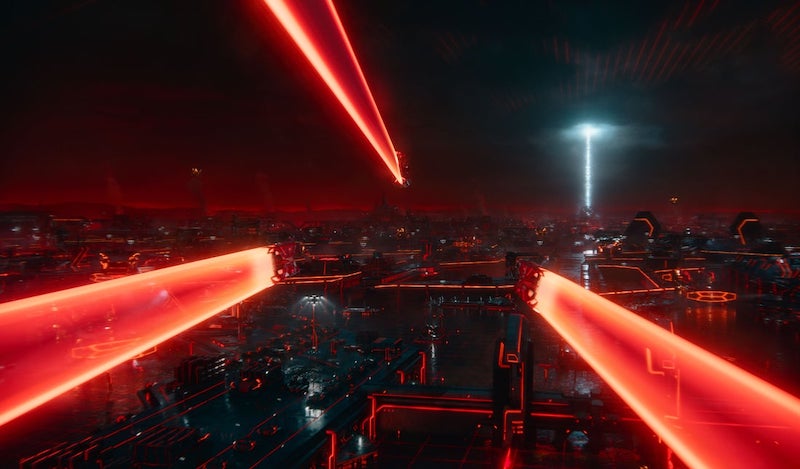
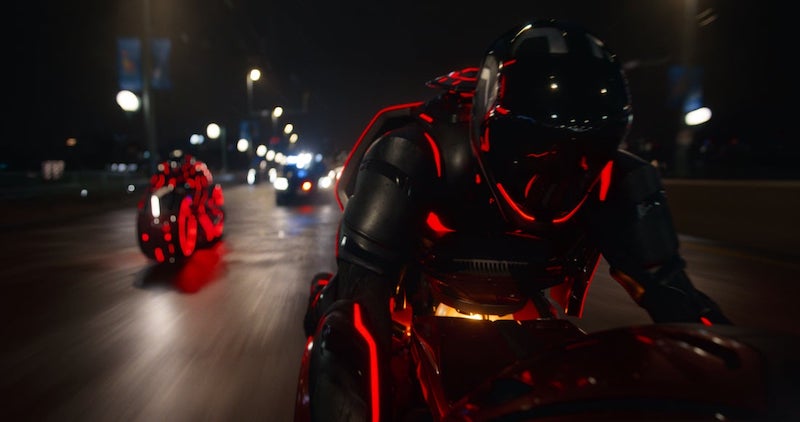
And while Lee and Turner-Smith are outstanding, the film itself is undeniably an audiovisual feast. The digital landscapes are stunning, with cutting-edge effects that render neon-soaked vistas and immersive environments in breathtaking detail. Light, color, and motion are deployed with precision, building a world that feels both futuristic and otherworldly. The action crackles with energy, with light trails igniting the screen during high-speed chases through Vancouver. Upgraded from their Tron: Legacy days, the trails now bend and twist in new ways, giving the sequences an added dynamism. Even data itself is visualized as something tangible and alive. This is a film that knows how to dazzle the senses.
If “TRON: Ares” is designed to stimulate the senses, it succeeds with its spectacular visuals and searing sounds. Every sonic detail, from the hum of neon circuitry to the crackle of weapon fire and the deletions within the grid, reinforces the illusion of a world that is both artificial and alive. The soundscape layers mechanical whirs, glitchy distortions, and synthetic pulses to create an atmosphere that is futuristic yet unsettling. It heightens the urgency of the action while lending surprising weight to quieter moments.
Nine Inch Nails’ score builds on that immersion. Trent Reznor and Atticus Ross lean into their signature industrial aggression, mixing distorted synths, pulsing bass, and ambient drones with sparse piano motifs. At times the music even nods toward the darker edges of 80s electronic pop, with echoes of Depeche Mode woven into its atmosphere. The result is a score that feels raw, brooding, and emotionally charged. It stands in stark contrast to Daft Punk’s Legacy soundtrack, which fused orchestral grandeur with electronic beats to evoke wonder and adventure. Where Daft Punk gave the digital world sleek optimism and memorable melodic hooks, NIN pushes it into darker, more experimental territory, mirroring Ares’ themes of conflict and existential uncertainty.
Even if “TRON: Ares” is stunning to the senses, it still falls into repetitive story beats within its circuitry. Too often, the film circles back to the same conflict: Julian’s programs have a limited amount of time to complete their directives before they destabilize and are deleted. The stakes play out in nearly identical fashion again and again, draining tension instead of building it. And it is only when these programs are pushed to the brink or stumble upon ways to extend their sustainability that the narrative finally feels like it’s going somewhere.
“TRON: Ares” is at its best when it overwhelms the senses with neon light trails, thunderous action, and a blistering Nine Inch Nails score. Greta Lee and Jodie Turner-Smith ground the spectacle with standout performances, even as the film stumbles on character depth and repeats its conflicts. The sheer audiovisual immersion, however, makes it a ride worth taking.
Rating: 7 out of 10