James Cameron has turned “Avatar” into a must see cinematic event. Every visit is gorgeous, overwhelming, and just a little bit exhausting. “Avatar: Fire and Ash” is no different. The third film is a grief-stricken, fire-scorched chapter that pushes the franchise’s visuals to new heights, even as its story keeps spinning in place.
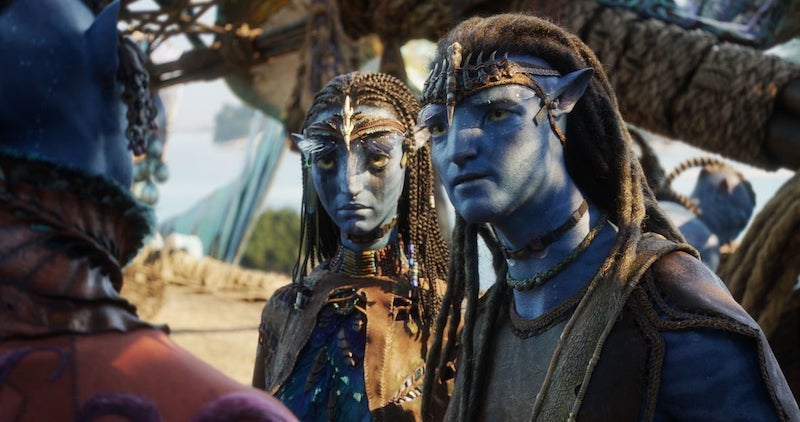
Picking up after “The Way of Water,” “Fire and Ash” finds the Sullys shattered by loss. Jake (Sam Worthington) retreats even further into soldier mode, treating every choice like a tactical move rather than a father’s instinct. Neytiri (Zoe Saldana), once the franchise’s rock of spiritual certainty, clings to Eywa while quietly wondering how much more she is expected to sacrifice. Their kids feel Neteyam’s absence in different ways: Lo’ak (Britain Dalton) is drowning in guilt, Kiri (Sigourney Weaver) is still searching for who and what she is, Tuk (Trinity Jo-Li Bliss) is forced to grow up too fast, and human adoptee Spider (Jack Champion) struggles to belong in a body and a world that literally cannot sustain him without a battery-powered mask.
On paper, that alone is enough for a full movie. “Fire and Ash” piles even more on top of it.
Quaritch (Stephen Lang), resurrected again, renews his mission with fresh fury. A new Na’vi clan, the Mangkwan—also called the Ash People—enter the story, led by Oona Chaplin’s Varang, a tribal chief who feels abandoned by Eywa and is willing to weaponize that resentment. Spider’s desperate need for family, Kiri’s mysterious origins, Jake and Neytiri’s crumbling trust in each other and in their god, Varang’s rage, and Quaritch’s obsession all intersect in ways that should be electrifying.
Instead, Cameron rarely gives any of it room to breathe. The film sprints from one thread to the next, sketching out potent emotional territory and then rushing off to the next battle, vision, or lore drop. The result is a movie that somehow feels overstuffed and undercooked at the same time: packed with ideas, but reluctant to sit with them long enough for the audience to really feel them.
Nowhere is that clearer than in the Sully family dynamics. You can see what everyone is going through—the guilt, the anger, the numbness—but so much of that is buried under the sheer volume of plot. Jake and Neytiri’s treatment of Spider, for example, stays so rigid for so long that when the script finally needs a shift, it plays less like a natural evolution and more like a switch was flipped offscreen. Moments that should redefine what “family” means for the Sullys land as quick checkpoints on the way to the next set piece.
Surprisingly, the most intriguing relationship isn’t in the Sully home at all. It’s the push-pull between Quaritch and Varang. Their scenes crackle with a kind of hostile chemistry the film never quite knows what to do with. There’s mutual respect, simmering attraction, and an understanding that both of them are using each other, even as something more complicated threatens to form in the middle of all that ash and ruin. The idea of a resurrected colonizer and a disillusioned Na’vi leader drawn together by power, grief, and survival is messy in all the right ways. “Fire and Ash” flirts with that tension but rarely commits, leaving what could have been one of the franchise’s most fascinating dynamics at the level of suggestion.
Things get even thornier when Quaritch starts arming Varang’s warriors with human guns. Varang calls their rifles “thunder,” a small detail that says a lot. These are colonizers’ weapons being mythologized and folded into a belief system that once centered Eywa. Visually, watching Na’vi with burn scars and ash-smeared skin fire assault rifles in volcanic landscapes is striking. The film, however, seems more interested in how cool it looks than in what it means for the franchise’s first morally gray Na’vi clan to be trained and armed by the same man who led Pandora’s original invasion.
That ties into the larger discomfort “Fire and Ash” never fully addresses. Like the previous films, this one pulls heavily from real Indigenous cultures—here drawing inspiration from Rabaul in Papua New Guinea and the fire ceremonies of the Baining—for the Mangkwan’s design, rituals, and spiritual language. The result is visually powerful. From the red war paint, burn scars, hardened armor, to the palette of smoke and ember that turns Pandora into a landscape of permanent aftermath, all of it shapes the visual language. But their trauma, faith, and fury mostly function as context for Jake’s journey. Even three films in, the saga still positions a white man as the primary emotional lens through which the audience experiences cultures clearly coded as Indigenous. The Na’vi cosmologies and histories rarely exist for their own sake. They’re stages for Jake to doubt, suffer, learn, and ultimately reaffirm his heroism.
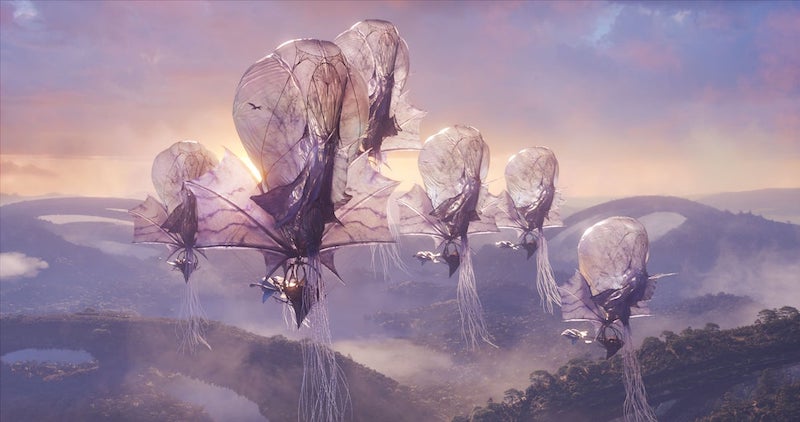
Where “Fire and Ash” is undeniable is in the craft, Cameron and his team are still playing in a different league when it comes to world-building and digital performance. Pandora is rendered with such obsessive detail that you almost forget you’re watching visual effects. Light glints off ash-caked skin, flaming arrows cut through smoke, embers drift like haunted snow. The contrast between the RDA’s cold machinery and the natural world remains razor sharp. In 3D, the film feels immersive rather than gimmicky, and the sound design lets you feel every crackle of fire, whir of engines, and surge of the natural world down to your bones.
The action is a little more uneven. When Cameron slows down enough to let us track the geography and stakes, the sequences are genuinely thrilling. But the movie often leans on fast edits and overlapping set pieces, juggling aerial dogfights, ground skirmishes, prison breaks, and spiritual visions all at once. Each piece is impressive on its own; stacked together, they can blur into noise. You walk away remembering certain images more vividly than the moment-to-moment emotional stakes that were supposed to drive them.
The core issue isn’t that “Fire and Ash” lacks emotion. The grief, anger, and spiritual doubt are all right there on the surface. It’s that the film keeps circling those feelings instead of pushing them somewhere new. The immaculate visuals and sound design end up doing a lot of heavy lifting for a story that often feels like it’s marking time between bigger swings the franchise is saving for later.
As a big-screen experience, “Avatar: Fire and Ash” absolutely delivers. If you’re already invested in Pandora and the Sullys, there’s plenty here to justify another trip: breathtaking images, strong performances (especially from Saldana, Weaver, and Chaplin), and stray emotional beats that linger. As a chapter in a larger saga about family, faith, war, and colonization, though, it feels more like very expensive connective tissue—impressive to look at, but still searching for the story that can match its spectacle.
7/10