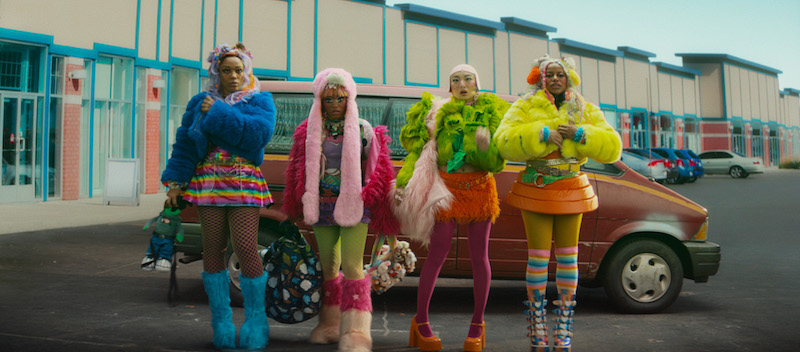
If Sorry to Bother You was Boots Riley’s surreal takedown of modern capitalism and racial assimilation, then I Love Boosters is his commentary on luxury-fashion capitalism, global supply chains, and worker exploitation. Colorful, shocking, and proudly unsubtle, I Love Boosters makes its point with the volume turned all the way up.
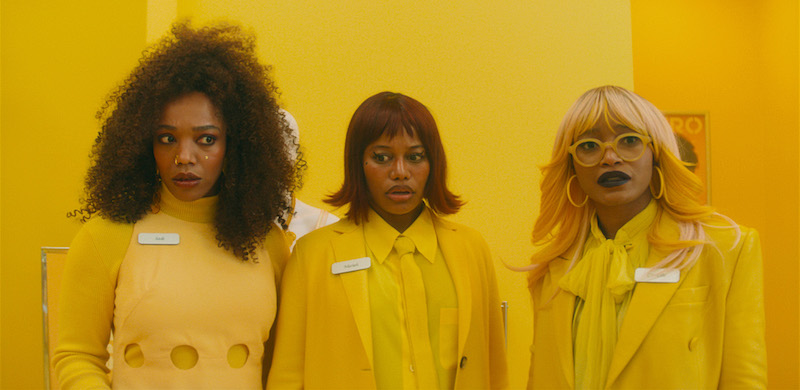
Set in the modern-day Bay Area, I Love Boosters follows Corvette (Keke Palmer), a small-time thief with a bigger political purpose. She and her crew, known as the Velvet Gang, slip into luxury spaces built to exclude people like them, walking out with racks of high-fashion clothing from celebrated designer Christie Smith (Demi Moore) and reselling them to their community at prices they can actually afford. In Corvette’s mind, it is less a crime than a correction.
The Velvet Gang’s heists are messy, funny, and anything but sleek. The process sees them distracting one of Christie Smith’s Metro Designers employees with a fake illness while the others stuff their shirts and pants with merchandise until they have to waddle out of the store like overstuffed mannequins. From there, Corvette and her crew, Sade (Naomi Ackie) and Mariah (Taylour Paige), pile into their beat-up van and head back to their cramped apartment or the fried chicken shack they are squatting in. But the more successful the heists become, the more exposed they are. Every trip back does not just mean more clothes. It means more eyes on them, more security footage to wipe, and more reasons for the system to decide these “low-class urban bitches” need to be made into an example.
But Corvette’s relationship to fashion is more complicated than simple resentment. She admires Christie as an artist. In her eyes, Christie is capable of creating bold, beautiful garments that seem to belong to another world. The tragedy is that Corvette can only enter that world through disguise, theft, and performance. She can look the part long enough to pass through the front doors, but never long enough to truly belong. So she chooses the only form of access left to her. If the system will not let her in, she will take from it.
That is where I Love Boosters becomes more than a heist comedy with an anti-capitalist edge. Riley is not asking whether Corvette and the Velvet Gang are right or wrong in the clean, legal sense. He is asking who gets to define theft in the first place. Corvette steals clothes from Metro Designers, but the film makes clear that the larger theft has already happened long before she enters the store. It happened in the factories, in the supply chains, in the labor practices, and in the way people like Christie Smith steal creativity from working-class communities without giving those artists the credit they deserve.
Corvette’s vendetta stems from more than economic resentment. It comes from the painful realization that her creativity was valuable enough to be stolen, but not valuable enough to be recognized as her own. She once considered submitting one of her designs to Metro, only to decide it was too strange, too personal, or too outside the brand’s polished image. But when a nearly identical piece appears in Christie Smith’s collection, Corvette sees the system’s cruelty laid bare. Her imagination can enter the luxury-fashion world, but only after it has been stripped of her name, her labor, and her authorship.
One of the challenges I Love Boosters faces is not the complexity of its ideas, but the number of directions Riley tries to take them. The film has plenty to say about luxury fashion, global supply chains, worker exploitation, racialized language, spiritual capitalism, consumer culture, and the theft of working-class creativity. But because it is trying to attack so many systems at once, some of its sharper themes can get lost in the noise. That overstuffed quality shows up in everything from the massive boulder of trash containing bills, eviction notices, and Corvette’s self-worth, to LaKeith Stanfield’s Pinky Ring Guy, a charming, soul-sucking demon who gives the film’s existential dread a literal face.
Both images are memorable on their own, but together they also show how crowded Riley’s satire can become. He is not just critiquing fashion or capitalism. He is also taking aim at debt, housing insecurity, self-image, spiritual emptiness, performative community, and the way people are pressured to turn their pain into something marketable. The ambition is admirable, and often thrilling, but it can also make the film feel like it is constantly racing toward the next metaphor before the previous one has fully landed.
Another subplot that seems out of place at first is Sade’s attempt to recruit Corvette into “Friends Being Friendly,” a pyramid scheme run by the hilariously slippery Dr. Jack, played by an almost unrecognizable Don Cheadle. But the more the film unfolds, the clearer it becomes that Riley is drawing a direct line between Christie’s empire and Dr. Jack’s scam. Both profit from people who are desperate to belong. Christie’s brand monetizes labor, style, and aspiration, building itself on Chinese garment workers whose lungs are exposed to toxic chemicals, Black women whose style is absorbed into the brand, and retail staff who are underpaid while being forced to buy the very uniforms they are expected to sell. Friends Being Friendly does the same thing emotionally. Dr. Jack wraps a classic pyramid scheme in the language of healing and community, asking for $2,000 “love offerings” while promising a $12,000 payout if recruits bring in more “friends.”
That is the kind of connection Riley is best at making. Even when “I Love Boosters” seems to be wandering away from its main story, it is usually circling the same target from another angle. The film is full of scams, disguises, performances, and sales pitches. Everyone is selling something, and almost everyone is being sold a lie. That can make the movie feel crowded, but it also gives it an unruly charge. Riley’s world feels like it could collapse under the weight of its own ideas at any moment, which is also part of what makes it exciting.
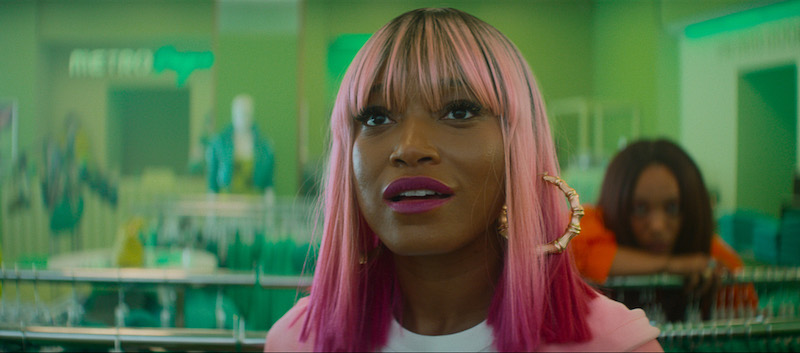
Palmer is the reason the film does not get swallowed by its metaphors. Corvette could have easily become a symbol of working-class rage, but Palmer makes her funny, wounded, stylish, insecure, and stubbornly alive. She understands Corvette’s contradiction. Corvette wants to dismantle Christie’s world, but some part of her still wants to be seen by it. That push and pull gives the film its emotional center.
Demi Moore works well as Christie because she plays her less like a cartoon villain and more like someone who has fully bought into her own mythology. Christie sees herself as a visionary, even as she shows total disregard for the health of the textile factory workers making Metro Designers garments. Don Cheadle brings slippery comic energy to Dr. Jack, while LaKeith Stanfield turns Pinky Ring Guy into one of the film’s strangest and most seductive images of existential dread. Eiza González’s Violetta, meanwhile, helps broaden the world of Metro Designers beyond Corvette and her crew. She may not get a major arc, but her presence matters. As another retail worker expected to sell, wear, and perform the brand while being exploited by it, Violetta makes the store feel less like a backdrop and more like a workplace full of people trapped in the same system. Ackie and Paige bring warmth to Corvette’s crew, though the film does not always give them enough room to develop beyond Corvette’s orbit.
The film’s sound and visual imagination push the boundaries. The score gives the movie a restless energy, while the surreal flourishes push Corvette’s anxieties into physical form. A boulder of bills, a soul-sucking demon, impossible devices that bend time, space, and reality at the press of a button, make the film feel like it is constantly threatening to break out of its own shape. Not every swing lands, but the swings themselves are part of the appeal. Riley is not interested in making a neat satire. He is making a messy, angry, funny, visually overloaded protest object.
That messiness is both the film’s weakness and its power. “I Love Boosters” can be too crowded for its own good, and some of its supporting characters deserve more space than Riley gives them. But there is also something thrilling about watching a filmmaker refuse to make his politics smaller or more digestible. The film does not always know when to stop adding ideas, but it always knows what it is angry about.
For all its excess, “I Love Boosters” remains alive in a way few studio-adjacent satires are. It is funny, furious, uneven, and visually electric, a film that understands fashion as both art and exploitation, fantasy and theft.
8/10