
In trauma-driven romance adaptations like “Reminders of Him”, catharsis, redemption, forgiveness, and second chances are filtered through grief. Yet the film’s repetitive stop-start pacing and relentlessly earnest dialogue drain the story of nuance, mistaking insufferable sentimentality for genuine emotional depth.
Kenna (Maika Monroe) and Scott (Rudy Pankow) begin as the very image of a romance novel couple, deeply in love and defined by all the familiar clichés that come with it. That image shatters when a tragic mistake kills Scott and sends Kenna to prison. Seven years later, she returns to her Wyoming hometown carrying the weight of grief and the nearly impossible hope of building a relationship with Diem, the daughter she has never had the chance to know. But Scott’s parents and Diem’s custodial grandparents (Lauren Graham and Bradley Whitford) are waiting, their pain hardened into a resentment that leaves little room for mercy.
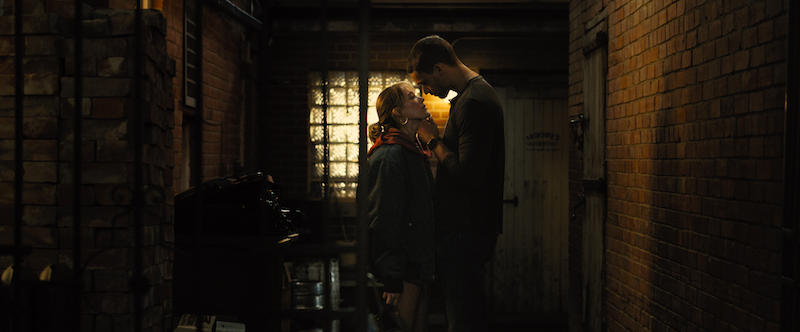
Kenna’s path toward redemption takes a more complicated turn when she grows close to Ledger (Tyriq Withers), Scott’s best friend and a former NFL player turned local bar owner. What begins as an unlikely friendship gradually develops into a secret romance, one that places both characters in emotional jeopardy and pushes the film toward its inevitable questions of heartbreak, forgiveness, and second chances.
With a title like “Reminders of Him,” Scott’s memory should carry a certain specificity, one felt not only by the characters but by the audience as well. While the film succeeds in conveying that reverence among those still mourning him, it is less convincing in making Scott feel fully present to the viewer.
Instead, “Reminders of Him” treats Scott less as a realized person than as a sentimental ideal. Characters speak of Scotty with the kind of reverence usually reserved for the perfect son, best friend, and soulmate. Kenna herself calls him “your perfect boy,” while the narrative positions his death as the moral and emotional axis around which every other character revolves.
Scott exists less as a character than as a narrative catalyst. His death fuels nearly every conflict in the film. There’s the obvious Kenna’s guilt and prison sentence, then his parents’ refusal to let her near Diem to add obstacles for Kenna, and Ledger’s internal struggle between loyalty to his best friend and compassion for the woman who loved him to give some narrative complexity. The film offers occasional anecdotes meant to humanize him, including stories about their first kiss, shared jokes, and plans for a future that never arrived. Yet these fragments function less as a portrait of Scott himself and more as emotional shorthand for the grief surrounding him. What emerges is a character whose absence is meant to feel monumental, even as the person he was remains frustratingly indistinct.
The irony is that while Scotty remains more idea than person, Kenna is given almost too much explanation. Through confession scenes, composition-book letters, and emotional monologues, “Reminders of Him” keeps circling her guilt, her prison sentence, and her longing for the daughter she barely knows. Rather than letting those feelings accumulate naturally, the script repeatedly stops to spell them out for the audience as if they aren’t allowed to process her grief through sights and sounds.
Monroe, to her credit, finds more depth in Kenna than the screenplay does. In quieter moments, she suggests a woman worn down by grief and self-recrimination, someone whose guilt has forged her identity.
The same issue carries over to Ledger, who is one of the few characters positioned to see Kenna outside the framework that society has cast upon her. Where others like Scott’s parents, the law, and others inside of Scott’s circle want her reduced to a villain, Ledger at least recognizes that her existence in this story is far more complicated than that. That should give the character real dramatic weight. Once he realizes who she is, his interest in her should become tangled up in grief, loyalty, and the discomfort of questioning what everyone around him has chosen to believe.

Ledger protects Diem at all costs and has largely taken on the role of her quiet guardian, watching Kenna with the suspicion of someone determined not to let the past repeat itself. He even follows Kenna back to her motel, less out of hostility than a need to understand what kind of person has returned to town claiming redemption. Yet his certainty begins to waver in small and unexpected ways, particularly when he sees how Kenna interacts with Lady (Monika Myers), a young girl with Down syndrome who refuses to treat Kenna like the monster everyone else insists she must be. Lady’s blunt question to Ledger about whether he is the one keeping Diem away from her cuts through the town’s moral certainty with surprising clarity. When he admits that he is, her immediate response is to call him a jerk, a moment the film plays for humor but one that quietly exposes the fragility of the black-and-white judgment Ledger has been trying to maintain.
This working-class texture is one of the film’s more grounded instincts. The bars, supermarkets, modest houses, wide shots of the heartland Wyoming, even though the film was shot in Calgary, Alberta, Canada, and unfinished home give “Reminders of Him” the feel of a blue-collar melodrama rather than a glossy romance.
What also quietly separates Kenna from the rest of the characters is how differently grief is allowed to exist in their lives. Kenna’s return to town is defined by survival. She sleeps in a motel, struggles to afford basic furniture, and works multiple jobs just to stay afloat. Scotty’s parents, by contrast, mourn from the stability of a comfortable home and a tight-knit community that protects their version of events. Ledger sits somewhere between those worlds, running his bar and slowly building a house of his own. The film presents all of them as participants in the same emotional tragedy, but the material reality surrounding that grief is far from equal.
Kenna’s redemption is measured not just through remorse, but through visible hardship and moral discipline. The film frequently frames her isolation and poverty as evidence that she has “paid enough,” using images of bare apartments, long walks in the rain, and late-night shifts to signal her suffering. Yet those visual cues risk turning the structural difficulties of rebuilding life after prison into little more than sentimental scenery. As the film progresses, Kenna’s bare motel room starts to look like an actual home where she can sleep on an inflated mattress instead of the couch. A plastic milk crate serves as a coffee table. She has clothes in the closet.
Scott’s parents represent the film’s most uncompromising form of grief. Grace and Patrick have built their lives around protecting the memory of their son by keeping Kenna at a distance. In doing so, they become the guardians of the town’s moral certainty. Their fear that Kenna might one day take Diem away from them gives the story the stakes it needs, but the film rarely allows them to exist beyond that role. They are not framed as villains so much as people grieving the loss of their son.
The script itself is serviceable but rarely surprising. Much of it follows the familiar rhythms of contemporary romance melodrama, moving its characters from confession to confrontation with little room for ambiguity in between. The cast does what it can within those narrative parameters. Those restrictions make it feel as though it is working against a screenplay that feels more assembled from genre expectations than discovered through lived emotion.
For what it is worth, “Reminders of Him” is not without its sincere intentions. It clearly wants to be a story about grief, accountability, and the possibility of forgiveness. But sincerity alone does not guarantee emotional truth. Sure, Kenna’s arc has that emotional payoff, but it feels like the characters have to repeat certain beats in order to get there.
6/10