The “Toy Story” franchise has always understood that even as technology evolves and childhood changes, a child’s need for imagination, companionship, and play remains the same. It is the kind of series that seemed like it should have ended with its third film, only for each new installment to remind us why these toys still matter. So it makes sense that “Toy Story 5” reflects the world children are growing up in now, where the battle between toys and technology is not as simple as it first appears.
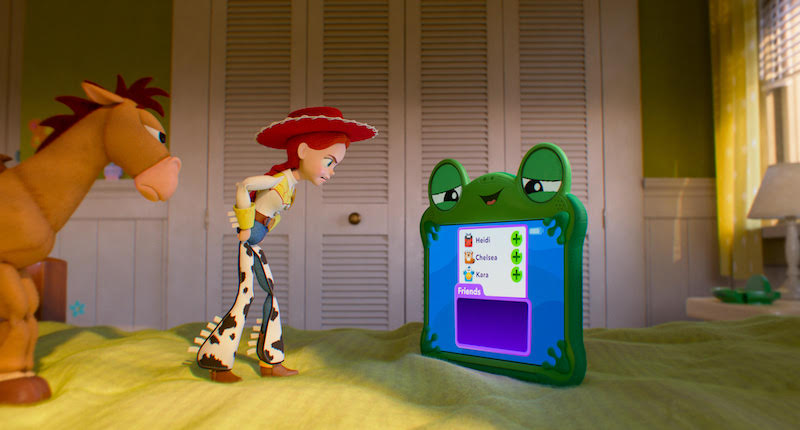
(L-R): Bullseye, Jessie, and Lilypad in Disney and Pixar’s TOY STORY 5. Photo courtesy of Pixar. © 2026 Disney/Pixar. All Rights Reserved.
“Toy Story 5” follows Jessie (Joan Cusack) who has now assumed the role of Sheriff of Bonnie’s room. Taking the lessons that she’s learned from Woody (Tom Hanks), all the while patiently waiting for Buzz Lightyear (Tim Allen) to muster the courage to share his feelings, Jessie is about to experience a generational shift as toys meet tech.
Where television once pulled a child’s attention away from toys, and growing up brought new interests like sports or nail polish, Jessie now has to contend with Lilypad (Greta Lee), a smart device designed to help its users connect with others. To Bonnie, Lilypad may seem like a way to make friends. To the toys, however, she represents a disruption that could take over Bonnie’s playtime at an age when peer connection is becoming central to her social development.
While the films have often centered on Woody and Buzz, “Toy Story 5” shifts its attention to Jessie as she navigates a world where toys and technology are competing for a child’s attention. She may not have all the answers, and neither does Woody, but that uncertainty becomes part of her journey. Jessie has to discover not only what her purpose is as Bonnie’s sheriff, but what it means for any toy to matter when a child’s world begins to change.
Lee’s Lilypad is voiced with a chipper confidence that makes the device both funny and unsettling. The smart device is not presented as a simple villain. She is designed to help Bonnie connect with others, but her idea of connection is built around group chats, friend requests, games, and data points. To Lilypad, friendship is something that can be optimized. To Jessie, it looks like Bonnie is slipping further away from the kind of imaginative play that once made toys feel essential.
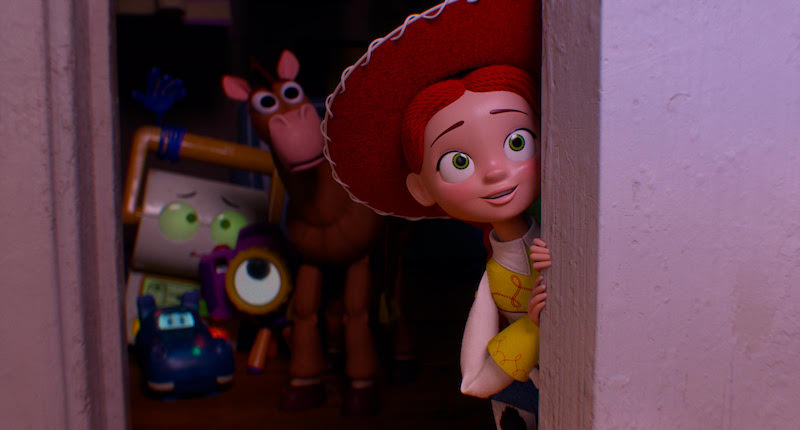
(L-R): Smarty Pants, Atlas, Snappy, Bullseye, and Jessie in Disney and Pixar’s TOY STORY 5. Photo courtesy of Pixar. © 2026 Disney/Pixar. All Rights Reserved.
That is what gives the conflict its emotional weight. Jessie is not only worried that Bonnie is spending too much time with a screen. She has already lived through the pain of being loved, forgotten, and left behind. Watching Bonnie become attached to Lilypad brings those old wounds back to the surface, forcing Jessie to confront the possibility that being a good toy may no longer mean being played with every day.
That fear follows Jessie, whose determination to separate Lilypad from Bonnie leads to a series of misfortunes that brings her back to the house where Emily once lived. Now owned by a new family, the home places Jessie in the hands of Blaze, a young girl who still understands the value of imaginative play. But Blaze has also experienced the disappointment of technology when a friend cancels a playdate over chat instead of telling her in person.
Blaze becomes an important counterpoint to Bonnie because she shows that technology and imagination do not have to cancel each other out. She understands the disappointment that can come from digital communication, but she still finds joy in animals, toys, and the worlds that play can create. That idea also extends to her tech-friendly toys. Smarty Pants (Conan O’Brien) is a fussy and hilariously pedantic toilet-training toy, Atlas (Craig Robinson) is a mellow GPS navigator, and Snappy (Shelby Rabara) is a bright and eager camera. They may be connected devices, but they also miss the days when they were part of a child’s playtime instead of being pushed aside by smarter, sleeker screens. Through them, Jessie begins to see that the problem is not technology itself, but the way it can turn friendship into messages, notifications, and quick responses instead of real presence.
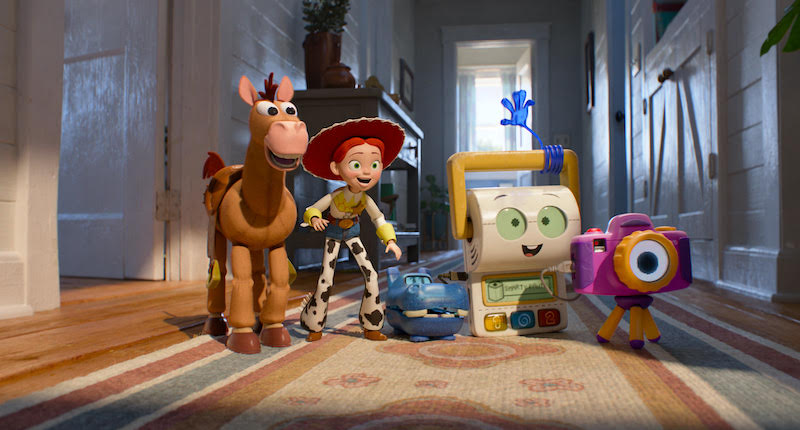
(L-R): Bullseye, Jessie, Atlas, Smarty Pants, and Snappy in Disney and Pixar’s TOY STORY 5. Photo courtesy of Pixar. © 2026 Disney/Pixar. All Rights Reserved.
“Toy Story 5” may set itself up as a simple toys-versus-tech story, but there is more nuance to it than that. Part of what makes Lilypad funny is that, for all her intelligence and access to Bonnie’s connected home, she is still limited by something as basic as battery life. She can communicate with other smart devices and manipulate the adults around her, but she cannot plug herself back in once the toys take away her power source. Smarty Pants works in a similar way. When his battery runs low, he behaves like a drunken piece of obsolete tech, becoming laggy, overdramatic, and weirdly unfiltered as his sputtering reboots send him careening between self-pity and grandstanding.
While O’Brien’s Smarty Pants threatens to steal the film, “Toy Story 5’s” strongest material still belongs to Jessie. Returning to Emily’s house forces her to confront the part of herself that never fully healed after being left behind. The home no longer belongs to the child she remembers, but traces of that old life are still there. Every familiar detail reminds Jessie that she was once deeply loved before she was eventually outgrown. Her journey comes full circle when she revisits a tire swing connected to her memories of Emily, giving her a moment of closure that feels genuinely earned. If you have been following Jessie since her debut, it is hard not to feel that one.
That moment also reframes Jessie’s relationship with Bonnie. For most of the film, Jessie treats Lilypad as something she has to defeat in order to keep Bonnie close. But Emily’s house reminds her that a child changing does not erase the love that came before. Jessie begins to understand that her purpose is not to stop Bonnie from growing up or to prove that toys are better than technology. Her purpose is to be there when Bonnie needs her, even if that need looks different than it once did.
That idea comes through beautifully in the film’s playtime sequences. When Bonnie stages a wedding between Forky (Tony Hale) and Karen Beverly (Melissa Villaseñor), or when Blaze sends her toys on a spy mission, the animation shifts between the children playing in the real world and the larger, more stylized adventures the toys experience. Those scenes capture what “Toy Story” has always done best. It shows how a simple game can become an entire world when a child gives it meaning.
“Toy Story 5” is not afraid to acknowledge that technology can be useful when it is handled with care and responsibility. Lily Pad is not really a villain. She is an earnest little algorithm who genuinely wants Bonnie to belong. She can send friend requests in seconds, pull Bonnie into group chats, and make social connection feel easier at an age when fitting in starts to matter more. But the film is clear about her blind spots. Lily Pad reduces friendship to pings, metrics, and screen time, confusing constant contact with genuine closeness. She also becomes the tool that allows Bonnie’s classmates to mock her online, not because she means to hurt Bonnie, but because she cannot understand the emotional weight of the messages she delivers. The problem is not that Lily Pad exists. It is that her version of connection starts to crowd out the slower, messier, in-person play that Jessie is trying so hard to protect.
The film is not always as clean as Jessie’s emotional arc. Like many late-franchise sequels, “Toy Story 5” has a lot of characters and subplots to service. Woody’s return brings some welcome nostalgia, while Buzz’s storyline gives the film its broader comedy, but both occasionally pull attention away from Jessie and Lilypad’s more compelling conflict. The new Buzz Lightyear toys add energy and laughs, yet they also make the film feel busier than it needs to be. Whenever the story returns to Jessie, Bonnie, Blaze, and Lilypad, it is much easier to see why this sequel exists.
That focus is strengthened by Cusack’s voice performance, which gives Jessie both her familiar toughness and a more fragile emotional edge. She still has the confidence of Bonnie’s sheriff, but Cusack lets the fear underneath come through whenever Jessie realizes she may be losing another child. Lee is equally strong as Lilypad, giving the device a relentlessly cheerful certainty that makes her funny, helpful, and unsettling all at once. She never plays Lilypad as evil, which is what makes the character work.
Even when its subplots crowd the story, “Toy Story 5” finds an emotional reason to bring these characters back. By centering Jessie, the film revisits the franchise’s fear of being outgrown through someone who has carried that pain for years. Its message about technology may be obvious at times, but it is not as simple as “screens are bad.” What matters is whether technology helps children connect or keeps them from the imagination, presence, and play they still need. Five films in, these toys still have something meaningful to say about growing up and knowing when to let go.