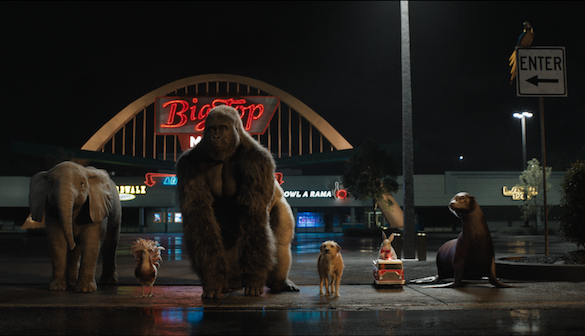
Pixar’s “Hoppers” doesn’t shy away from the harsh honesty of devoted advocacy. Growing up, children are often sold a romantic story about caring deeply. Work hard, speak up, fight for what’s right, and the world will reward you. But real life is far less cinematic. Caring does not guarantee change. Sometimes it only guarantees exhaustion. For those who devote themselves to causes larger than their own lives, the fight can begin to feel endless, even unwinnable. Yet even in those moments, when the battle feels impossibly uphill, empathy remains one of the few forces that refuses to burn out.
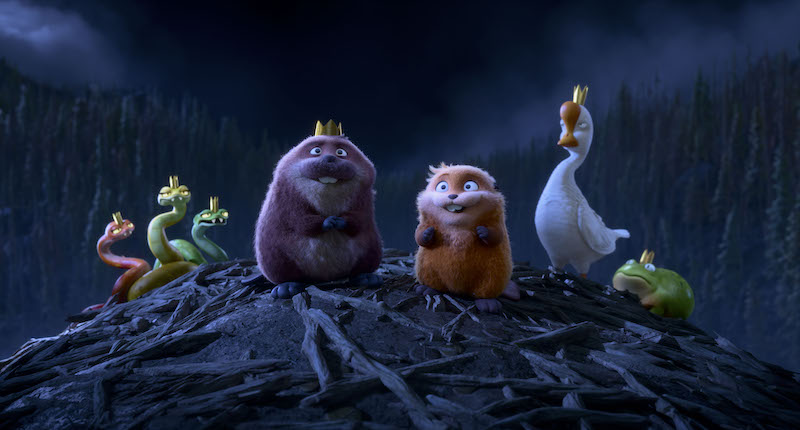
A scene from Disney and Pixar’s HOPPERS. Photo courtesy of Pixar. © 2026 Disney/Pixar. All Rights Reserved.
Mabel Tanaka (Piper Curda), a 19-year-old environmental activist at the heart of “Hoppers, is fiercely devoted to protecting the Glade she grew up loving. She is taught about enviromental activism from her grandmother who taught her about the importance of the glades and how Mabel can be a protector of animals and nature through different methods that doesn’t require biting. Mabel believes that urgency is a virtue. If something is wrong, you fix it. If a system is unjust, you confront it. If a highway threatens your sanctuary, you stand in its path.
When she takes that leap, “Hoppers” turns the concept of activism into something literal. Mabel enters the Glade not as a visitor, but as a part of the wildlife, forced to navigate its “Pond Rules,” 80s rock rhythms, and social hierarchies from the inside. The film mines plenty of comedy from the sheer awkwardness of her new form, but the bigger idea is sharper. In this world, influence does not come from being the loudest voice. It comes from learning how to move with others without flattening them in the process.
That is where King George (Bobby Moynihan) comes in. The pond’s self-appointed ruler is all charisma and communal cheer, a leader who believes harmony is something you practice, not something you demand. His pond rules may sound silly at first, but they function like a survival philosophy, an insistence that community is built through small, repeated acts of care rather than grand gestures. For Mabel, who is used to confrontation, George becomes an unexpectedly gentle counterweight, pushing her to consider whether urgency alone is enough to create meaningful change.
And this is where “Hoppers” quietly separates itself from being simply a message movie. Pixar has told stories about big emotions before, but “Hoppers” is unusually direct about the emotional math of advocacy, the way grief can harden into rage, and the way rage can begin to consume everything else you are. It understands the seduction of escalation, the feeling that if you just push harder, sacrifice more, and burn brighter, the world will finally listen. The film’s wisdom lies in recognizing what that approach builds, what it breaks, and what it costs.
But “Hoppers” does not make that recognition easy. As Mabel pushes forward, her influence stretches beyond intention. Words meant to rally begin to polarize. Calls for unity ripple outward into strategies that feel increasingly volatile. The animals respond not only to her conviction, but to the urgency beneath it. What begins as protection risks mutating into something closer to retaliation. The film is careful not to villainize her passion, yet it refuses to romanticize it either.
That widening scope introduces a broader cross-section of the Glade’s leadership, each with their own instincts for survival. The humor remains buoyant, with misunderstandings escalating into spectacle, but the comedy carries a tension beneath the surface. “Hoppers” understands that movements can spiral, especially when fueled by righteous anger. It asks a difficult question without turning it into a lecture: when urgency becomes the dominant language, who ultimately pays the price?
Visually, the film balances that tension with tactile warmth. The Glade feels textured and alive, mossy and kinetic, full of motion that mirrors Mabel’s restless drive. The physical comedy of her new form keeps the story buoyant even when the stakes darken. Pixar’s animation team once again proves adept at pairing softness with sharpness, building a world that feels safe enough for humor yet fragile enough for loss.
In the end, “Hoppers” is less concerned with whether Mabel wins than with whether she learns how to keep caring without letting the fight hollow her out. Devotion alone is not enough. Neither is anger. The film suggests that empathy may be the quiet discipline that keeps people from giving up when the battle feels unwinnable. The world may not reward advocacy in cinematic ways, but it can respond to those who keep choosing understanding over escalation. “Hoppers” understands that caring deeply is not a weakness. It is endurance.
10/10