“In Your Dreams” examines how kids process life-changing events like their parents divorcing and the complicated emotions that follow. Alex Woo’s directorial debut is as stunning visually as it is emotionally resonant, and in a landscape crowded with animated releases, this Netflix film stands out for portraying a biracial family with honesty and warmth. Rather than treating identity or separation as a “very special episode,” the movie folds those realities into a candy-colored, fast-moving dream adventure that respects how children actually feel and think.

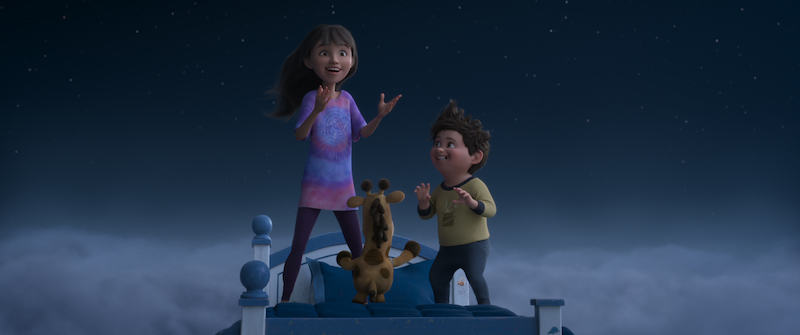
From its opening beats, “In Your Dreams” moves with the quicksilver energy of a child’s inner world. Stevie (Jolie Hoang-Rappaport) and Elliot (Elias Janssen) are siblings living what feels like a charmed life. As the eldest, Stevie adores her music-loving parents. Mom (Cristin Milioti) teaches music to students who somehow do not know who Prince is, and Dad (Simu Liu) is a stay-at-home father still nurturing the dream of finishing the album he and his wife once started. From the kids’ point of view, everything seems perfectly fine.
That is until, one night, Stevie is wakes up to hear her parents argue about their current living situtation. Mom wants to take a job as an associate professor, which means having to move to Duluth. While it would mean more money, living in a bigger home, and the kids going to a better school, Dad believes their life belongs where they are now and that taking a job would mean giving up on their dreams of making their album. Stevie sensing that the two are drifting apart makes attempts to help them make amends by cooking them breakfast, a family pastime.
However, it’s not enough. So when Mom leaves for the interview, it is up to Stevie to hold down the fort. As she helps her annoying brother, who thinks a C grade is perfectly acceptable, on his report, they come across a book about the legendary Sandman who is said that if you are able to get past the nightmares and stay awake long enough, he will make your dreams come true. With that, the two embark on an adventure of a nighttime.
Visually, “In Your Dreams” is a feast. Woo and the animation team layer saturated palettes, fluid movement, and inventive transitions that feel like a child’s imagination splashed across the screen. Set pieces glide and morph without losing clarity, the kind of confident design that keeps a fast pace from devolving into noise. Dreams becoming nightmares are fluid instead of jarring as it eases into the transitions without it being overly complicated. The look is playful but polished and sometimes scary with Breakfast Town looking sweet with its sugary and savory times, as well as a ball pit river riffing off “it’s a small word” then turning into something you’d take up from with those same breakfast foods turning gross and moldy and the ballpit river becoming that resembles hell but for kids.
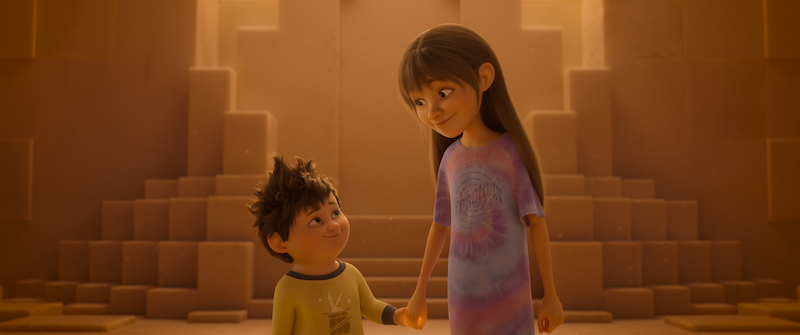
And when they finally arrive at the Sandman’s castle, it’s something that looks inspired by an MC Escher piece. The entire architecture defies gravity, and little cute grains of sand helping to build it. Meanwhile, Nightmara’s appearance is a cross of a violent storm and a phantom, but it is her final reveal that helps understand her purpose in the film. Families looking for a beautiful Netflix animated film will find plenty to savor in the craft alone.
The vocal performances amplify the film’s tonal agility. The kids sound spontaneous and grounded, the Sandman and Nightmara pair swing toward theatrical highs, and while the conversations about parents discussing the idea of moving to a new home or even splitting up resonates because its grounded in a reality. While those contrasts help “In Your Dreams” balance out the film, it can be a bit off because that same tonal agility and range tends to be more skewed towards a younger audience. The dialogue isn’t nearly as sharp as it would be and the pacing can rush past moments that might have benefitted from breath and nuance.
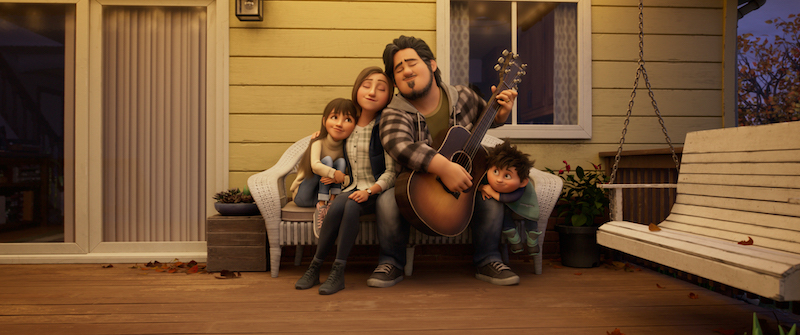
One of the movie’s most meaningful strengths is its biracial family representation. It’s neither tokenized nor ignored; it simply is. Cultural identity informs the family’s lived reality without consuming the plot, which is a relief and a rarity. For viewers searching for representation, “In Your Dreams'” spotlighting a biracial this is exactly the kind of textured, day-to-day authenticity that resonates because it whose who are of a biracial identity to see themselves in the characters on screen without having that narrative be the central focus. Rather, it features biracial kids in the leading role learning about resilience and love.
If there’s a caveat, it’s that the film sometimes arrives at emotional comfort a beat faster than life typically allows. But the swiftness feels intentional. “In Your Dreams” is designed as a bridge to help families to talk about change in ways that are accessible to kids who do not have the emotional complexities to comprhend what their parents are going through. It’s not a definitive diagnosis of how to survive it. The movie names fear without magnifying trauma, treats fantasy as a coping tool rather than an escape hatch, and suggests that love can stretch without snapping. For parents and kids who will debrief afterward, that design choice is a feature, not a flaw.
As an animated feature for families on Netflix, “In Your Dreams” delivers the rare combination of kinetic fun and genuine insight. It’s bright and breathless when it should be, gentle when it needs to be, and honest throughout. Woo’s debut uses the language of dreams to make the reality of divorce discussable by modeling empathy, curiosity, and courage into the narrative. At the same time, his directorial debut honors biracial family life as a lived truth, not a plot device, and treats children’s emotions with the seriousness they deserve while also showing that these situations affects all families.
7.5/10