There are plenty of ways to tell a story about grief, but being swallowed by a sperm whale certainly isn’t a conventional approach. Yet that’s the premise behind Brian Duffield’s “Whalefall,” a claustrophobic survival thriller that dives into the depths of grief and estrangement and contains an emotional father-son story beneath its terrifying premise.
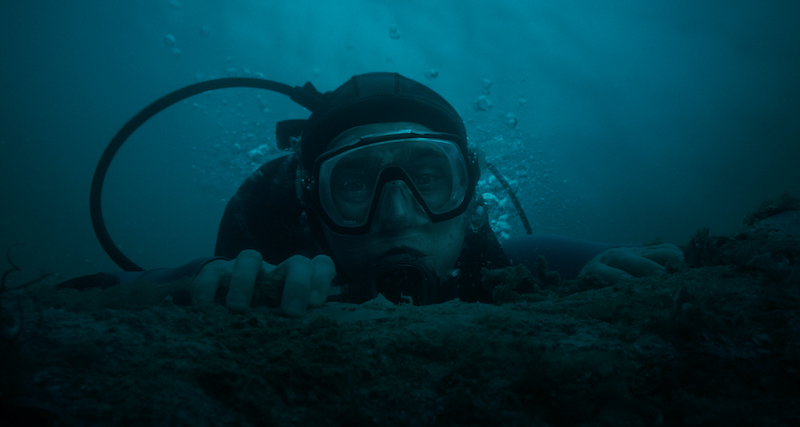
Austin Abrams as Jay Gardiner in 20th Century Studios’ WHALEFALL. © 2026 20th Century Studios. All Rights Reserved.
Based on Daniel Kraus’ novel of the same name, the film pairs son’s desperate fight for survival with the emotional weight of unresolved family trauma.
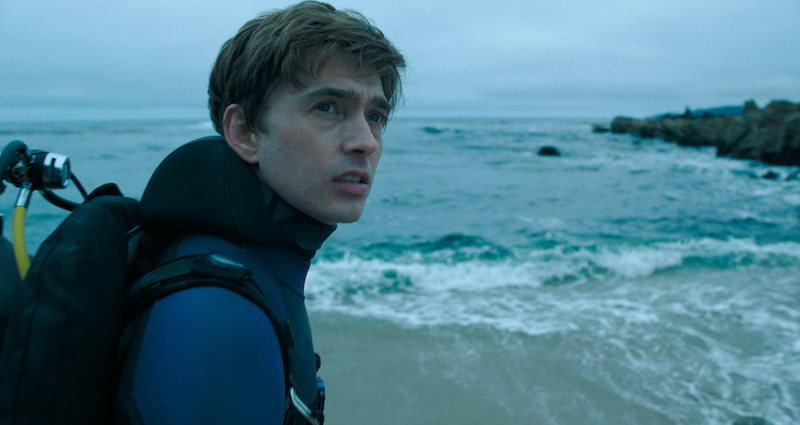
“Whalefall” centers on Jay Gardiner (Austin Abrams), a young man trying to cope with the death of his estranged father, Mitt (Josh Brolin). Their relationship was marked by years of conflict, resentment, and expectations Jay felt he could never meet. However, it is also where past lessons become essential to surviving the present and finding closure for the future.
Duffield first shows Jay in a quiet overhead shot, sitting in a car outside a cemetery with his eyes closed, waiting for his mother to come back from Mitt’s grave. This calm moment shows Jay’s emotional distance and the grief he hasn’t faced yet. Looking for closure, Jay heads back to the waters off California’s central coast to search for his father’s remains.
But Jay’s personal quest quickly turns terrifying when he is swallowed by a huge sperm whale. Stuck inside the whale’s digestive system with only about an hour of oxygen left, he has to figure out how to escape before he runs out of air. With few resources and barely any space, Jay must use the diving skills his father taught him, even as memories of their difficult relationship come back.
Looking for closure, Jay goes back to Monterey Bay and Monastery Beach in Monterey County, California, hoping to find his father’s remains. But his search takes a shocking turn when a giant sperm whale swallows him. Trapped inside with only about an hour of oxygen, Jay must escape before his air runs out. With few tools and little space, he has to depend on the diving lessons his father gave him, even as memories of their strained relationship return.
Duffield, who co-wrote the screenplay with Kraus, turns this unusual survival story into something personal, set in one of the harshest places imaginable. Most of “Whalefall” happens inside the whale’s stomach, where cinematographer Aaron Morton and production designer Ramsey Avery create a tight, claustrophobic setting. The glowing, fleshy walls, tight spaces, and constant movement make Jay’s situation feel suffocating, with no clear way out and no idea what might be ahead. The whale’s size doesn’t help, since almost every part of Jay’s surroundings is dangerous, especially as the walls keep shifting and pushing him deeper inside.
A significant A big part of the film’s impact comes from its production design and practical effects, which make the inside of the whale feel real. Instead of using only computer effects, the filmmakers built moving sets to show the whale’s internal movements. This creates an environment that feels strangely alive, with pulsing walls, shifting surfaces, and water that always moves around Jay. It’s unsettling how the whale’s digestive system works on its own, not caring that Jay is there. The whale isn’t trying to hurt him. It’s just acting like any animal would. That lack of awareness makes Jay’s situation even scarier and as such the dangers become increasingly apparent as Jay attempts to navigate the whale’s stomach chambers.
One of the film’s more disturbing developments involves his movement into another compartment, where digestive acids are breaking down the remains of the whale’s previous meals, like the giant octopus that latched on to him before it was swallowed. It’s a particularly unpleasant reminder that Jay isn’t simply trapped inside a living creature alone. He’s caught in a digestive process that continues whether he survives. As such, the environment becomes as much of an obstacle as his dwindling oxygen supply, turning every attempt to move forward into another potentially fatal decision.
Jay’s limited oxygen adds to the tension, as he keeps checking his tank’s pressure gauge, reminding us how little time he has left. But running out of air isn’t his only problem. As he moves through the whale, he suffers a broken rib, a hand injury from the octopus’s beak, and a broken leg.
Jay’s fight with the octopus is especially intense. He has to fend off the creature while trying to move through the whale’s tight spaces. With barely any room, every action takes effort and uses up oxygen he can’t spare. As his injuries add up and the dangers grow, Jay’s own body becomes as much of a challenge as the whale itself.
The film’s sound design adds to the tension, playing a big part in keeping the suspense high. We hear Jay’s breathing through his regulator, water moving, and strange noises from the whale’s body, all of which make us constantly aware of his situation. Even the whale’s heartbeat is part of the experience, reminding us that Jay is inside a living creature. These details work best when the film lets the environment speak for itself, using sounds and visuals instead of dialogue to show the danger. This immersive sound makes “Whalefall” a great fit for a Dolby Cinema.
But “Whalefall” isn’t just about facing danger after danger. Through flashbacks, Duffield slowly shows us the relationship between Jay and Mitt, which gives the survival story its emotional core. Mitt is a strict father who loves the ocean and values discipline, shaping much of Jay’s childhood. For Mitt, diving is a way of life, not just a hobby, and he wants Jay to learn everything about it. But his efforts to teach Jay often lead to conflict, especially as Jay starts to follow his own dreams instead of the path his father wants for him.
Brolin’s performance is key here. He plays Mitt as a flawed father whose demanding and controlling ways make it hard for Jay to find his own independence. Mitt is stubborn, especially when he thinks his life experience should be enough to guide Jay. But under his tough exterior, he’s facing his own mortality and the fear that his relationship with Jay may never be what he wants. As such, Brolin shows this complexity, letting us see the love behind Mitt’s actions while also making it clear why Jay feels pushed away.
Abrams is just as important to the film, carrying much of it with a physically demanding role. Since Jay spends much of the movie alone inside the whale, Abrams has to show his fear, exhaustion, and desperation without saying much. He’s especially good in the quiet moments, when Jay is figuring out what to do next and trying to save his oxygen. As Jay’s injuries get worse and his air runs low, Abrams shows how hard even simple movements become. Underneath all this, he also shows the emotional weight of someone who has tried to escape his father’s influence, only to realize how much it still affects him.
The conflict between a son and his father is what makes the film emotionally compelling. For Jay, he has spent years trying to get away from his father’s expectations, and yet, his desire to find his father’s remains and turns a near-fatal death into an opportunity to rely on everything Mitt taught him to survive. The lessons about breathing, equipment, and handling danger, which once felt controlling, now become his lifeline. What Jay used to resent is now what keeps him alive, making him rethink his father’s intentions and how they shaped him.
As the story goes on, Jay’s fight to survive becomes more personal when he forms an unexpected bond with the whale that swallowed him. This connection grows deeper when a pod of orcas attacks the whale. Duffield uses sonar-like visuals to show the dark ocean depths and the danger the whale faces as it tries to protect itself.
The supporting cast includes Elisabeth Shue, Jane Levy, Emily Rudd, and John Ortiz. They help show the relationships and community around the Gardiner family. These scenes make it clear that Mitt’s problems with Jay weren’t about a lack of love, but about not knowing how to be the father Jay needed. Even as Mitt’s health gets worse, he hopes for another chance to reconnect. Meanwhile, Jay finds it hard to face his father’s coming death and pulls away. In the end, the emotional focus is on Abrams and Brolin, whose characters are separated by death but still linked by memories, unresolved issues, and their shared love of diving.
This unresolved relationship becomes even more meaningful when orcas attack the sperm whale. In a dreamlike moment, the whale seems to take on his father’s spirit, letting Jay talk to Mitt in a way he never could before. Jay begs the whale to call for help, but Mitt’s voice answers with sadness, thinking no one will come and he isn’t worth saving. This scene is especially emotional because Jay’s pleas are about more than survival—they’re about facing his guilt and regret over his father’s death. When Jay urges the whale to call for its family and promises to be there, it mirrors his own struggle to be present for Mitt at the end. When other sperm whales come to help, it highlights how important it is to accept help from loved ones, something both Jay and Mitt found difficult.
Duffield uses flashbacks to show how hard it is to reconnect after years apart. Jay remembers a father who was often overbearing, even when he thought he was helping. Mitt wants to protect Jay, but struggles to let him make his own choices. At the same time, Jay’s need to find his own path puts him at odds with the person who shaped him most. Both sides have their reasons, making their relationship more complex than just a stubborn father and a rebellious son.
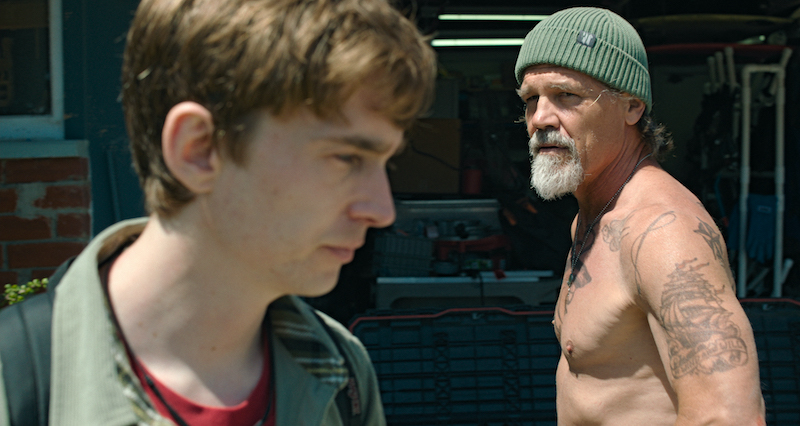
While the flashbacks break up the action inside the whale, they help explain why Jay’s situation feels so desperate. The film shifts between his fight to survive and his emotional struggle with the past, slowly tying them together. Sometimes the father-son drama takes center stage over the survival story, but this focus gives “Whalefall” more depth than just its unusual plot. The film is more interested in exploring how a parent’s influence lasts long after they’re gone than in just showing one challenge after another.
The film’s environmental themes add another layer to the story. In Jay’s memories, Mitt talks about marine life, the ocean’s fragile ecosystems, and how people relate to nature. These talks show his love for diving, but they also introduce the idea of death and renewal. And the film goes as far as to getting Mitt to explain what a whalefall is, which directly ties into the film’s themes and way of life. A whale fall happens when a dead whale sinks to the ocean floor, feeding other creatures and supporting life long after it’s gone. This natural process gives the film’s title a deeper meaning.
In many ways, this idea mirrors Jay’s relationship with his father. Even though Mitt is gone, the lessons, memories, and experiences he left behind still shape Jay’s life. Some of these are painful, filled with regret and resentment, but others give Jay the strength and knowledge to keep going. Death ends a life, but not a person’s influence. Just as a whale’s remains support new life, something meaningful can grow from what is left behind.
Despite its scary scenes and tense moments, “Whalefall’s” real strength is the human story at its heart. Duffield delivers a visually intense and physically challenging film, with strong production design, immersive sound, and a dedicated performance from Abrams. But it’s the complex relationship between Jay and Mitt, brought to life by Abrams and Brolin, that gives the movie its emotional depth.
9/10
WHALEFALL releases in theaters October 16, 2026.