

Will Gluck’s “One Night Only” is essentially The Purge reimagined as a romantic comedy, where instead of all crime being legal for one night, it is premarital sex. Or, perhaps more accurately, it is The Sex Purge.

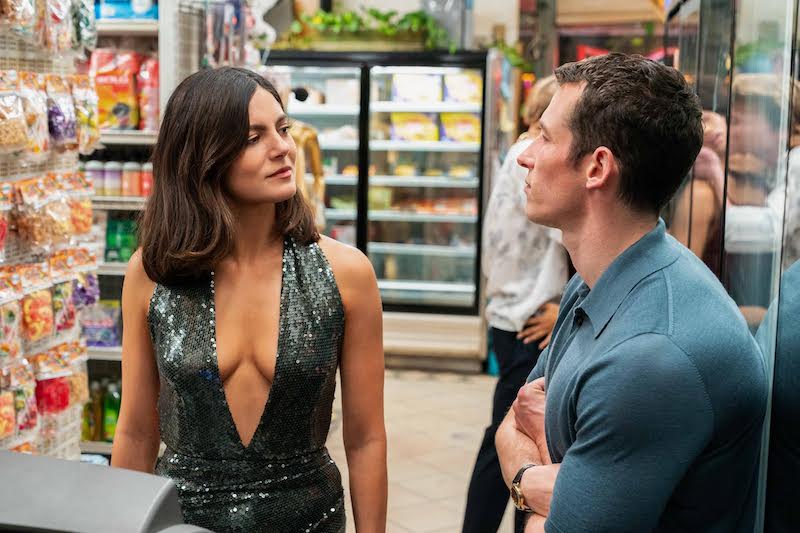
(From left) Allie (Monica Barbaro) and Owen (Callum Turner) in ONE NIGHT ONLY, directed by Will Gluck.
While the premise is absurd, the connections our two central characters forge over the film’s brisk 102-minute runtime are sincere. Gluck uses the outrageous setup, written by Travis Braun, not simply as an excuse for raunchy comedy, but as a way to explore the pressures, expectations, and emotional vulnerability that come with intimacy.
Set in a fictional version of New York City, “One Night Only” takes place in a society that has determined sex outside of marriage is simply too dangerous to remain legal. The mandate is sold to the public as both a moral restoration project and a public-health success story. Teen pregnancy numbers are down. STIs are also down. The numbers prove that for three years practicing abstinence for 364 days works.
The nation has gone so far as to retrofit every adult with a biosensor tattoo: green if you are married, red if you are not. The technology monitors hormonal activity and alerts the authorities when it detects that two unmarried people may be getting a little too close.
So when the one night arrives when premarital sex is legal, it is treated like New Year’s Eve for every unmarried person starved for physical intimacy. There are public countdowns, packed parties, and restaurants offering specials. To make matters even more complicated, the law requires everyone to use protection, turning condoms into the most sought-after item in the city and giving bodegas and pharmacies an excuse to price-gouge desperate customers.
On a night like this, you’d expect sex‑starved singles to be too busy hooking up to bother with feelings. But for recently dumped pizza parlor owner Owen (Callum Turner) and hopeful romantic Allie (Monica Barbaro), who is also an aspirational singer making by with recording pharmaceutical jingles, they might be the only two people in the city looking for more than just a quick encounter. Their first meeting is hardly romantic: Owen pukes an entire omakase he’d ordered for his now ex‑fiancée Malika (Maya Hawke) right in front of Allie. From there, the two fight over the last condom locked in a glass pyramid at a bodega, collide again at a precinct after Allie’s almost‑hookup with a restless and charmig bad boy biker named Max (Andrew Burnap) turns out to be a mandate‑breaking con man and Owen gets swept up in a honeypot sting, and finally crash into each other at exclusive party, where he slips her past the door and ends up playing hypeman as she’s pushed into a surprise “Only You” performance.
While this could have easily been a film about two attractive people racing against the clock to get laid, it is really a character-driven romance about choice, timing, and self-awareness. In a world obsessed with body counts, health metrics, and sexual surveillance, we become emotionally invested in Owen and Allie becoming a couple because their connection is not simply about finding someone before the night ends. It is about finding the right person at a moment when neither of them is entirely prepared for what that might mean. For Allie, it’s not so much about sex as it is about the build-up, and for Owen, it’s more about the afterglow.
Gluck also uses the absurdity of the mandate to stage some of the film’s best physical comedy. Owen and Allie’s desperation reaches a slapstick high at the bodega, where the last condom in New York is locked inside a glass pyramid like a cursed relic and priced at an outrageous $200. When neither can withdraw enough cash, Allie resorts to stealing the entire display. Even after they manage to break it open, neither is willing to give the condom to the other, so Allie suggests settling the matter with a coin toss. Naturally, it falls through a storm drain instead.
What follows is essentially a full-scale heist for the opportunity to have protected sex, with Owen prying open the grate and lowering Allie into the sewer by her legs to retrieve it. The sequence is broad, chaotic, and expertly committed to the ridiculousness of the premise, but it also strengthens their chemistry. Even while competing against each other, Owen and Allie are at their funniest and most compatible when forced to work together.
Even when there isn’t any physical comedy, the two are pitted against each other in ways that reveal a lot about their characters. The condom means something else for these two. For Owen, the condom is a race against time to prove that he isn’t rigid or stuck in a box post‑breakup. For Allie, she needs the condom because she may have a real connection with somebody.
So naturally, Owen questions what that real connection is. As a pizza parlor owner, Owen argues that having a real connection with someone means knowing what they order on their pizza. Allie immediately corrects him and says it is knowing how they take their coffee. Owen repeats her question. The exchange is quick, playful, and slightly combative, with each of them revealing more than they intend while pretending they are only challenging the other’s definition of romance.
That kind of back-and-forth allows Turner and Barbaro to create something genuine even when the film is not leaning on physical comedy. Their banter does more than generate jokes. It exposes Owen’s skepticism, Allie’s romantic idealism, and the growing possibility that each may understand the other better than the people they originally intended to spend the night with.
Together, Turner and Barbaro find the rhythm necessary to make Gluck’s heightened world feel emotionally grounded. Their chemistry is not built around immediate declarations or prolonged longing glances. It develops through arguments, interruptions, small observations, and the gradual realization that their sparring has become more intimate than either of their intended encounters. Even when Owen and Allie find dates, these dates end up having the two conveniently meeting each other again.
Allie questions Owen if he is following her, adding it is way too convenient they run into each other in a city this big. Of course, how these two meet may lead even the most skeptical to believe the universe is pushing these two together even though they constantly push each other away. For Allie, it’s meeting a con man, and for Owen, it’s falling for the honey trap. Even when they are working together to get into a party, Owen helps bring out Allie’s insecurities of performing live on stage. For Allie, she helps Owen realize that he isn’t the wounded man that he makes himself out to be. Instead, Allie represents s something he hasn’t imagined for himself yet.
The film is a commentary on dating culture, shaped by apps, ghosting, and the illusion that a better option is always one more swipe away. Its technology mostly remains in the background, but it quietly turns romance into something competitive, measurable, and disposable. That makes Owen and Allie’s connection stand out. Because even if they can’t find someone on the apps or their potential hookups turn out to be less than desired, they still manage to end up together. So, instead of choosing each other from an endless catalog of profiles, some of which have photos of Glen Powell or Sydney Sweeney, they gradually form a bond through time, conversation, conflict, and the kind of unexpected vulnerability no algorithm can predict.
The film’s commitment to Owen and Allie does mean that its larger dystopian world remains more amusing than fully developed. The mandate raises countless questions about marriage, privacy, power, and who profits from regulating intimacy, but Gluck is generally more interested in using those ideas as fuel for jokes than following them to their darkest conclusions. The coincidences repeatedly bringing Owen and Allie together can also feel overly convenient, even by romantic-comedy standards. Still, Turner and Barbaro are charming enough to make each collision feel less like a narrative shortcut and more like the universe becoming increasingly impatient with them.
The supporting cast also gives Owen and Allie’s chaotic night a little more emotional and comedic texture. Molly Ringwald brings warmth and blunt honesty to Linda, Owen’s mother, who understands that he needs both sympathy and a push after his engagement falls apart. Her reminder that life will not stick to his plan, but that he still has to own his choices, speaks directly to Owen’s larger arc. LeVar Burton is an unexpectedly funny match for Ringwald as Linda’s devoted boyfriend Rick, an unwanted father figure whose sincerity is made even more amusing by how desperately Owen wants to know nothing about their sex life. Quintessa Swindell brings similar support to Allie as Arya, the practical best friend determined to stop her from hiding behind romantic expectations and actually take a chance on what she wants.
That willingness to prioritize emotional sincerity over airtight world-building ultimately works in the film’s favor. The film’s New York City setting isn’t quite as dystopian as the premise makes it out to be, but rather something that gives the story scale. These characters have to take taxis, Ubers, subways, private cars, and bikes to get to where they need to go. And the city is the embodiment of the romantic possibility. Given that there are only 12 hours for these characters to do the deed before the exemption ends, all inconvenient detours carry the weight of a ticking clock. Yet the enormous city also makes Owen and Allie’s repeated encounters feel increasingly meaningful.
While Gluck’s “One Night Only” delivers the raunchy jokes, physical comedy, and romantic coincidences the concept promises, Turner and Barbaro give the film its sincerity. Their chemistry is magnetic, and you cannot help but root for them, even while they are rooting against each other. Of course, that begins to change once they realize the thing they have been searching for all night may have been standing in front of them the entire time. That realization does not erase the absurdity surrounding them, but it gives the film an emotional payoff that feels earned.
Owen and Allie begin their night determined to prove something to themselves through other people. By the end, they are forced to admit that what they actually want has less to do with sex than with finding someone who makes them feel understood. So while “One Night Only” may sell itself as “The Sex Purge,” the romantic comedy is really about finding that real connection that knows what you like on your pizza and is willing to be the only one listening to you sing your heart out on stage.
9/10