
“Send Help” isn’t just a film about two plane crash survivors stranded on a remote island. It’s about an underappreciated strategist forced to survive alongside her toxic boss—the man who spent years dismissing her for being different and denying her a well-deserved promotion. The experience becomes something far more dangerous when there’s no HR department, no corporate hierarchy, and no rules left to protect him. Such is the brutal, darkly comic premise of Sam Raimi’s latest film.

The film centers on Linda Liddle (Rachel McAdams), a corporate strategist who has spent most of her career cleaning up other people’s messes, only to be dismissed as expendable when it comes time for recognition and reward. No one includes her in conversations or company get-togethers. So, when the workday ends, she returns to an apartment filled with survivalist manuals, a pet bird, and endless episodes of Survivor. It might look like a lonely life, but it’s also a quiet form of preparation—one that suggests Linda has been training for a moment she doesn’t yet know she’ll need.
One day, she’s introduced to Bradley Preston (Dylan O’Brien), a young corporate golden boy whose confidence far outweighs his competence and whose authority feels less earned than inherited. Raimi wastes little time establishing Bradley as insufferable, particularly in the way he treats Linda—not as a colleague, but as an accessory to his own ambition, someone useful but fundamentally beneath notice. Not only does he offer a promotion to his corporate bro, he also wants to send her to a satellite office far away from him and her tuna fish sandwich smell.
When Bradley invites Linda to join him and the rest of the definitions of toxic masculinity for a work trip, Linda sees it as an opportunity to prove why she deserves the promotion. But it turns out it’s more of a hostile work environment as the dudes laugh at Linda’s Survivor audition tape. That is when the plane crashes and strands Linda and Bradley on a remote island.
From there, “Send Help” becomes more than a survival thriller about two people versus the elements. As Linda’s competence turns into power and Bradley’s privilege turns into liability, the film shifts into something sharper and more morally queasy. See, the film has Linda as the one who is prepared to survive the harsh and unpredictable conditions. She knows how to build shelters, prepare food properly, what plants to avoid because they are poisonous, and what areas of the island to avoid because of the uneven terrain. More importantly, she knows that building a raft sounds easy, but using it to get off the island is the bigger challenge.
What makes the film work so well is that Raimi leans into the power dynamics. Since Bradley’s company rewards optics, he’s under the impression that hierarchy gives him permission to boss someone like Linda around—even on a remote island where there’s no chance of anyone finding them. There are no bros to lean on and no HR department to hide behind, yet he still acts as if titles apply. As such, he keeps throwing his weight around, demanding the impossible from Linda as if she’s still on his payroll.
So being on the island strips everything down to survival and who has the skills to actually function when the safety nets disappear. Out there, charisma and titles mean nothing. On the island, competence is the only power that matters, and Linda suddenly has more of it than Bradley can stand. Bradley doesn’t have the practical skills to survive on his own, but he is attentive and observant. The problem is that he can’t use those instincts productively—only defensively. He tries to weaponize whatever Linda teaches him, turning her warnings about poisonous plants and even the appearance of mysterious knives into tools for control, as if information alone can restore the authority he’s lost.
And yet, Damian Shannon and Mark Swift’s script complicates that power struggle by giving the audience reason to sympathize with both Linda and Bradley. After everything Linda endures under Bradley, her anger feels earned, and the film understands why she stands by her choices. She’s competent in more ways than one—practically, emotionally, and strategically. Bradley, meanwhile, is repeatedly given chances to redeem himself, even though he refuses the reality of the situation—he refuses to eat, can’t stand that Linda hasn’t built HELP signs, and whines about the shelter. The film lets us see flashes of self-awareness even as he keeps slipping back into entitlement.
It’s in those moments that “Send Help” becomes genuinely unsettling, because the film refuses to give you clean heroes or villains. You can understand Linda’s fury without endorsing every step she takes, and you can see Bradley’s vulnerability without excusing the damage he’s caused.
But Raimi’s sharpest move isn’t just fleshing out the power dynamic; it’s how he transforms corporate language into physical violence. On the island, the phrases Bradley once used to manage, belittle, and motivate Linda stop being metaphors and start becoming instructions. The corporate language was always about control—about shrinking people into roles, disciplining them into compliance, and punishing whatever doesn’t fit the company’s idea of “professional.” On the island, Linda turns the language that was used against her and belittle her around on Bradley.
“Send Help” finds ways for the characters to throw that language back at each other, transforming performance reviews, HR euphemisms, and history lessons into tools of humiliation, control, and punishment. This isn’t achieved through dialogue alone, but through Raimi’s graphic imagery—most pointedly when Linda speaks about “compliance” and invokes the idea of Egyptians “fixing” enslaved people to make them more obedient, turning corporate metaphors about managing workers into literal body horror.
Raimi reinforces that idea with body-horror imagery that isn’t limited to physical injury. The film slips into nightmare logic and grotesque hallucinations that externalize Linda’s guilt and paranoia, turning the island into a psychological prison as much as a literal one.
McAdams and O’Brien are the reason that moral unease lands instead of collapsing into caricature. McAdams makes Linda’s evolution feel believable, not like a character swap. She’s especially strong in Raimi’s tonal shifts, where a funny or tender beat can curdle into menace in the same breath. Her physical performance sells the survival skills as earned, and she keeps Linda morally complicated—part trauma, part calculation, with flashes of care that make the character unsettling rather than purely triumphant.
O’Brien plays Bradley as entitled and insecure rather than purely evil, which keeps the character human and uncomfortable to watch. He’s convincingly smug in the office, then gradually falls apart on the island as his “leader” persona collapses. That mix of cruelty and weakness makes him a strong foil for McAdams, and it’s what makes Linda’s rise feel both satisfying and morally queasy.
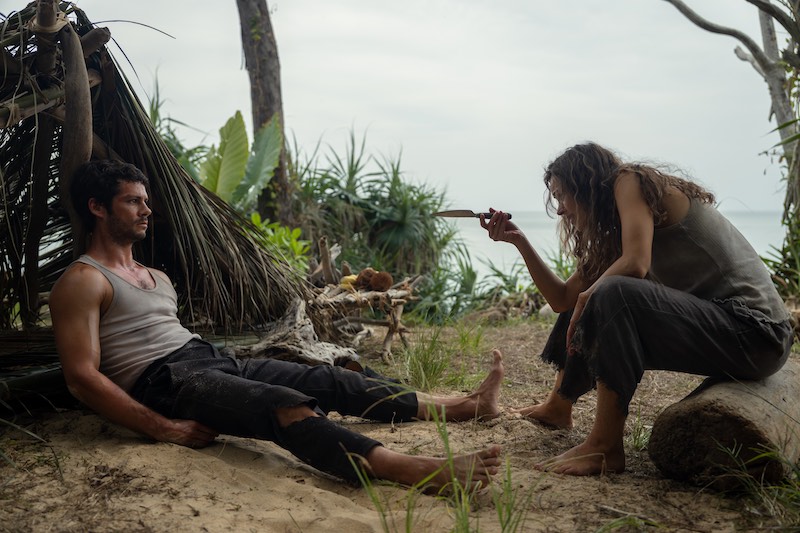
“Send Help’s” most disturbing achievement is how long it keeps the audience on Linda’s side. She lives up to her title as a strategist and planner. She calculates every move and builds in contingencies. And while she comes off as prepared, Raimi leaves enough room for new details—and increasingly extreme choices—to make your loyalty feel shaky. Bradley gets a version of that treatment too. He starts as an arrogant, privileged brat, but the script offers flashes of humanity that tempt you into believing he’s capable of growth—until entitlement snaps back into place. That pacing and unpredictability keep you constantly questioning who you should be siding with.
There’s enough body horror in “Send Help” to remind us this is Raimi, a story that weaponizes grotesque imagery the same way it weaponizes corporate language. The result is a nasty, funny, and uncomfortably satisfying popcorn flick that keeps you guessing.
9.5/10
Send Helpr releases January 30, 2026