Star Wars: Visions changed the way fans saw the galaxy far, far away by expanding the mythology through the lens of anime. With Vol. 3, Star Wars: Visions keeps rewiring canon expectations by returning to its anime roots. Audiences explore new Jedi myths, found family bonds, and the Force through wildly different visual languages. The result is not continuity, it is possibility.
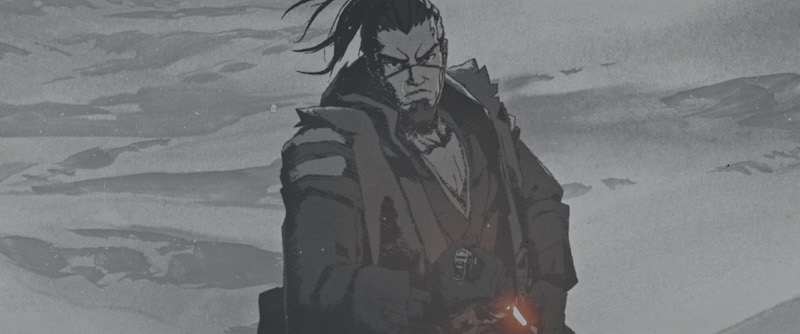
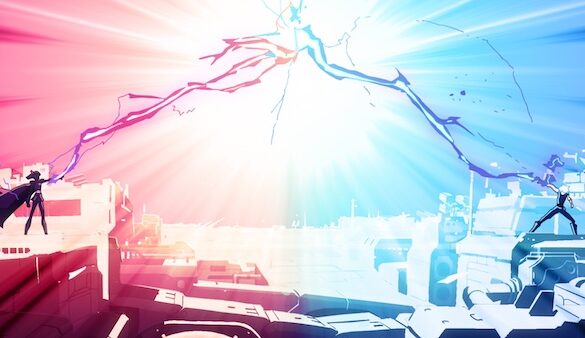
A scene from “The Duel: Payback,” from Lucasfilm’s STAR WARS: VISIONS VOLUME 3, exclusively on Disney+. © 2025 Lucasfilm Ltd. All Rights Reserved.
Because these shorts draw from both Japanese and Western aesthetics, the season thrives on bold genre mashups. Returning favorites deliver sharp showcases. “The Duel: Payback” channels classic Japanese cinema as the Ronin faces a vengeful Grand Master, while “The Ninth Jedi: Child of Hope” follows Kara, pursued by Jedi Hunters and cast adrift, onto a seemingly abandoned ship tended by a mysterious droid. New stories like Studio Project Q’s “The Song of Four Wings” follow a princess turned rebel who protects a child from the might of the Empire on a snowbound planet.
Like the previous seasons, Star Wars: Visions Vol. 3 is a collection of standalone stories, some of them follow ups, that take place within Star Wars lore but are not connected to the larger Skywalker mythology. One does not need to do any homework or have prior knowledge of the films or animated series like Clone Wars or Rebels. “The Duel: Payback” is the monochromatic Akira Kurosawa inspired ronin story where the only color appears in ignited lightsabers that burn red or blue, and “The Ninth Jedi: Child of Hope” is a follow up to episodes from Vol. 1. Both were fan favorites, and the latter ends on a cliffhanger that literally says to be continued.
What each studio does so well is present its story in a way that focuses more on ideas and creativity that respect the mythology rather than filling in canon gaps for continuity’s sake. In practice, that reframes canon as a toolbox, not a leash. Visions argues the galaxy feels bigger when continuity steps back and possibility steps forward.
“The Bounty Hunters” (WIT Studio) probes the line between morals and ethics for Sevn (Anna Sawai) and her dual personality droid IV A4 (Ronny Chieng), one programmed for medical care, the other for assassination. As agents of Basham close in, the pair duck into a port run by a seemingly philanthropic industrialist whose reform scheme doubles as social control, especially when insurgents threaten his bottom line. As one of Vol. 3’s standouts, the short lets bounty hunters’ code, morals, and survivor’s guilt collide, turning honor among thieves into a choice made moment by moment.
“Yuko’s Treasure” (Kinema Citrus) follows Yuko (Liam Karlsson), an orphan cared for by Bily (Harvey Guillén), a teddy bear droid and the last remnant of her family. She meets Sola (Julian Paz Fedorov), a streetwise kid sent by pirates to extract information about a mysterious treasure hidden by Yuko’s parents. When Bily is kidnapped by Fox Ear (Steve Buscemi) and his band of pirates, a determined Yuko and a scrappy Sola launch a dangerous rescue. The episode plays like a storybook for kids, with endearing heroes, lighthearted humor, brisk action, and just enough suspense, plus a neat twist, to keep little hearts racing. It hardly feels like Star Wars at all beyond a Mos Eisley backdrop and a Twi’lek pirate, and that is exactly why it works. While the hook is treasure hunting, the episode trades gold for what actually matters and offers that lesson to viewers who may be too young for the original films.
“The Lost Ones” (Kinema Citrus) returns F (Karen Fukuhara), a Jedi who is forced to confront the ghosts of her past. On a planet a third entombed in carbon, the script grows from children’s questions into a quiet lesson on reality versus perception, belief without proof, and the difference between getting older and growing up. Tight symmetrical compositions and a hushed and heavy sound design turn each exchange into a firm decision point as curiosity opens minds and ignorance threatens to harden into conflict. By the end, F does not hand down answers. She models a method built on study, observation, and choice, and the miners’ next chapter feels chosen rather than bestowed.
When F is captured, she reunites with her former teacher Shad Rah (Mark Strong), now called Zero. Long thought dead, Zero wants to guide F again, this time as a Sith. He argues that the Jedi were misguided, that their choices helped spark the war, and that the Order must be destroyed. Seeing F as a true Jedi who ran, he offers a brutal choice, become his apprentice or die as the knight he despises. Narratively, this turns F’s path into a reckoning with the ideals she tried to leave behind and a decision to accept what the Jedi way asks of her.
Visually, the episode shifts between a lived in cinematic present and storybook framed flashbacks. The present sits in cool slate and steel, while the flashbacks glow with warm ambers and creams that suggest safety, mentorship, and the hope of first beliefs. The contrast moves F from remembered comfort to a decisive lightsaber duel on an artificial battlefield made from the remnants of home for both the Sith Lord and the Jedi Knight.
Not every story lands. Trigger’s “The Smuggler” opens as a welcome change of pace, trading lightsabers for a Western forward vibe. It follows Chita (Emma Myers), a bold smuggler short on credits and on the Empire’s most wanted list, hired by Gleenu (Judith Light) to move Arluu (Tanner Buchanan) to any system outside Imperial control. Once Chita starts asking what happened to the Jedi, the path becomes clear and the reveals feel predictable. The images, fight choreography, and score still hit, with crisp staging and clean cuts. The direction does not fully trust the Western frame, and a looser dust and rail freight energy might have suited the piece better.
With Star Wars: Visions Vol. 3, the franchise proves there is room for new angles on Jedi ethics, Sith Lord journeys, found family, and the Force without chasing continuity, and it does so through the lens of anime. The volume trusts craft and authorship to carry meaning. Color and texture do as much storytelling as dialogue, and the sound design gives every choice weight. While it has become customary to binge watch an entire season in one sitting, Vol. 3 is best experienced one or two at a time. The styles breathe better that way, and shared beats do not pile up. On that note, new viewers can enjoy the anthology without homework. Longtime fans will spot familiar motifs without needing a timeline.
8.5/10