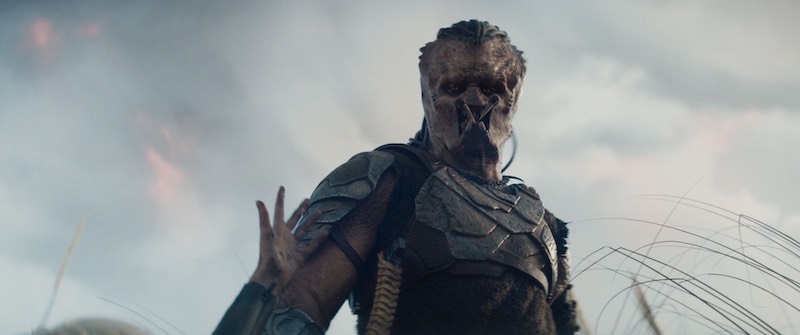
“Predator: Badlands” is a welcome change of pace for a franchise that has revolved around the titular Yautja hunting their prey, mostly humans, in a bloody game of cat and mouse. And while that game has changed throughout the years since the first film was released, the core concept has remained the same. Though generally framed as the antagonist, the new Dan Trachtenberg directed actioner sees the thrill of the hunt from the perspective of the Yautja, who appear to be more complex characters than they were originally designed.

The film opens with a codex that declares the Yautja are prey to none, friend to none, predator to all. It offers a glimpse of the code these hunters live by. Patrick Aison’s script then subverts the familiar image of relentless killers driven by sport and honor, revealing beings with social structures, vulnerability, and the capacity for relationships. They form families, they have the ability to grieve, and they mourn their dead.
These ideas come through in Dek (Dimitrius Schuster-Koloamatangi), a young predator who has yet to prove himself to his family as a hunter. Though his father sees the youngest as nothing more than a weak runt who should have been killed, Dek wants nothing more than to earn his respect. With the help of his older brother, Kwei, Dek trains to be the killer he knows he can be. Kwei tells Dek that if he can bring home the goliath of a beast called the Kalisk from the planet Genna, then their father might spare Dek’s life.
Unfortunately, Dek and Kwei’s father grows impatient and demands that Kwei kill Dek. Kwei refuses and sacrifices his life so that Dek can live. In doing so, Kwei is able to get Dek aboard a ship that is already preprogrammed to travel to Genna. Once he arrives, he befriends a synth named Thia (Elle Fanning) who has been severed in half and left broken, and uses her as a guide to help him find the Kalisk while also aiding her in finding a pair of legs.
What emerges is a more humanized portrait of the Yautja. Rather than relentless sportsmen, they register as sentient beings with social structures, vulnerability, and grief. Dek is not so much motivated to capture the Kalisk as a trophy to bring home to his dad; instead, he is driven by vengeance and a desire to honor his brother by capturing the one thing no Yautja has ever brought home.
The moral frame is not binary. Weyland-Yutani machines exploit because they are built to, and they can betray or ally when advantage demands it. What makes Thia interesting is that she, along with her synth sister Tessa, is programmed with emotion to help understand the planet’s creatures. Though she has lost half her body, she reads Genna’s ecosystems with care and serves as Dek’s guide through a world teeming with life that wants to kill them.
Dek’s smaller frame becomes an advantage, with agile footwork, quick entries and exits, and sword work that favors precision over power. It is not that he is incapable of killing or reading the land; it is that he is constantly underestimated by his family and by Thia, Tessa, and the Weyland-Yutani group. As such, this flips the Predator franchise script on its head and allows audiences to spend more time with Dek.
In a jaw dropping set piece, Thia fights as two halves. The upper body grabs or fires and the lower half kicks or applies leg locks. Two stunt doubles work in tight tandem to sell the illusion that torso and legs form a single fighter.
Aside from the usual sword slashing, bow and arrow shooting, and shuriken throwing, much of the film’s physicality relies on us believing that Dek carries Fanning’s Thia on his back while fighting off deadly creatures. To sell the weightless effect while strapped to Schuster-Koloamatangi’s back, Fanning often sat in an “L” position on a spreader, with her legs supported by harnesses, wires, wheelbarrows, or rolling benches depending on the landscape, creating the illusion that Dek was hauling a dismembered synth. Pulling that off against the natural beauty of New Zealand is no easy task.
Because so much of the first two acts was filmed on location, Genna gains a tactile, lived in realism. It feels inhabited, especially when Dek, Thia, and their animal companion, Bud, are out camping. New Zealand’s countryside brings layers of flora and fauna that add beauty and, with some smart VFX augmentation, an ever present sense of danger.
Early skirmishes and Thia’s understanding of Genna function like tutorials for Dek. He later turns those lessons not on the Kalisk but on Weyland-Yutani, which hopes to profit from the creature’s regenerative biology. Filming in New Zealand rather than on a soundstage gives the action a grounded reality. The terrain has weight, the wind and water register on screen, and movement feels tactile in a way blue screen work rarely captures. Hits land harder, chases feel rooted in real geography, and the danger reads as physical instead of digital.
“Predator: Badlands” is the kind of action film that hits the ground running and only lets up either to expand upon Dek’s motivations and inner turmoil or expands the world-building by having Dek and Thia traverse the extermely dangerous terrain. Even the way it introduces Weyland-Yuntai, a corporation that exploits humans for their profits, is interesting because there are no humans for the synths to exploit. Instead, Thia and Tessa are two sides of a different coin.
When the fight between Dek and the Kalisk arrives, it feels earned. Dek reads the ground and repurposes Weyland-Yutani debris. At times the movement looks like parkour as he runs, jumps, and slides.
Going any further would spoil the fun, but it is worth noting that Elle Fanning effectively plays two roles, or perhaps one and a half. She brings verbal and physical dexterity to both, with Thia eager to help and playful against Schuster-Koloamatangi’s Dek, and Tessa more cutthroat and mission focused.
Though much of the banter between Dek and Thia is in two different languages, with Dek clicking in Yautja and Thia speaking English, the scene work stays clear, and they are able to bounce off each other through layered expressions and sharp reactions. Thia’s effervescent spirit does not waver. Even though Dek sees her as nothing more than a tool, he grows to respect her. Fanning threads precision and warmth into Thia and plays analytical curiosity as a way to show she sympathizes with Dek.
Soon they collaborate during hunts, with Thia providing Dek the necessary information to understand deadly plant life like razor grass, and in quieter exchanges she understands why Dek is considered an outcast. Both find connection in being tossed out by their family. As they trade personal losses and reveal the Yautja’s capacity to grieve, Dek sees the value of having a support system and the benefits of breaking down the old ways. Their bond through shared struggle is what makes their dynamic click.
Sure, there are moments where the film does feel a bit disjointed. While the expansion of the Yautja is welcome for a franchise that seemed stuck on the titular hunters slaying humans, this approach asks us to understand their nature. As such, it might not be the kind of film some fans want if they expect the Yautja to be nothing more than one dimensional killers. These in depth explorations of the two characters can make the through line harder to follow as lengthy action sequences share space with multiple plot threads and exposition.
Still, Trachtenberg keeps a steady pulse. Clear action, real locations, and the chemistry between Schuster-Koloamatangi and Fanning keep the movie tethered to character even when things get complicated. The francise which has often been trapped inside its own mythology, finds itself in a very interesting place, one that would get fans and audiences to rethink what they know about Yautja. And while it isn’t perfect, at least “Predator: Badlands” has the audacity to reframe the code and expands the world of the galaxy’s deadliest hunter by making the Yautja a bit more relatable but still remain the vicious killers that we all know and love.
8/10