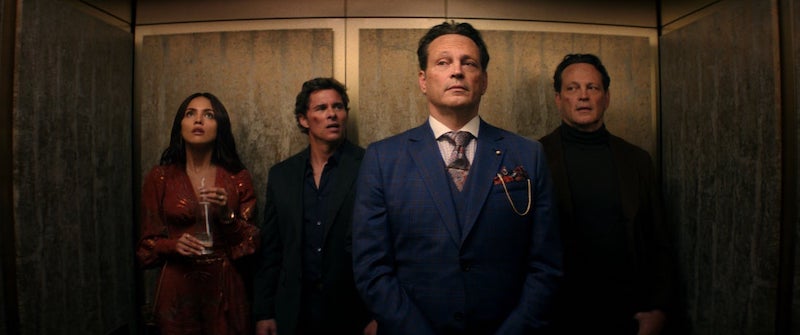
BenDavid Grabinski’s “Mike and Nick and Nick and Alice” is an effortlessly funny and clever crime comedy that uses “Gilmore Girls” deep dives and a few needle drops to deliver a sharp story about regret, loyalty, and the messy people caught between love and violence.
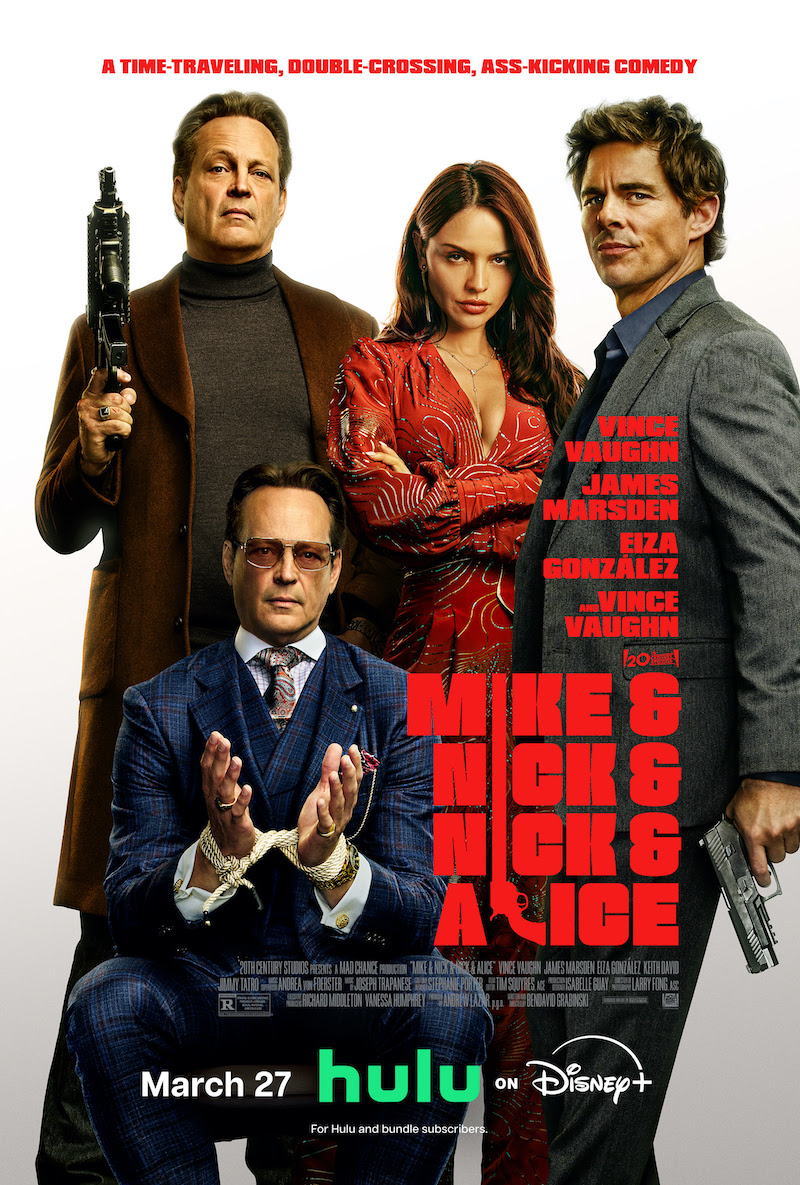
Set over the course of one increasingly chaotic night, “Mike and Nick and Nick and Alice” follows a pair of gangsters, the woman caught between them, and a situation that spirals further out of control once time travel enters the equation.
Rather than treat that high-concept hook as a gimmick, Grabinski uses it to reshape what could have been a straightforward crime story into something far more reflective. The film’s time-travel mechanics aren’t about spectacle, but about perspective, allowing its characters to confront the consequences of their worst decisions in real time. In doing so, Mike and Nick and Nick and Alice becomes less about surviving the night and more about whether any of them deserve to.
Vince Vaughn takes on a dual performance as Nick, playing both the impulsive present-day version and the more self-aware version shaped by regret. What could have easily become a gimmick instead turns into the film’s emotional backbone, as Vaughn carefully distinguishes between the two without ever losing the character’s core identity. The present Nick is reactive, prideful, and driven by jealousy, while his future counterpart carries the weight of those decisions with a quiet sense of guilt and urgency.
By leaning into the contrasting personalities created by the present and future Nicks, the humor comes from Nick’s frustration and ego while grounding the character in something more reflective and human. Such a dichotomy of performances becomes less about the mechanics of time travel and more about what it means to confront the consequences of your worst choices in real time.
James Marsden brings a quiet sincerity to Quick Draw Mike, a character who could have easily been reduced to the “other guy” in a love triangle. Instead, Marsden plays him as someone worn down by the life he’s been pulled into, giving Mike a softness that contrasts sharply with the world around him. Even as he’s known for being lethal, there’s a clear reluctance to violence that makes his presence feel more human than hardened. That tension between who Mike is expected to be and who he actually wants to be gives the character an emotional weight that anchors the film, turning him into more than just a target or a rival, but the person whose survival ultimately matters most.
Eiza González gives Alice a sharpness and emotional clarity that elevates the film beyond its high-concept premise. Rather than existing as the woman caught between two men, Alice emerges as the one character who fully understands the cost of the life they’re all trapped in and actively wants out. González plays her with a mix of frustration, vulnerability, and resolve, allowing the character to push back against Nick’s control and redefine her own future. In a story driven by regret and second chances, Alice becomes the clearest expression of what’s actually at stake
The film’s use of pop culture, particularly its recurring Gilmore Girls thread, is doing far more than just landing jokes. What starts as a detailed, almost obsessive debate over Rory’s relationships evolves into a thematic framework for the story itself, using the idea of generational cycles and “bad endings” to underscore what’s at stake for Mike and Alice. It’s a smart piece of narrative shorthand, allowing the film to explore its emotional stakes through familiar cultural touchpoints while simultaneously humanizing its characters. In a world defined by violence and chaos, these moments of shared pop culture act as both tonal relief and emotional grounding, reinforcing the film’s balance between absurdity and sincerity.
Even as the film leans heavily on dialogue, its pacing remains largely tight, driven by a sense of urgency that rarely lets the tension slip for too long. Grabinski keeps the story moving through a series of escalating scenarios, from early suspicions of betrayal to increasingly elaborate attempts to stay ahead of the night’s inevitable collision. There are moments where the film risks feeling slightly indulgent, particularly in some of its longer comedic exchanges, but those scenes are often doing double duty, layering humor with exposition and character development. The result is a film that feels dense rather than slow, trusting its audience to keep up with its shifting timelines, overlapping schemes, and emotional reveals without ever fully stopping to explain itself.
That density extends to the film’s structure and writing, which balance a complex mix of time travel mechanics, criminal intrigue, and interpersonal drama. While some of the exposition can feel heavy in places, particularly when unpacking the logistics of its central premise, it is almost always filtered through character voice and conflict, keeping it from becoming purely mechanical.
More importantly, the film consistently rewards that attention with strong setup and payoff, reframing earlier assumptions and allowing its characters’ choices to carry real consequences. If anything, the film occasionally flirts with undercutting its own emotional weight by leaning too heavily on humor in moments that could have benefited from more restraint, but even then, its commitment to character keeps those beats from feeling hollow.
What ultimately holds all of these moving parts together is how confidently Grabinski blends tone without letting any one element overpower the others. The film shifts effortlessly between crime thriller, absurdist comedy, and character-driven drama, often within the same scene. Moments that begin with genuine tension, whether it’s a looming threat or a carefully orchestrated plan, are quickly punctuated by humor that feels organic rather than disruptive. That balance is crucial, because it allows the film to maintain a sense of unpredictability without losing emotional clarity.
Even at its most chaotic, the story never feels unfocused, as each tonal shift is anchored in the characters’ perspectives and motivations. It’s a difficult balance to strike, especially in a film juggling time travel, multiple timelines, and overlapping agendas, but “Mike and Nick and Nick” and Alice manages to keep those elements aligned in a way that feels intentional rather than overwhelming.
By grounding its high-concept premise in character and consequence rather than spectacle, Mike and Nick and Nick and Alice ultimately succeeds as both a crime comedy and a story about accountability. It understands that second chances are only meaningful if its characters are willing to confront what they’ve done, and that tension gives the film a surprising emotional resonance beneath its chaotic surface. In a genre often defined by style over substance, Grabinski’s film finds a way to deliver both, using humor, time travel, and pop culture not just as entertainment, but as a means of exploring what it takes to change.
8/10